Podcast
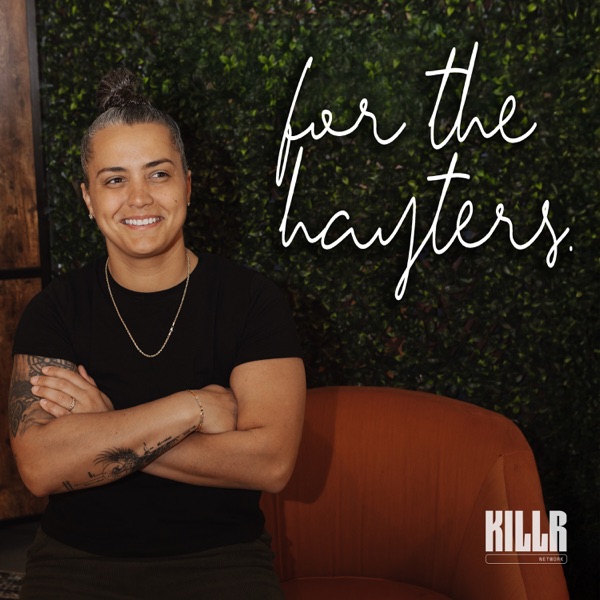
For The Hayters: The Stories We Survive
For The Hayters: The Stories We Survive is a space where vulnerability is met with strength, and real stories remind us we’re never alone. Hosted by a community of storytellers and listeners alike, this podcast dives into the personal journeys - both beautiful and brutal - that shape who we are. From life-changing challenges to moments of resilience, our guests open up about the experiences that have defined them, in hopes of connecting, healing, and inspiring others. Whether you’re here to feel seen, heard, or understood, this is your reminder: your story matters.
- Episodes
- 130
- Releases
- Twice a week
- Typical length
- 53 min
- On air since
- 2019
- Latest episode
- 2 days ago
Episodes
130 episodes, newest first
-
57 min
The Girl Who Looked Too Much Like Her Mother
Show notes
Trigger Warning: This episode includes child physical and emotional abuse, domestic violence, self-harm, drug use, teen homelessness, parental mental illness, and strong language.
Liz's story doesn't start with a fact. It starts with a few different versions, all told by a mom who doesn't always tell the truth. By nine, her mom was gone. By 15, her mom told another woman she could keep Liz if she got to keep the car. By 16, Liz was out on her own with a black trash bag and a Lion King pillowcase.
She's my neighbor and my chosen family, and I thought I knew her story. I didn't know half of it. In this episode, Liz walks through a childhood shaped by abuse, a parent who made up whole lives, a dad she loved and lost and found again, and the friends who ended up raising her. She's blunt, she's funny, and she gives grace to people who probably haven't earned it.
This is a story about who gets to tell your story, and what happens when you finally take it back.
For The Hayters is a podcast that normalizes hard conversations. Listener discretion is advised.
Interview, narration, and editing by Becky Hayter, with post-production, scripting, and sound design by Emily Nadal.
Don’t forget to subscribe, like, and share to help us continue bringing these stories to light.
🔹 New episodes drop every Sunday!
🔹 Join our community! patreon.com/beckyhayter
🔹 Follow us on Instagram: @forthehayters
🔹 Submit your story: info@forthehayters.com
🔹 Grab some merch! beckyhayter.com
🔹 A KILLR Network podcast! killrentertainment.com
See Privacy Policy at https://art19.com/privacy and California Privacy Notice at https://art19.com/privacy#do-not-sell-my-info.
-
44 min
Turner Syndrome, IVF, and Waiting on a Calendar
Show notes
Trigger Warning: This episode discusses infertility, IVF, early pregnancy loss, and a family member's dementia.
Yvette married Josh in February 2022, and the plan was simple: start a family. After the wedding, her period never came back. It wasn't stress. It wasn't pregnancy. It was Turner syndrome, a chromosomal condition usually diagnosed in childhood. Yvette found out at 34, along with the news that her ovaries had already failed.
In this episode, Yvette talks about the family explanation that kept anyone from looking closer, the answer that was sitting in her chart unflagged, and what it really costs to build a family when the usual way isn't an option. She opens up about donor embryos, the conversation she had to have with Josh, and what it's like to keep hoping on a timeline she doesn't control.
For The Hayters is a podcast that normalizes hard conversations. Listener discretion is advised.
Interview, narration, and editing by Becky Hayter, with post-production, scripting, and sound design by Emily Nadal.
Don’t forget to subscribe, like, and share to help us continue bringing these stories to light.
🔹 New episodes drop every Sunday!
🔹 Join our community! patreon.com/beckyhayter
🔹 Follow us on Instagram: @forthehayters
🔹 Submit your story: info@forthehayters.com
🔹 Grab some merch! beckyhayter.com
🔹 A KILLR Network podcast! killrentertainment.com
See Privacy Policy at https://art19.com/privacy and California Privacy Notice at https://art19.com/privacy#do-not-sell-my-info.
-
35 min
Wallet Therapy: Is the Market Going to Crash? Wrong Question.
Show notes
Every time I open my phone, someone is yelling that the market is about to crash. And honestly? I get anxious when money just sits there. Alex is the total opposite. She’s over here stressing about pulling money out of savings for a lanai she literally saved for. So this week we finally asked the question everyone’s whispering: is the market going to crash? Spoiler: nobody knows. Not Alex, not the guy on TikTok, not even most professional fund managers. The better question is what YOU are going to do when it happens.
The Solution
Correction, bear market, crash: what those scary words actually mean (10%, 20%, and “oh no”).
Panic selling is two bad bets: you have to time getting out AND getting back in, and selling turns a temporary dip into a permanent loss.
Time horizon is everything: if you don’t need this money for 30 years, today’s drop isn’t your emergency.
Your emergency fund is your crash pad: cash on hand means you’re never forced to sell at the bottom.
Sometimes it’s not the market, it’s your portfolio: if a dip has you losing sleep, your mix might be too aggressive for who you really are.
Keep contributing: sticking to your plan during a downturn means buying at lower prices.
Plus a listener question from a 38-year-old with $250K who wants to move it all to cash, and a detour to a stock market bar in Barcelona where the drink prices crash too.
This week’s homework
Open your investment account and run the 30% test. Multiply your balance by 0.7 and write that number down. Then sit with it. Would you panic? Would you sell? Would you stop contributing? If the honest answer scares you, adjust your plan now, not in the middle of a crash.
Connect with us
Join the Hayters on Patreon for early episodes, a monthly Wallet Therapy Live, and direct access to Alex: patreon.com/beckyhayter
Got a money question for Alex? Email us at info@forthehayters.com
See Privacy Policy at https://art19.com/privacy and California Privacy Notice at https://art19.com/privacy#do-not-sell-my-info.
-
1 hr 5 min
Rare Disease, Vision Loss & Raising a Daughter With the Same Diagnosis
Show notes
Trigger warnings: abortion, miscarriage, NICU and infant medical emergency, pediatric surgery, chronic pain, vision loss, panic attacks and alcohol use, parental infidelity and anger, family estrangement.
Bree was born visually impaired. By the time she was five, she'd had six or seven eye surgeries. For twenty-two years, nobody could explain why her body worked the way it did: the cataracts, the glaucoma, the hole in her heart, the dental problems dentists had never seen before, and the daily pain she assumed everyone had.
At 22, genetic testing finally gave her a name for it: oculofaciocardiodental (OFCD) syndrome, a rare genetic disorder she could pass on to her children. For someone whose biggest dream was to be a mom, the answer didn't feel like relief. It felt like one more thing to grieve.
Bree talks about growing up with a mom who fought for her at every turn and a dad who mostly wasn't there, the losses that came before her daughter, a NICU stay nobody could fully explain, and what it's like to sit on the other side of the exam table now, advocating for a little girl who shares her diagnosis.
For The Hayters is a podcast that normalizes hard conversations. Listener discretion is advised.
Interview, narration, and editing by Becky Hayter, with post-production, scripting, and sound design by Emily Nadal.
Don’t forget to subscribe, like, and share to help us continue bringing these stories to light.
🔹 New episodes drop every Sunday!
🔹 Join our community! patreon.com/beckyhayter
🔹 Follow us on Instagram: @forthehayters
🔹 Submit your story: info@forthehayters.com
🔹 Grab some merch! beckyhayter.com
🔹 A KILLR Network podcast! killrentertainment.com
See Privacy Policy at https://art19.com/privacy and California Privacy Notice at https://art19.com/privacy#do-not-sell-my-info.
-
56 min
Bows, Hairspray, and Heroin: How a Drunk Driver Took Rachel’s Before
Show notes
Trigger Warning: This episode discusses traumatic brain injury, drunk driving, substance use and addiction (including heroin), overdose, sexual assault, not caring whether you live or die, psychiatric hospitalization, a serious car crash, and the overdose death of a close friend.
At 15, Rachel was flying through the air at Worlds. Cheer wasn't her hobby. It was her whole life. Then one summer evening, a drunk driver ran a stop sign and hit her while she was crossing on her bike. She jumped up and told everyone she was fine.
She wasn't. The brain injury nobody could see took her grades, her muscle memory, her sport, and her friends. What came after took her to places her family still can't fully talk about. In this conversation, Rachel talks about the years she barely remembers, the parents who never stopped showing up, and the surprisingly ordinary moment she finally walked away.
This is a story about teen addiction, invisible injury, regret, and what it looks like to build a quiet life after years of chaos.
For The Hayters is a podcast that normalizes hard conversations. Listener discretion is advised.
Interview, narration, and editing by Becky Hayter, with post-production, scripting, and sound design by Emily Nadal.
Don’t forget to subscribe, like, and share to help us continue bringing these stories to light.
🔹 New episodes drop every Sunday!
🔹 Join our community! patreon.com/beckyhayter
🔹 Follow us on Instagram: @forthehayters
🔹 Submit your story: info@forthehayters.com
🔹 Grab some merch! beckyhayter.com
🔹 A KILLR Network podcast! killrentertainment.com
See Privacy Policy at https://art19.com/privacy and California Privacy Notice at https://art19.com/privacy#do-not-sell-my-info.
-
32 min
Wallet Therapy: My Parents Didn't Save Enough. Now What?
Show notes
Confession: I took out a personal loan this month. After working SO hard to get where I am, I had to go back ten steps because our old house has not sold and the credit card interest was starting to scare me. I'm telling you because this show is about being honest about money, even when it's embarrassing. I'm also telling you because Alex has opinions about how to do it right.
Then we get into the conversation nobody wants to have until they're forced to. What happens when your parents retire and realize they don't have enough? Are you supposed to help? And how do you do that while you're paying your own mortgage, raising kids, and trying to save for your own retirement? Alex and I have lived this one with our own family, so we're getting real about it.
The Solution
Medicare is not free: Part B alone runs about $202.90 a month in 2026, before deductibles, coinsurance, prescriptions, dental, vision, and hearing.
Long-term care is a need, not a place: Whether it's assisted living (median cost around $6,200 a month) or someone checking in on Mom once a day, it costs money and someone has to provide it.
Three questions before you help: Is this an emergency? Is there a sustainable solution? Can you actually afford it without wrecking your own future?
Don't create your kids' problem: If you sacrifice your retirement to fund your parents', you might be handing the same crisis down a generation.
If you're 50 and behind: Know your numbers, estimate what retirement will really cost, plan for healthcare and housing, and have the family conversation now.
This week's homework
Pick one parent, partner, or even just yourself and ask three questions. How much is saved for retirement? What happens if someone needs long-term care? What do you expect from family financially? Write down the answers, even if they're scary. Especially if they're scary.
Patreon members get Alex's full retirement expense checklist and the complete list of questions to ask your parents.
Connect with us
Join the Hayters on Patreon for early episodes, bonus content, and the full checklist: patreon.com/beckyhayter
Questions for Alex? Email us at info@forthehayters.com
Money is emotional. And you deserve to feel safe with it.
See Privacy Policy at https://art19.com/privacy and California Privacy Notice at https://art19.com/privacy#do-not-sell-my-info.
-
1 hr
A Marine, Twin Mom, and Trafficking Fighter: Raids, Bottles, and a Top Secret Clearance
Show notes
Trigger Warning: This episode discusses human trafficking, sexual violence, child sexual abuse and exploitation, organ harvesting, ritual violence against children, and domestic abuse. A content note comes before the hardest section. Listener discretion is advised.
Korrin's mornings look like a lot of ours: breakfast, the childcare handoff, nine-month-old twins who need everything at once. Somewhere between the bottles, there's a call from Uganda and a trip to Ecuador to plan. Korrin is a former Marine Corps cryptologic linguist, an attorney, a volunteer prosecutor, and the founder of Lantern Rescue, an organization fighting human trafficking in 18 countries.
In this conversation, Korrin talks about going from an insurance job she couldn't stand to a Russian language school in Monterey, to studying for the LSAT by flashlight in the back of a truck in Haiti. She explains why most trafficking victims don't know they're being trafficked, why those viral "almost got trafficked at Target" posts do more harm than good, and what happened after the night a woman we're calling Rosa was found.
This is a story about the worst things people do to each other, told by someone who refuses to look away and still goes home and makes dinner.
For The Hayters is a podcast that normalizes hard conversations. Listener discretion is advised.
Interview, narration, and editing by Becky Hayter, with post-production, scripting, and sound design by Emily Nadal.
Don’t forget to subscribe, like, and share to help us continue bringing these stories to light.
🔹 New episodes drop every Sunday!
🔹 Join our community! patreon.com/beckyhayter
🔹 Follow us on Instagram: @forthehayters
🔹 Submit your story: info@forthehayters.com
🔹 Grab some merch! beckyhayter.com
🔹 A KILLR Network podcast! killrentertainment.com
See Privacy Policy at https://art19.com/privacy and California Privacy Notice at https://art19.com/privacy#do-not-sell-my-info.
-
1 hr 15 min
Cancer, Chronic Illness & Coming Out Later in Life
Show notes
Trigger warnings: cancer diagnosis and chemotherapy, hysterectomy and invasive medical procedures, brief discussion of intimacy after surgery, chronic illness and chronic pain, medical dismissal and weight bias in healthcare, a partner's severe anxiety, divorce and custody court, separation from children during COVID, and fear around losing health insurance.
Kristin's surgeon walked out of the operating room and told her family everything looked fantastic. A week later, a nurse handed her an envelope at her follow-up. She didn't open it. Then the doctor walked in and asked if she'd read it.
Kristin grew up an only child outside Detroit, sure of one thing: she was going to be a mom. Life got her there in unexpected ways. She became a stepmom to a four-year-old in her twenties, moved across the country and back, and ended a 16-year marriage to a man she still has love for. She came out during the pandemic while running a memory care facility in lockdown. Then her body started keeping score. There were years of "normal" lab results, a Hashimoto's diagnosis, a rare ovarian cancer called granulosa cell tumor, and a fibromyalgia diagnosis that came only after one specialist sent her a message that said, "I wish you luck."
This is a conversation about medical gaslighting, coming out later in life, and the things nobody tells you before surgery. It's also about what happened when Kristin finally shared her story and realized she wasn't as alone as she thought.
For The Hayters is a podcast that normalizes hard conversations. Listener discretion is advised.
Interview, narration, and editing by Becky Hayter, with post-production, scripting, and sound design by Emily Nadal.
Don’t forget to subscribe, like, and share to help us continue bringing these stories to light.
🔹 New episodes drop every Sunday!
🔹 Join our community! patreon.com/beckyhayter
🔹 Follow us on Instagram: @forthehayters
🔹 Submit your story: info@forthehayters.com
🔹 Grab some merch! beckyhayter.com
🔹 A KILLR Network podcast! killrentertainment.com
See Privacy Policy at https://art19.com/privacy and California Privacy Notice at https://art19.com/privacy#do-not-sell-my-info.
-
27 min
Wallet Therapy: Lease vs. Buy: Would You Still Want This Car If No One Saw It?
Show notes
Confession: I have never once walked into a car purchase asking "can I afford this car?" I asked "can I afford this payment?" and called it a day. Turns out those are two very different questions, and the gap between them is where a LOT of money disappears.
This week Alex and I tackle the lease vs. buy debate. We cover why leasing can make an $80,000 car feel weirdly affordable, why a new car's "low" interest rate might still cost you more, and the Scion story that proves nobody actually knows what's in your bank account by looking at your car.
The Solution
Leasing means financing depreciation: You're paying to use a car for two to four years, plus mileage limits, wear and tear fees, and a payment that never ends.
Buying wins when you keep it: Pay it off, keep driving it, and suddenly $500 a month is yours again.
Watch the interest rate trap: New cars often come with lower rates than used ones, but on average you'll still pay around $15,000 more for the new one.
Know what $600 a month really costs: That's $36,000 over five years before gas, insurance, and maintenance. Invested instead, it could grow to over $350,000 in 20 years.
Ask the real question: Would you still want this car if no one saw it?
This week's homework
Calculate your true monthly car cost. Add up your payment, insurance, gas, maintenance, and registration. Then put that number next to your income and your goals and ask yourself: what else could this money be doing for me?
Connect with us
Join the Wallet Therapy community on Patreon for early episodes, monthly live sessions, and Discord access where Alex answers your questions directly: http://patreon.com/beckyhayter
Got a car decision you regret (or one you're proud of)? Tell us: info@forthehayters.com
See Privacy Policy at https://art19.com/privacy and California Privacy Notice at https://art19.com/privacy#do-not-sell-my-info.
-
1 hr 15 min
The Keeper of Secrets: A Marriage Built and Nearly Lost on Hidden Bills
Show notes
Trigger Warning: This episode discusses financial trauma, debt, foreclosure and eviction, childhood dysfunction, the death of a family member, substance use, and a dark period of anxiety and self-blame. Listener discretion is advised.
Shannon has a master's degree. She was a teacher. On paper, she had it together. And for two years, she hid thousands of dollars of debt from the man she was about to marry.
It didn't start with a reckless swipe of a card. It started in childhood, in a house where money was a secret and "rob Peter to pay Paul" was the family motto. By 14, she was keeping her mother's financial secrets. By her late twenties, she'd bought a house alone, in her name only, and learned that asking for help made her physically sick.
In this conversation, Shannon walks me through the split mortgage payments, the predatory loans, the late notices in the trash, and the foreclosure letter she opened by herself. She tells me how the lie almost cost her the house, the marriage, and the person she thought she was, and what it finally took to stop hiding and say the two words that changed her marriage: same team.
For The Hayters is a podcast that normalizes hard conversations. Listener discretion is advised.
Interview, narration, and editing by Becky Hayter, with post-production, scripting, and sound design by Emily Nadal.
Don’t forget to subscribe, like, and share to help us continue bringing these stories to light.
🔹 New episodes drop every Sunday!
🔹 Join our community! patreon.com/beckyhayter
🔹 Follow us on Instagram: @forthehayters
🔹 Submit your story: info@forthehayters.com
🔹 Grab some merch! beckyhayter.com
🔹 A KILLR Network podcast! killrentertainment.com
See Privacy Policy at https://art19.com/privacy and California Privacy Notice at https://art19.com/privacy#do-not-sell-my-info.
-
57 min
A Parent Worth Mourning: Justine on Abuse, Surrogacy Loss, and Choosing Herself
Show notes
Trigger Warning: This episode discusses childhood sexual abuse, physical abuse, alcoholism, a disclosure that wasn't believed, pregnancy loss, surrogacy, and estrangement from a parent. Listener discretion is advised.
For most of her life, Justine's family ran on one rule: keep mom happy, whatever it costs you. She started paying that bill as a kid trying to survive her father. At 14, she finally told someone the truth and got handed an ultimatum instead of help. She spent years after that finding new people to save, because saving herself was never on the table.
A husband. A son. And for a while, two strangers on the other side of the world she agreed to carry a baby for. In this conversation, Justine talks about a house that looked completely normal in the school photo, what it costs to keep protecting people who don't deserve it, and the morning she wrote two goodbye letters and drove across the country with a U-Haul running.
This is a story about the difference between the parent you thought you had and the one you actually did, and what finally happens when someone decides it stops with her.
For The Hayters is a podcast that normalizes hard conversations. Listener discretion is advised.
Interview, narration, and editing by Becky Hayter, with post-production, scripting, and sound design by Emily Nadal.
Don’t forget to subscribe, like, and share to help us continue bringing these stories to light.
🔹 New episodes drop every Sunday!
🔹 Join our community! patreon.com/beckyhayter
🔹 Follow us on Instagram: @forthehayters
🔹 Submit your story: info@forthehayters.com
🔹 Grab some merch! beckyhayter.com
🔹 A KILLR Network podcast! killrentertainment.com
See Privacy Policy at https://art19.com/privacy and California Privacy Notice at https://art19.com/privacy#do-not-sell-my-info.
-
32 min
Wallet Therapy: Credit Cards - Are You Using Them, or Are They Using You?
Show notes
Credit cards are the topic where everyone has an extreme opinion. Either they're a free travel hack or they're evil and you should cut them all up. Alex's take is neither. A credit card is a tool, and the tool isn't good or bad on its own. What matters is how you're using it, and I am living proof that you can use one very badly for a very long time.
The Solution
The four types of credit card users. The credit card company's favorite customer, who carries a balance and pays minimums. The rewards optimizer, who pays in full and uses the card strategically. The avoider, who usually got there by clawing out of debt and is now scared of the thing. And the fourth type we added mid-episode, which is me: pays it off, but has no idea what benefits the card even has.
How credit card companies actually make money. Interest, annual fees, late fees, and interchange fees paid by merchants. That last one is where your rewards come from. If you're paying 25 percent interest to earn 2 percent cash back, you are not beating the credit card company.
The biggest mistakes. Carrying a balance to "build credit," which does not work. Paying only the minimum, which your statement will tell you takes anywhere from five to fifteen years. Buying things you can't afford yet. Opening too many cards. And doing a balance transfer without changing the behavior, which can leave you back charged for all the interest you thought you skipped.
The four rules if you're using them well. Pay the full balance, not just the statement balance. Treat the card like a debit card, so if you have $500 in checking you have $500 to spend, not your $5,000 limit. Set up autopay. Know your due date and review your spending monthly.
Should you cancel old cards? Audit them first. Check for annual fees, how old the account is, whether you actually use the benefits, and what canceling would do to your credit utilization. And ask about a downgrade option before you close anything, because most companies would rather keep you than lose you.
How to maximize rewards without wrecking yourself. Pick a card that matches spending you already do. Never manufacture spending to hit a welcome bonus. Actually redeem your points. Alex parks her cash back in a high yield account earning three and a half percent, and she and Derek are sitting on about $6,000 in points earmarked for a cold plunge and a sauna, which is a choice.
This week's homework
Pull up one card. Look at your total spending, the rewards you earned, the interest you paid, and the annual fee. Then answer one question: am I making money from this card, or is this card making money from me?
Connect with us
Join the Patreon for the monthly Wallet Therapy Live plus the master spreadsheet with the credit utilization calculator: patreon.com/beckyhayter
Got a question or a money confession? info@forthehaters.com
Track your card spending in one place with Monarch Money: https://monarch.com/referral/ey3kkk8c7e
See Privacy Policy at https://art19.com/privacy and California Privacy Notice at https://art19.com/privacy#do-not-sell-my-info.
-
53 min
A Mother, Two Suicide Attempts, and the Marriage That Came After | The Beautiful Disaster
Show notes
TW: This episode discusses suicide attempts and methods, self-harm, domestic violence and strangulation, psychiatric hospitalization, postpartum depression, and the death of a child. Listener discretion is advised.
Nicole calls her life a beautiful disaster, and she means both words. By twenty-seven, she'd survived two suicide attempts in the same year, both times pulled back by her mother in the narrowest window imaginable. Not long after, she met a man who felt like the safest person she'd ever known. That feeling didn't last.
In this conversation, Nicole walks through the childhood that taught her to disappear so everyone else could be okay, the marriage that shrank her world down to who she was allowed to talk to and what she was allowed to wear, and the ordinary morning it turned physical in front of her son. She talks about the three days it took to pack his things, the twenty years of silence that followed, and the slow work of learning she was allowed to need things too.
This is a story about the version of survival nobody photographs: the therapy, the letters to the dead, the me-time in a locked bathroom, and one decision, made too many times to count, to stay.
Interview, narration, and editing by Becky Hayter, with post-production, scripting, and sound design by Emily Nadal.
Don’t forget to subscribe, like, and share to help us continue bringing these stories to light.
🔹 New episodes drop every Sunday!
🔹 Join our community! patreon.com/beckyhayter
🔹 Follow us on Instagram: @forthehayters
🔹 Submit your story: info@forthehayters.com
🔹 Grab some merch! beckyhayter.com
🔹 A KILLR Network podcast! killrentertainment.com
See Privacy Policy at https://art19.com/privacy and California Privacy Notice at https://art19.com/privacy#do-not-sell-my-info.
-
54 min
Three Pieces of Salt: A Grandmother’s Fight for Skylar and Gage
Show notes
Trigger Warning: This episode discusses child death, fentanyl poisoning, overdose, CPR, and suicide in detail. Listener discretion is advised.
On a snow day in January of 2024, Kathy Jones' daughter went upstairs to wake her two kids for school. Fifteen minutes later, this family's life split into before and after.
Skylar was 14, an honor roll student who never met a stranger. Gage was 10, obsessed with dinosaurs and his pet turtle, Vicky. That afternoon, a fentanyl poisoning took them both, and their family went from a hospital waiting room they never got to sit in straight to a coroner's office.
In this conversation, Kathy talks about the day that changed everything, the rumors and misinformation that followed, raising her surviving granddaughter, and why she now speaks at the Washington Monument and the White House so that Skylar and Gage are never just a headline. This is a story about a family that did everything right, and lost everything anyway.
For The Hayters is a podcast that normalizes hard conversations. Listener discretion is advised. If you are struggling, you can call or text 988 in the US to reach the Suicide and Crisis Lifeline.
Interview, narration, and editing by Becky Hayter, with post-production, scripting, and sound design by Emily Nadal.
Don’t forget to subscribe, like, and share to help us continue bringing these stories to light.
🔹 New episodes drop every Sunday!
🔹 Join our community! patreon.com/beckyhayter
🔹 Follow us on Instagram: @forthehayters
🔹 Submit your story: info@forthehayters.com
🔹 Grab some merch! beckyhayter.com
🔹 A KILLR Network podcast! killrentertainment.com
See Privacy Policy at https://art19.com/privacy and California Privacy Notice at https://art19.com/privacy#do-not-sell-my-info.
-
31 min
Wallet Therapy: The Bank Said Yes. Should You?
Show notes
I had to pull cash out of my savings this week to pay for a patio, because apparently some people still only take cash in the year of our lord. So I am feeling some feelings about housing costs. Meanwhile Alex is under contract on a house, I just moved into a smaller one, and we both learned the same lesson from opposite directions: getting approved for a mortgage and being able to live comfortably with it are two completely different things.
The Solution
Approval is not a plan. The bank is measuring risk to the bank. It has no idea whether you want kids, want to retire early, or want to travel. Affording the payment is not the same as living with it.
Why this feels so hard right now. The median US home is around $435,000 and the median household income is about $88,000. To comfortably afford that house you'd need closer to $110,000. If buying feels out of reach, you are not imagining it.
Renting is not throwing money away. Renting buys flexibility, predictable costs, and way fewer maintenance surprises. Alex rented for two years after selling in Naples specifically so she could figure out where she actually wanted to live. Renting isn't wasted money if what it's buying you is options.
What ready actually looks like. Three to six month emergency fund still fully funded after you close. Stable income. A down payment you understand, including whether PMI applies. Closing costs of roughly 2 to 5 percent. And a maintenance budget of about 2 percent of the home's value each year for new construction, closer to 5 percent for an older home.
The hidden line items. Property taxes, homeowners insurance, HOA dues, lawn care, utilities, appliances, furniture. Alex was paying close to $1,500 a month in HOA fees in Naples for a gym she didn't even like.
The listener question that says it all. A couple got approved for $800,000 but planned to spend $550,000. Alex runs both numbers: about $3,000 a month versus $4,320 a month. That's $1,350 a month, over $16,000 a year, and close to $500,000 across a 30 year mortgage before you even count what that money could have grown into.
This week's homework
Calculate your true monthly housing cost. Not the mortgage or rent number, the real one. Add taxes, insurance, HOA, maintenance, and utilities. Then ask yourself two questions. Would I feel financially comfortable if one unexpected expense hit next month? And if no one ever saw my house, would I still want this one?
Connect with us
Join the Patreon for episodes early plus Wallet Therapy Live: patreon.com/beckyhayter
Got a question or a money confession? info@forthehaters.com
Track every dollar of that true housing cost in one place with Monarch Money: https://monarch.com/referral/ey3kkk8c7e
See Privacy Policy at https://art19.com/privacy and California Privacy Notice at https://art19.com/privacy#do-not-sell-my-info.
-
48 min
32-Year-Old Mom Faces Triple-Negative Breast Cancer
Show notes
TW: cancer, medical trauma, death of a loved one, grief, body image. At 32, Jess found a lump adjusting a bra she'd bought herself for Christmas. What followed was a year of aggressive treatment, a gene she didn't know she carried, and a body that screamed for six weeks before the system let anyone say the word.
For The Hayters is a podcast that normalizes hard conversations. Listener discretion is advised. If you are struggling, you can call or text 988 in the US to reach the Suicide and Crisis Lifeline.
Interview, narration, and editing by Becky Hayter, with post-production, scripting, and sound design by Emily Nadal.
Don’t forget to subscribe, like, and share to help us continue bringing these stories to light.
🔹 New episodes drop every Sunday!
🔹 Join our community! http://patreon.com/beckyhayter
🔹 Follow us on Instagram: @forthehayters
🔹 Submit your story: info@forthehayters.com
🔹 Grab some merch! http://beckyhayter.com/
🔹 A KILLR Network podcast! http://killrentertainment.com/
See Privacy Policy at https://art19.com/privacy and California Privacy Notice at https://art19.com/privacy#do-not-sell-my-info.
-
56 min
Hydrocephalus, Brain Surgery, and Building an Ordinary Life Anyway
Show notes
Val was diagnosed with hydrocephalus before she was born, and the doctors gave her mom a number and a recommendation. She's 27 now, married, teaching special education, finishing her master's, and living with hardware in her head and her back that has to be replaced when it fails. We talked about what it costs to build a completely ordinary life inside a body that keeps interrupting it, and how much of that life you have to go out and take.
For The Hayters is a podcast that normalizes hard conversations. Listener discretion is advised. If you are struggling, you can call or text 988 in the US to reach the Suicide and Crisis Lifeline.
Interview, narration, and editing by Becky Hayter, with post-production, scripting, and sound design by Emily Nadal.
Don’t forget to subscribe, like, and share to help us continue bringing these stories to light.
🔹 New episodes drop every Sunday!
🔹 Join our community! http://patreon.com/beckyhayter
🔹 Follow us on Instagram: @forthehayters
🔹 Submit your story: info@forthehayters.com
🔹 Grab some merch! http://beckyhayter.com/
🔹 A KILLR Network podcast! http://killrentertainment.com/
See Privacy Policy at https://art19.com/privacy and California Privacy Notice at https://art19.com/privacy#do-not-sell-my-info.
-
18 min
Wallet Therapy: How Do I Prioritize My Money?
Show notes
Today’s episode is a little different because Becky is away on her podcast tour, so Alex is flying solo and answering your money questions.
From $18,000 in credit card debt and feeling overwhelmed, to figuring out how to prioritize an emergency fund, Roth IRA, HSA, student loans, and future goals, Alex talks through the real-life financial decisions that can feel complicated when you’re trying to do everything at once.
She also breaks down snowball vs. avalanche debt payoff, what to consider when your student loans are in deferment, and whether apps like Acorns and Fetch are actually helping you—or just making it easier to spend.
Plus, a rapid-fire round covering mortgages, investing, checking your investments, combining finances with a partner, and one of the biggest financial mistakes people make in their 30s: waiting.
But underneath all of these questions is something bigger.
Fear of making the wrong decision.
Fear of falling behind.
Fear of not knowing enough.
You don't need to have everything figured out to start feeling more confident with money.
Sometimes you just need to make the next right decision.
Money is emotional—and you deserve to feel safe with it. 💚
Send us your money questions for a future episode!
See Privacy Policy at https://art19.com/privacy and California Privacy Notice at https://art19.com/privacy#do-not-sell-my-info.
-
1 hr 11 min
Eleven Years Between a Prescription and a Backyard | Lauren's Story
Show notes
TW: opioid addiction, drug poisoning and overdose, suicide loss, incarceration, newborn withdrawal, loss of custody.
Lauren was 16 when a doctor handed her a prescription for straight oxycodone for a cheerleading injury. No warning, no follow up, just take this for the pain. What happened in the eleven years between that waiting room and the house with the backyard she lives in now is the whole conversation. She talks about the parts that don't make her look good, on purpose, because she thinks somebody out there needs to hear them.
For The Hayters is a podcast that normalizes hard conversations. Listener discretion is advised. If you are struggling, you can call or text 988 in the US to reach the Suicide and Crisis Lifeline.
Interview, narration, and editing by Becky Hayter, with post-production, scripting, and sound design by Emily Nadal.
Don’t forget to subscribe, like, and share to help us continue bringing these stories to light.
🔹 New episodes drop every Sunday!
🔹 Join our community! http://patreon.com/beckyhayter
🔹 Follow us on Instagram: @forthehayters
🔹 Submit your story: info@forthehayters.com
🔹 Grab some merch! http://beckyhayter.com/
🔹 A KILLR Network podcast! http://killrentertainment.com/
See Privacy Policy at https://art19.com/privacy and California Privacy Notice at https://art19.com/privacy#do-not-sell-my-info.
-
45 min
Three Losses, Endometriosis, and Choosing a Hysterectomy at 28
Show notes
TW: pregnancy loss, infant loss, medical trauma and dismissal, hysterectomy, immigration enforcement and community fear.
Yari became a mom at 19 and spent the next decade being told her pain was normal, her odds were good, and the procedure would hold. It didn't. In this conversation she walks through three losses, the surgery she had to fight her own doctor to get at 28, and what she's doing right now for the elders on her block in Chicago.
For The Hayters is a podcast that normalizes hard conversations. Listener discretion is advised. If you are struggling, you can call or text 988 in the US to reach the Suicide and Crisis Lifeline.
Interview, narration, and editing by Becky Hayter, with post-production, scripting, and sound design by Emily Nadal.
Don’t forget to subscribe, like, and share to help us continue bringing these stories to light.
🔹 New episodes drop every Monday!
🔹 Join our community! http://patreon.com/beckyhayter
🔹 Follow us on Instagram: @forthehayters
🔹 Submit your story: info@forthehayters.com
🔹 Grab some merch! http://beckyhayter.com
🔹 A KILLR Network podcast! http://killrentertainment.com
See Privacy Policy at https://art19.com/privacy and California Privacy Notice at https://art19.com/privacy#do-not-sell-my-info.
On these lists
For The Hayters: The Stories We Survive is one of the shows picked out on this list



More in Health & Fitness
Placed highest on Apple Podcasts' Health & Fitness chart right now