Podcast
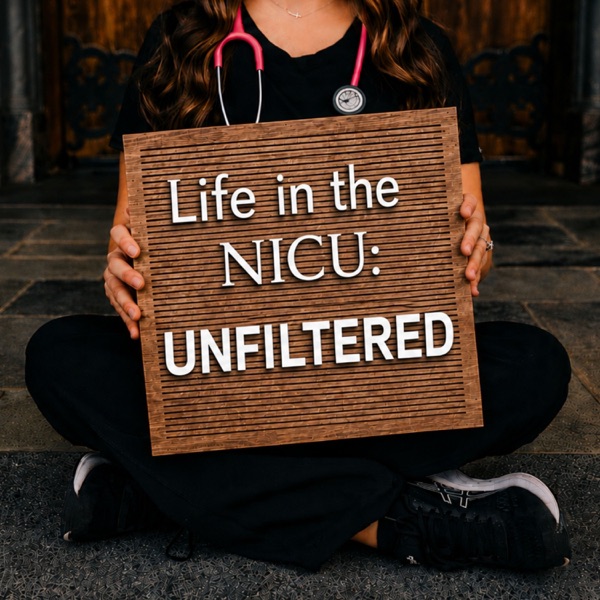
Life in the NICU: Unfiltered
Life in the NICU: Unfiltered is the NICU podcast for parents who need real stories, honest answers, and the feeling that they’re not walking this road alone.
Hosted by Sam Huber, RN, a neonatal intensive care nurse and NICU mom, each episode brings evidence-based information, personal stories, and practical resources to families with a premature or medically fragile baby.
Sam knows the NICU from both sides of the isolette. Her twin daughters were born at 30 weeks after one of them, Cadence, had passed away at 25 weeks. Her surviving daughter, Lexi, spent four weeks in the NICU. Sam went home each night without her baby and wished she’d had other NICU moms to sit with and someone to help her sort through the fear, grief, and joy all at once. Those needs led her to become a NICU nurse, and this show is the support she was looking for.
The show is called Unfiltered because it covers the good, the bad, the ugly, and everything in between. You’ll hear about:
•
Preterm labor, premature birth, and what to expect in the NICU
•
NICU emotions like fear, guilt, anger, loneliness, and grief
•
Pregnancy loss, miscarriage, and the loss of a twin
•
NICU discharge and the transition home
•
Questions to ask your care team so the unfamiliar feels less scary
Whether you’re in the middle of a NICU stay, bringing your baby home, or still processing a past experience, you belong here.
Follow the show so you never miss an episode, and leave a five-star rating to help other NICU families find it. For more tips and resources, visit NICU Necessities. Links are in the show notes.
This podcast is for education and support and is not a substitute for medical advice. Talk with your baby’s care team about your family’s needs.
- Episodes
- 5
- Releases
- Weekly
- Typical length
- 17 min
- On air since
- 2026
- Latest episode
- 5 days ago
Episodes
5 episodes, newest first
-
17 min
Apnea of Prematurity, Explained: What Every NICU Parent Needs to Know
Season 1, Episode 4
Show notes
Takeaways
• Apnea of prematurity happens because a premature baby's brain and breathing muscles are still developing, not because something is wrong.
• Words like event, episode, and spell can involve apnea, bradycardia, and desaturation, alone or together, so it's always okay to ask your medical team exactly what happened.
• There are three types of apnea, obstructive, central, and mixed, and knowing which one your baby is experiencing helps guide their care.
• Treatment ranges from simple stimulation to caffeine to added respiratory support, and it is always tailored to your baby's specific situation.
• Most babies outgrow apnea of prematurity as they mature, and many NICUs require a spell free countdown of five to seven days before discharge.Summary of the episode
In this episode of Life in the NICU: Unfiltered, host Sam Huber breaks down apnea of prematurity, drawing on guidance from trusted sources like the American Academy of Pediatrics and Johns Hopkins Medicine. She starts by decoding the language parents hear constantly in the NICU: event, episode, and spell, and explains how these terms can involve apnea, a pause in breathing, bradycardia, a drop in heart rate, and desaturation, a drop in oxygen level, either alone or together.
Sam shares a personal story about her friend Liz, whose daughter was born at 31 weeks, to illustrate the gap between how routine an apnea event can feel to a NICU nurse and how frightening it can feel to a parent watching it happen for the first time. From there, she walks through what apnea of prematurity actually is, why it becomes more common the earlier a baby is born, and the three types parents may hear about: obstructive, central, and mixed apnea.
The episode also covers how these episodes are managed, from close monitoring and gentle stimulation to caffeine and, for more significant events, additional respiratory support. Sam addresses the long term outlook, the color changes parents may notice during an episode, and what the discharge process looks like, including the apnea countdown many NICUs require and how caffeine timing can affect it. She closes with a reminder that parents are a critical part of their baby's care team and should never hesitate to speak up.
Resources: Visit NICU Necessities for more NICU tips and resources https://www.nicunecessities.com/
This podcast is for education and support and is not a substitute for medical advice. Always talk with your baby’s care team about your family’s needs.
-
10 min
Why NICU Babies Get Caffeine (And It's Nothing Like Yours)
Season 1, Episode 3
Show notes
Takeaways
• Apnea of prematurity happens because a premature baby's brain is still developing and doesn't yet consistently signal the lungs to breathe, and caffeine helps strengthen that signal.
• The caffeine used in the NICU, caffeine citrate, is a different formulation than the caffeine anhydrous found in coffee, so it is not the same as giving a baby "a little bit of coffee."
• Caffeine is typically discontinued around 33 to 35 weeks gestational age once a baby goes five to seven days without a significant apnea episode, and most babies are off it well before they leave the NICU.Summary of the episode
In this episode of Life in the NICU: Unfiltered, host Sam Huber breaks down one of the most common medications given to premature babies: caffeine. Drawing on guidance from a meta-analysis compiled by trusted sources like the American Academy of Pediatrics and Johns Hopkins Medicine, Sam explains what apnea of prematurity actually is and why it happens. A premature baby's brain is still developing the ability to consistently tell the lungs when to breathe, and the muscles that keep the airway open may not be strong enough yet. Stress factors like infection, low oxygen, feeding difficulties, or too much stimulation can make these episodes more frequent.
Sam walks through why caffeine, despite sounding like an unusual choice for a newborn, has been used for decades to treat apnea of prematurity. It stimulates the brain and supports the communication between the brain and lungs, essentially reminding the baby to breathe. She clarifies an important distinction many NICU parents wonder about: the caffeine citrate given to premature babies is a completely different formulation than the caffeine anhydrous found in coffee, so this is not the same thing as giving a baby a bit of coffee.
The episode also covers the practical side of caffeine treatment: how it starts with a larger loading dose before moving to a regular maintenance dose, how that dose changes as a baby grows, common side effects like increased heart rate and fussiness, and what the process of coming off caffeine looks like as a baby approaches 33 to 35 weeks gestational age. Sam closes with a reminder that every step in the NICU journey, no matter how small it looks from the outside, is worth celebrating.
Resources: Visit NICU Necessities for more NICU tips and resources https://www.nicunecessities.com/
This podcast is for education and support and is not a substitute for medical advice. Always talk with your baby’s care team about your family’s needs.
-
17 min
NICU Nurse's Unfiltered Guide to Fear, Guilt, and Grief
Season 1, Episode 2
Show notes
Takeaways
• Fear, joy, guilt, anger, loneliness, and grief are the six emotions Sam sees over and over again in NICU parents, sometimes all in the same day.
• Guilt tells NICU parents it's their fault. Sam explains why that almost never holds up, and why grace matters more than blame.
• Grief in the NICU isn't only about loss of life. It can mean grieving the birth plan, the delivery, or the homecoming day that didn't happen the way you pictured it.Summary of the episode
In episode two of Life in the NICU: UNFILTERED, host Sam Huber walks through the six emotions that show up most for parents with a baby in the NICU: fear, joy, guilt, anger, loneliness, and grief. She speaks both as a NICU nurse and as a mother who lived through her own NICU journey after losing one of her twin daughters and delivering her surviving daughter ten weeks premature.
Sam starts with fear, the emotion she felt first when a NICU provider walked into her hospital room before her C-section. She unpacks the difference between fear of the unknown and fear of the unfamiliar, and shares the advice she now gives parents as a nurse: keep asking questions until something actually makes sense, even if that means asking more than one provider.
From there she moves into joy, describing the small, specific moments that carry NICU parents through hard days: skin to skin contact, hat check time, a baby's first bottle, tiny fingers wrapping around a parent's hand. She then turns to the harder emotions. Guilt, especially the version that shows up when parents blame themselves for something outside their control. Anger, including her own anger at her body for what she felt was a series of betrayals. Loneliness, the specific kind that comes from walking past every other room to get straight to your own baby's isolette. And finally grief, which she reframes as something bigger than death alone, something that can include grieving a birth plan, a delivery method, or a homecoming that didn't happen on schedule.
Sam closes the episode with a direct message to anyone listening who is struggling: reaching out for help is a sign of strength, not weakness, and no one has to carry these feelings alone.
Resources: Visit NICU Necessities for more NICU tips and resources https://www.nicunecessities.com/
This podcast is for education and support and is not a substitute for medical advice. Always talk with your baby’s care team about your family’s needs.
-
34 min
Surviving Miscarriage, Twin Loss, and a 25-Week Delivery: My NICU Journey
Season 1, Episode 1
Show notes
Takeaways
• Samantha shares how her first pregnancy ended in an early miscarriage, and how that grief shaped every pregnancy that followed.
• At 25 weeks pregnant with twins, Samantha lost one daughter, Cadence, while continuing to carry her surviving twin, Lexi, all the way to delivery.
• After a four week NICU stay and years of healing, Samantha went back to school to become a NICU nurse so other parents never feel alone.Summary of the episode
Welcome to episode one of Life in the NICU Unfiltered. Host Samantha Huber opens the show with the story that started it all, her own journey through miscarriage, a high-risk twin pregnancy, the loss of one daughter, and a NICU stay with the other. This episode is the foundation for everything the podcast stands for.
Samantha walks through her first pregnancy, which ended in an early miscarriage at 12 weeks, and the isolation she felt navigating that loss without anyone in her life who had gone through the same thing. Three months later, she became pregnant again, this time with twins. What started as double the excitement turned into a high-risk pregnancy when a 20-week ultrasound revealed one twin was growing at half the rate of the other. Complete bed rest, weekly home health visits, and constant monitoring became her new normal.
At 25 weeks, Samantha learned her daughter Cadence had passed while her twin sister, Lexi, continued to grow. She carried both the grief and the pregnancy at once, delivered by emergency C-section, and spent the following weeks splitting her time between holding her surviving daughter in the NICU and planning a funeral for the daughter she lost.
The episode closes with Lexi's NICU discharge, the fear and confidence that came with bringing a preemie home, and Samantha's decision years later to become a NICU nurse so she could sit with other parents in the moments she once faced alone.
Resources: Visit NICU Necessities for more NICU tips and resources https://www.nicunecessities.com/
This podcast is for education and support and is not a substitute for medical advice. Always talk with your baby’s care team about your family’s needs.
-
4 min
Welcome to Life in the NICU: Unfiltered Trailer
Season 1
Show notes
Welcome to Life in the NICU: Unfiltered, the podcast for NICU parents and families who need real stories, evidence-based information, and the reminder that they are not walking this journey alone.
In this short trailer, host Sam Huber, RN, a neonatal intensive care unit nurse and NICU mom, shares why she started the show and what you can expect from every episode.
Sam became a NICU nurse after her twin daughters were born at 30 weeks. One of her twins, Cadence, had passed away at 25 weeks, which led to preterm labor. Sam went into the NICU not knowing anything about premature babies, and she believed she was going to lose her surviving daughter, too. The nurses and providers who cared for her family changed the course of her life. What she still wishes she’d had was a place to sit with other moms who understood the grief, the joy, and the heaviness of leaving her baby behind in the NICU while she went home.
In this episode, you’ll hear:
• Sam’s NICU story and why she became a NICU nurse
• What it feels like to be a first-time mom facing preterm labor
• Why NICU parents need support for their emotional and mental health, too
• What to expect from the show: evidence-based information, real-life NICU stories, and resources that go beyond the audioWho this podcast is for: Parents, families, and caregivers of premature and medically fragile babies, whether you’re in the middle of a NICU stay, getting ready for discharge, or still processing a past experience.
Support the show: Follow or subscribe so you never miss an episode. If this trailer spoke to you, please leave a five-star rating and review so other NICU families can find this support when they need it most.
Resources: Visit NICU Necessities for more NICU tips and resources: https://www.nicunecessities.com/
This podcast is for education and support and is not a substitute for medical advice. Always talk with your baby’s care team about your family’s needs.
Medicine lists
More Medicine shows picked out from the charts










More in Medicine
Placed highest on Apple Podcasts' Medicine chart right now