Podcast
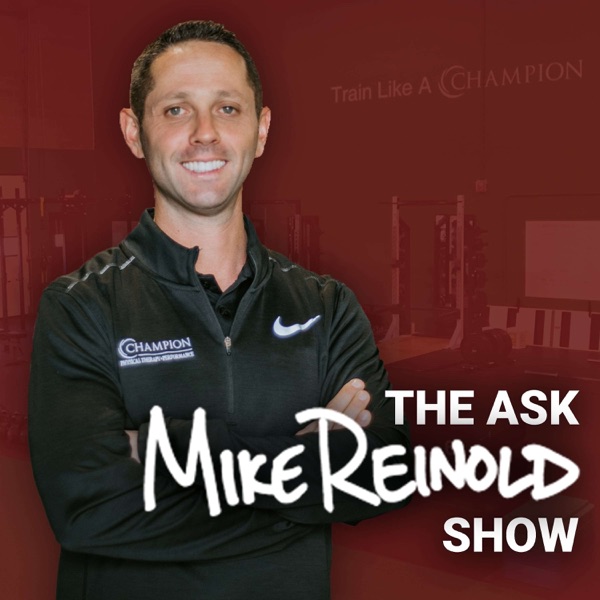
The Ask Mike Reinold Show
Answering all your physical therapy, fitness, strength and conditioning, sports performance, and career advice questions. Join me, Lenny Macrina, Dave Tilley, Dan Pope, Mike Scaduto, Lisa Russell, Kevin Coughlin, Diwesh Poudyal, and others from my team at Champion Physical Therapy and Performance in Boston, MA and learn how we help people feel better, move better, and perform better. Ask your questions at http://mikereinold.com/askmikereinold.
- Episodes
- 397
- Releases
- Every two weeks
- Typical length
- 19 min
- On air since
- 2016
- Latest episode
- 1 week ago
Episodes
397 episodes, newest first
-
18 min
How Many Patients Per Day Is Too Many and Setting You Up to Burn Out? - #AMR398
Show notes
Seeing more patients can provide valuable clinical experience. It can also leave a young therapist rushing through examinations, repeating generic treatments, and completing documentation long after the clinic closes.
That makes “How many patients do you see?” an incomplete question. Visit complexity, double-booking, support staff, documentation expectations, mentorship, and control over the schedule all influence whether a caseload is sustainable.
In this episode, we discuss how new graduates should evaluate a job offer and how owners can balance productivity with patient care and staff development. Check out this week’s podcast for the warning signs both clinicians and employers should recognize.
To see full show notes and more, head to: https://mikereinold.com/how-many-patients-per-day-is-too-many-and-setting-you-up-to-burn-out/
Learn our proven system for sports PTs who want to master ACL rehab, confidently progress patients, and guide athletes safely back to high-level sport.
Click Here to View My Online Courses
Want to learn more from me? I have a variety of online courses on my website!Disclaimer: This post contains affiliate links. If you make a purchase, I may receive a commission at no extra cost to you.
_____
Want to learn more? Check out my blog, podcasts, and online courses
Follow me: Instagram | Twitter | Facebook | Youtube -
19 min
Does In-Season Training with BFR Improve Strength or Performance? - #AMR397
Show notes
Heavy lifting builds the strength behind every jump and sprint. But during a grinding competitive season, all that mechanical load piles onto athletes who are already worn down from games and practice, and at some point it stops helping and starts hurting. So what if you could keep training explosive power without the wear and tear?
A new study out of the Journal of Sports Sciences put that question to the test with Division I basketball players in the middle of their season. One group squatted heavy the traditional way. The other squatted light, around 30% of their max, with blood flow restriction cuffs on their thighs. Eight weeks later, the results were not what most of us would predict.
The light group didn't just keep up. On the two qualities that matter most for a basketball player, jumping and sprinting, they came out ahead, and they did it with a fraction of the physical load on their bodies. That last part is what makes this interesting for anyone managing in-season athletes.
But before you throw out the barbell, there's a catch in how the study was built that changes how much we can actually conclude, and one detail in the numbers that's easy to oversell. I get into both on this week's episode, along with exactly when and how I'd use this with in-season athletes.
Check out this week's podcast for the full breakdown.
To see full show notes and more, head to: https://mikereinold.com/does-in-season-training-with-bfr-improve-strength-or-performance/
Learn our proven system for sports PTs who want to master ACL rehab, confidently progress patients, and guide athletes safely back to high-level sport.
Click Here to View My Online Courses
Want to learn more from me? I have a variety of online courses on my website!Disclaimer: This post contains affiliate links. If you make a purchase, I may receive a commission at no extra cost to you.
_____
Want to learn more? Check out my blog, podcasts, and online courses
Follow me: Instagram | Twitter | Facebook | Youtube -
16 min
Drowning in Evidence: How to Read a Meta-Analysis Without Getting Fooled
Show notes
We're taught to treat systematic reviews and meta-analyses as the gold standard. They sit at the top of the evidence pyramid, so when one lands in our inbox saying an intervention works, we tend to believe it and move on. But what if that instinct is exactly the problem?
A new editorial from two of the most respected methodologists in sports medicine makes an uncomfortable argument: the explosion of meta-analyses in our field has outpaced the rigor behind them. Sport-related meta-analyses now make up a striking share of everything published, and when you look under the hood, a lot of them are built on shaky ground. In one recent example, only a single review out of nearly forty was at low risk of bias.
On this week's episode, I break down the specific red flags that separate a meta-analysis you can trust from one you can't, including one common practice that leading evidence organizations have flatly called "unacceptable." I also get into an example that hits close to home for a lot of us: a widely prescribed injury-prevention exercise whose evidence looks very different once the analysis is done right.
If you make clinical decisions based on the research you read, and we all do, this one will change how you read it. It won't take a statistics degree, just a handful of questions you can ask of any review before you let it change your practice.
Check out this week's podcast for the full breakdown.
To see full show notes and more, head to: https://mikereinold.com/drowning-in-evidence-how-to-read-a-meta-analysis-without-getting-fooled/
Learn our proven system for sports PTs who want to master ACL rehab, confidently progress patients, and guide athletes safely back to high-level sport.
Click Here to View My Online Courses
Want to learn more from me? I have a variety of online courses on my website!Disclaimer: This post contains affiliate links. If you make a purchase, I may receive a commission at no extra cost to you.
_____
Want to learn more? Check out my blog, podcasts, and online courses
Follow me: Instagram | Twitter | Facebook | Youtube -
18 min
How to Progressively Load the Rotator Cuff - #AMR395
Show notes
If you've ever programmed rotator cuff work, you've probably hit the same wall this week's listener did. You start with the classic light band or dumbbell external rotations, everything progresses nicely for a few weeks, and then it just stops. Add a couple pounds and the movement falls apart. So you assume you've maxed out what these little muscles can do and go back to maintenance mode.
Here's the question we got, and it's a good one: the infraspinatus and teres minor are small muscles, so at some point linear progression seems to stop working. Do they respond to heavier loading like three sets of eight, or is there a ceiling because of their size?
It's a smart question, and the answer starts by challenging a premise almost everyone believes. The idea that the external rotators are "tiny" muscles that can only handle light work is one of the most persistent myths in shoulder training, and it quietly shapes how most people program the cuff for years. Once you see the actual anatomy and understand what these muscles are really built to do in a throwing athlete, the whole approach to loading them changes.
So can you lift heavy for the rotator cuff? Should a performance athlete be doing sets of eight with real weight? And if linear progression has stalled, what's the variable you should reach for before you just pile on more load? We get into the exact framework on this week's episode, including why your progress probably stopped and the order we'd progress these muscles to break the plateau. Give it a listen.
To see full show notes and more, head to: https://mikereinold.com/how-to-progressively-load-the-rotator-cuff/
Learn our proven system for sports PTs who want to master ACL rehab, confidently progress patients, and guide athletes safely back to high-level sport.
Click Here to View My Online Courses
Want to learn more from me? I have a variety of online courses on my website!Disclaimer: This post contains affiliate links. If you make a purchase, I may receive a commission at no extra cost to you.
_____
Want to learn more? Check out my blog, podcasts, and online courses
Follow me: Instagram | Twitter | Facebook | Youtube -
15 min
Is Hamstring Tightness Correlated to Low Back Pain in Young Athletes? - #AMR394
Show notes
If you treat young athletes, you have seen this note a hundred times. A 14-year-old gets referred for low back pain, and somewhere in the orthopedic report is the phrase "hamstring tightness," presented as if it settles the question. Tight hamstrings, tilted pelvis, cranky back. Case closed. Go stretch.
It's a tidy story. It's also the kind of story that survives because it sounds mechanical and nobody stops to check it. And when you actually look at what the research says, the picture gets a lot more complicated in a way that should change how you evaluate these kids.
Start with the obvious problem. Almost every adolescent in the middle of a growth spurt has tight hamstrings. Bones outpace soft tissue, flexibility drops, and it happens to the kids with back pain and the kids without it. So if you're going to call it a cause, you have to explain why the vast majority of tight-hamstring teenagers walk around perfectly fine. Then there's the direction of the arrow. Does the tightness create the back pain, or does the back pain create the tightness?
That second question is where this gets clinically important. Because there is one specific scenario in adolescent back pain where hamstring tightness matters enormously, and in that scenario it is not something you stretch. It's something you recognize, and it should send you looking somewhere else entirely. Miss it and you can spend six weeks on a mobility program while the actual problem gets worse.
On this week's episode of the Ask Mike Reinold Show, we get into what hamstring tightness in a young athlete is actually telling you, how to tell the difference between short tissue, neural tension, and protective guarding, and the specific findings that should make you stop treating and start imaging. Give it a listen.
To see full show notes and more, head to: https://mikereinold.com/is-hamstring-tightness-correlated-to-low-back-pain-in-young-athletes/
Learn our proven system for sports PTs who want to master ACL rehab, confidently progress patients, and guide athletes safely back to high-level sport.
Click Here to View My Online Courses
Want to learn more from me? I have a variety of online courses on my website!Disclaimer: This post contains affiliate links. If you make a purchase, I may receive a commission at no extra cost to you.
_____
Want to learn more? Check out my blog, podcasts, and online courses
Follow me: Instagram | Twitter | Facebook | Youtube -
22 min
Does PRP Actually Work for Hamstring Strains?
Show notes
Hamstring strains are incredibly frustrating. You get an athlete feeling great, they go for a sprint, and the muscle grabs again. We have all been there. It is the most common time-loss injury we see in running and field sports.
For years, sports medicine professionals have debated whether biologics actually speed up recovery. Some studies show great results. Other studies suggest they are a waste of money. The conflicting data makes it hard to give our athletes a straight answer when they ask if an injection will get them back on the field faster.
A recent randomized controlled trial finally standardizes the protocol to give us better clarity. The researchers looked specifically at grade 2 tears and used ultrasound-guided injections alongside a traditional rehabilitation program. The results completely change how we should view biological adjuncts in muscle rehab.
Listen to this week's podcast episode to hear a full breakdown of the study. We discuss exactly how much time these injections can shave off a recovery timeline and how you can apply these findings to the athletes you treat.
To see full show notes and more, head to: https://mikereinold.com/does-prp-actually-work-for-hamstring-strains/
Learn our proven system for sports PTs who want to master ACL rehab, confidently progress patients, and guide athletes safely back to high-level sport.
Click Here to View My Online Courses
Want to learn more from me? I have a variety of online courses on my website!Disclaimer: This post contains affiliate links. If you make a purchase, I may receive a commission at no extra cost to you.
_____
Want to learn more? Check out my blog, podcasts, and online courses
Follow me: Instagram | Twitter | Facebook | Youtube -
18 min
Does Icing Your Shoulder Still Work for Baseball Pitchers? - #AMR392
Show notes
Pitchers are constantly looking for the best way to recover after a long outing. Walk into any training room, and you will hear the hum of massage guns and see guys strapped to ice machines. We're seeing newer things too, like ESTIM machines and even BFR after an outing. We know pitching causes microtrauma and neuromuscular fatigue. The debate over how to properly manage that fatigue never seems to stop.
A recent study finally put percussive massage and traditional ice therapy head to head. Researchers had collegiate pitchers throw 75 pitches and then gave them either a targeted massage gun session or 15 minutes of isolated icing. They tracked exactly what happened to the shoulder over the next 48 hours.
The results might force you to change how you handle your athletes post-game. One of these popular methods actually restored shoulder external rotation strength and proprioception. The other completely fell flat after two days. Check out this week's podcast episode to hear my breakdown of the data and find out exactly what you should be doing to keep your pitchers healthy and performing at their best.
To see full show notes and more, head to: https://mikereinold.com/does-icing-your-shoulder-still-work-for-baseball-pitchers/
Learn our proven system for sports PTs who want to master ACL rehab, confidently progress patients, and guide athletes safely back to high-level sport.
Click Here to View My Online Courses
Want to learn more from me? I have a variety of online courses on my website!Disclaimer: This post contains affiliate links. If you make a purchase, I may receive a commission at no extra cost to you.
_____
Want to learn more? Check out my blog, podcasts, and online courses
Follow me: Instagram | Twitter | Facebook | Youtube -
16 min
Stop Treating the MRI and Start Treating the Athlete
Show notes
Every sports physical therapist remembers the first time they handed a young, anxious athlete an MRI report filled with terms like "partial-thickness tear," "labral fraying," or "degenerative changes." It is a defining moment in a clinician's career. Instantly, the psychological landscape of the rehab process shifts. The athlete, who might only have mild, intermittent symptoms, suddenly views their joint as a ticking time bomb. As a clinician, it is incredibly easy to let that piece of paper dictate your entire treatment plan, leading to over-protection and a fear-avoidant rehab environment.
The reality of dealing with overhead athletes—especially baseball pitchers—is that structural abnormalities on an image are often just the cost of doing business. If you scan enough high-level shoulders, you are going to find fraying and partial tears in completely asymptomatic arms. The real skill lies in balancing those structural findings with the actual human being sitting on your treatment table. How do you maintain clinical objectivity when the scan says one thing but your manual muscle testing and special tests say another?
On this episode of the podcast, we answer a great question from a listener struggling to navigate this exact scenario with a collegiate pitcher. We discuss how to educate a freaked-out athlete, when to respect the structural pathology, and how to ensure you are treating the functional deficits rather than just chasing a clean image. Check out this week’s episode for our full breakdown and clinical pearls on mastering the physical exam.
To see full show notes and more, head to: https://mikereinold.com/stop-treating-the-mri-and-start-treating-the-athlete/
Learn our proven system for sports PTs who want to master ACL rehab, confidently progress patients, and guide athletes safely back to high-level sport.
Click Here to View My Online Courses
Want to learn more from me? I have a variety of online courses on my website!Disclaimer: This post contains affiliate links. If you make a purchase, I may receive a commission at no extra cost to you.
_____
Want to learn more? Check out my blog, podcasts, and online courses
Follow me: Instagram | Twitter | Facebook | Youtube -
17 min
Physician Referrals vs. Online Presence: Which One Grows Your Sports PT Clinic Faster? - #AMR390
Show notes
Building a sports physical therapy practice used to follow a predictable playbook. You opened your doors, printed some business cards, and spent your Friday afternoons dropping off food at local orthopedic clinics hoping to get on their referral list. For decades, doctor relationships were the lifeblood of private practice growth. But the modern healthcare consumer operates differently. Today, even when a physician hands a patient a specific script, that patient immediately pulls out their phone to check Google reviews, Instagram feeds, and website content before booking an appointment.
This shift has created a massive fork in the road for early-career professionals and aspiring clinic owners. Is the classic physician marketing route dead, or is it still the most reliable way to build a sustainable caseload? On the flip side, does a massive social media footprint actually translate into paying clients, or is it just an expensive vanity metric that takes time away from clinical care? If you were launching a brand-new hybrid performance facility today with zero brand awareness, where should you actually spend your time and marketing dollars?
In this week's episode of The Ask Mike Reinold Show, the crew dives headfirst into this exact dilemma. We break down the real-world math behind direct-to-consumer marketing versus physician networking, and share the exact strategy we would use if we had to start Champion from scratch today. Tune in to find out which avenue deserves your focus so you can build a thriving practice without wasting your time.
To see full show notes and more, head to: https://mikereinold.com/physician-referrals-vs-online-presence-which-one-grows-your-sports-pt-clinic-faster/
Learn our proven system for sports PTs who want to master ACL rehab, confidently progress patients, and guide athletes safely back to high-level sport.
Click Here to View My Online Courses
Want to learn more from me? I have a variety of online courses on my website!Disclaimer: This post contains affiliate links. If you make a purchase, I may receive a commission at no extra cost to you.
_____
Want to learn more? Check out my blog, podcasts, and online courses
Follow me: Instagram | Twitter | Facebook | Youtube -
20 min
The Truth About BPC 157 Peptide in Sports Medicine: What You Need to Know - #AMR389
Show notes
If you’ve spent any time on social media or in many gyms lately, you’ve probably heard the buzz about BPC-157. Often called the "healing peptide," it’s being touted as a miracle cure for everything from chronic tendinopathy to acute muscle tears. Patients are showing up in our clinics asking where they can get it, and some "wellness clinics" are already handing out injections like candy.
But as sports physical therapists, we have to look past the "bio-hacker" headlines and look at the hard data. Is there actually any human evidence that this works? And more importantly, is it even legal for your athletes to use?
A brand-new systematic review just hit the journals, and it’s the most comprehensive look we’ve seen yet at the mechanism, the MSK outcomes, and the massive safety "gray areas" surrounding this compound. The results are fascinating, but they come with some major red flags that every clinician needs to hear before their next patient interaction.
In this week’s episode, I’m diving deep into the science of BPC-157. We’re breaking down the pathways it uses to (potentially) speed up tissue repair, the truth about the current human research, and the legal warnings you must give your athletes to protect their careers.
To see full show notes and more, head to: https://mikereinold.com/the-truth-about-bpc-157-peptide-in-sports-medicine-what-you-need-to-know/
Learn our proven system for sports PTs who want to master ACL rehab, confidently progress patients, and guide athletes safely back to high-level sport.
Click Here to View My Online Courses
Want to learn more from me? I have a variety of online courses on my website!Disclaimer: This post contains affiliate links. If you make a purchase, I may receive a commission at no extra cost to you.
_____
Want to learn more? Check out my blog, podcasts, and online courses
Follow me: Instagram | Twitter | Facebook | Youtube -
26 min
Outcomes and Return to Sport Testing After Bankart and Laterjet Shoulder Stabilization Surgery - #AMR388
Show notes
We’ve all been there—you’re working with a high-level athlete after a Bankart repair or Laterjet, they’re at the 6-month mark, their ROM looks great, and they’re itching to get back on the field. The surgeon gives the green light, but you can’t help but wonder: Are they actually ready?
In the world of ACL rehab, we have strict batteries of tests, symmetry indexes, and psychological readiness scales. But when it comes to the shoulder, the literature has been surprisingly quiet on what "ready" actually looks like. A new scoping review just dropped in IJSPT that digs into the return-to-sport rates for over 2,000 competitive athletes, and the results are a massive wake-up call for sports physical therapists.
The study looked at the difference between soft tissue repairs and bony augmentations, but more importantly, it looked at how we are making the decision to clear these athletes. Is it based on strength? Function? Or just a date on the calendar?
On this week’s episode of the podcast, I’m diving deep into this research to discuss the current success rates of shoulder stabilizations and, more importantly, the 10 criteria surgeons are using to clear athletes. Some of what they found might surprise you—and it might change the way you progress your next shoulder patient. Check out this week’s episode to learn more!
To see full show notes and more, head to: https://mikereinold.com/outcomes-and-return-to-sport-testing-after-bankart-and-laterjet-shoulder-stabilization-surgery/
Learn our proven system for sports PTs who want to master ACL rehab, confidently progress patients, and guide athletes safely back to high-level sport.
Click Here to View My Online Courses
Want to learn more from me? I have a variety of online courses on my website!Disclaimer: This post contains affiliate links. If you make a purchase, I may receive a commission at no extra cost to you.
_____
Want to learn more? Check out my blog, podcasts, and online courses
Follow me: Instagram | Twitter | Facebook | Youtube -
16 min
Can the ACL Actually Heal Without Surgery? - #AMR387
Show notes
Wouldn't it be amazing if an ACL tear can heal on its own without surgery?
For sure, and there have been recent discussions about the Cross-Bracing Protocol and its impact on these injuries.
But is this too good to be true?
In this episode, we discuss the emerging cross-bracing protocol for non-operative ACL treatment, exploring its potential benefits and drawbacks. There is some skepticism about the protocol's effectiveness, but we discuss the importance of patient selection and quality of life considerations in treatment decisions.
Good timing on this episode. I just released my brand new online course, The ACL Rehab Masterclass: A Complete Guide to Criteria-Based Rehabilitation, Testing, and Return to Sport. I teamed up with Dan Pope and Kevin Coughlin to share the exact system we use at Champion.
• Click here to learn more about The ACL Rehab Masterclass
To see full show notes and more, head to: https://mikereinold.com/can-the-acl-actually-heal-without-surgery/
Learn our proven system for sports PTs who want to master ACL rehab, confidently progress patients, and guide athletes safely back to high-level sport.
Click Here to View My Online Courses
Want to learn more from me? I have a variety of online courses on my website!Disclaimer: This post contains affiliate links. If you make a purchase, I may receive a commission at no extra cost to you.
_____
Want to learn more? Check out my blog, podcasts, and online courses
Follow me: Instagram | Twitter | Facebook | Youtube -
20 min
The New Tommy John: The Rise of the Internal Brace - #AMR386
Show notes
Ten weeks to start throwing after UCL surgery sounds like a miracle timeline, until you’re the clinician staring at a stiff elbow, a deconditioned arm, and a protocol that assumes the athlete is further along than reality. We’re seeing more internal brace UCL repairs and fewer “classic” Tommy John reconstructions, and that shift is changing how baseball pitchers, gymnasts, and other overhead athletes move through rehab.
We talk through what’s actually different about the internal brace procedure, why surgeons became so optimistic early on, and why many athletes still aren’t truly ready to throw at week 10 even if they’re technically cleared. Readiness means more than ligament stability. We dig into the practical stuff that decides outcomes: restoring extension early without creating inflammation, building real strength and arm care habits, and using a plyometric progression before a return-to-throwing program. We also share what we’re watching for clinically, including ulnar nerve irritation from prolonged bracing, motion that never quite “settles,” and the unique posterior-medial elbow pain that can show up with deep flexion or forced extension.
Most importantly, we argue for criteria-based rehab over calendar-based rehab. If the athlete has time before the next season, use it to build capacity instead of chasing an artificial milestone. If you work in sports physical therapy, sports medicine, or baseball performance, this conversation will help you spot red flags early and guide internal brace athletes with more confidence.
Subscribe, share this with a coach or clinician who manages throwing programs, and leave a review if it helps. What’s the earliest return-to-throwing timeline you’ve seen that actually held up long term?
To see full show notes and more, head to: https://mikereinold.com/the-new-tommy-john-the-rise-of-the-internal-brace/
Learn our proven system for sports PTs who want to master ACL rehab, confidently progress patients, and guide athletes safely back to high-level sport.
Click Here to View My Online Courses
Want to learn more from me? I have a variety of online courses on my website!Disclaimer: This post contains affiliate links. If you make a purchase, I may receive a commission at no extra cost to you.
_____
Want to learn more? Check out my blog, podcasts, and online courses
Follow me: Instagram | Twitter | Facebook | Youtube -
22 min
Risk Factors of Arthrogenic Muscle Inhibition - #AMR385
Show notes
We’ve all seen it: the acute ACL patient who drags their leg into the clinic, unable to squeeze their quad to save their life. We call it Arthrogenic Muscle Inhibition (AMI), and for years, we’ve treated it as a stubborn, long-term enemy. But a fascinating new study from the American Journal of Sports Medicine suggests we might be overcomplicating it.
Researchers analyzed 300 acute ACL patients and found that while AMI is incredibly common (affecting over half of patients), it’s also surprisingly fragile. In fact, they found that nearly 80% of cases could be fully reversed in a single session with simple exercises. In this episode, we dive into the 'Red Flags' that predict quad shutdown—including one common sleeping habit you need to ban immediately—and how to flip the switch back on for your patients.
To see full show notes and more, head to: https://mikereinold.com/risk-factors-of-arthrogenic-muscle-inhibition
Learn our proven system for sports PTs who want to master ACL rehab, confidently progress patients, and guide athletes safely back to high-level sport.
Click Here to View My Online Courses
Want to learn more from me? I have a variety of online courses on my website!Disclaimer: This post contains affiliate links. If you make a purchase, I may receive a commission at no extra cost to you.
_____
Want to learn more? Check out my blog, podcasts, and online courses
Follow me: Instagram | Twitter | Facebook | Youtube -
23 min
Ranking the Top Patellar Tendon Exercises by Tendon Load - #AMR384
Show notes
We all have our favorite "go-to" exercises for patellar tendinopathy. For years, the single-leg decline squat has been the gold standard, often introduced early in rehabilitation to target the tendon. But what if I told you that this specific exercise actually places more load on the patellar tendon than running or double-leg jumping?
A massive new study just analyzed 35 common rehabilitation exercises—from step-ups to plyometrics—and ranked them based on actual biomechanical load. The results turn traditional progression models upside down and might explain why some of your patients flare up during "standard" rehab protocols. In this week's episode, we break down the 3 distinct tiers of tendon loading and give you a data-backed roadmap to build the perfect progression.
To see full show notes and more, head to: https://mikereinold.com/ranking-the-top-patellar-tendon-exercises-by-tendon-load/
Learn our proven system for sports PTs who want to master ACL rehab, confidently progress patients, and guide athletes safely back to high-level sport.
Click Here to View My Online Courses
Want to learn more from me? I have a variety of online courses on my website!Disclaimer: This post contains affiliate links. If you make a purchase, I may receive a commission at no extra cost to you.
_____
Want to learn more? Check out my blog, podcasts, and online courses
Follow me: Instagram | Twitter | Facebook | Youtube -
22 min
Using ChatGPT and AI in Physical Therapy
Show notes
The use of ChatGPT and other AI models has exploded in recent years, and you're starting to see this in most professions, including the medical profession.
We've been using AI quite a bit at Champion for a variety of things and wanted to share our experiences. We go over some of the use cases as well as different models that we've tried with varying success
We do think you should be using AI. It's an opportunity for growth.
We dig into how AI actually helps us treat, teach, and stay current without drowning in papers. From OpenEvidence to Gemini vs ChatGPT, we share real clinic workflows, movement apps we like, and guardrails to avoid hallucinations.
• why we trust OpenEvidence for fast, linked citations
• how AI reduces bias during eval prep
• when to compare ChatGPT, Gemini, and Grok
• prompts that demand sources and confidence levels
• movement analysis apps for golf and bar velocity
• ambient note tools to draft SOAP notes
• ethical guardrails on privacy, consent, and hallucinations
• practical routines for morning research sprints
• using AI to generate screeners, red flags, and alternatives
• model strengths, weaknesses, and staying literateTo see full show notes and more, head to: https://mikereinold.com/using-chatgpt-and-ai-in-physical-therapy/
Learn our proven system for sports PTs who want to master ACL rehab, confidently progress patients, and guide athletes safely back to high-level sport.
Click Here to View My Online Courses
Want to learn more from me? I have a variety of online courses on my website!Disclaimer: This post contains affiliate links. If you make a purchase, I may receive a commission at no extra cost to you.
_____
Want to learn more? Check out my blog, podcasts, and online courses
Follow me: Instagram | Twitter | Facebook | Youtube -
21 min
Should Adults Lift for Less than 5 Reps Per Set? - #AMR382
Show notes
Mike Boyle had a great discussion on Instagram several weeks ago about adults lifting to failure and using low rep schemes.
It sparked a lot of arguments among people about which approach is best and whether there's always an answer to this question.
We discuss whether adults should lift to failure on low-rep schemes in this week's episode.
We'll go over what we do at Champion, how we mostly agree with this, and why we may work low reps for a very certain population for a specific reason.
To see full show notes and more, head to: https://mikereinold.com/should-adults-lift-for-less-than-5-reps-per-set/
Learn our proven system for sports PTs who want to master ACL rehab, confidently progress patients, and guide athletes safely back to high-level sport.
Click Here to View My Online Courses
Want to learn more from me? I have a variety of online courses on my website!Disclaimer: This post contains affiliate links. If you make a purchase, I may receive a commission at no extra cost to you.
_____
Want to learn more? Check out my blog, podcasts, and online courses
Follow me: Instagram | Twitter | Facebook | Youtube -
19 min
ACLR + LET: Overkill or the New Gold Standard? - #AMR381
Show notes
Surgeons are adding more lateral extra-articular procedures to ACL reconstructions, especially in young cutting and pivoting athletes. On paper, it sounds great—tighten up the anterolateral side, improve stability, protect the graft. But what does that actually mean for clinical outcomes and for how we manage rehab?
A new Level 1 systematic review and meta-analysis just pulled together the randomized trials comparing isolated ACL reconstruction to ACL reconstruction plus a lateral extra-articular procedure. The results raise important questions: Are these athletes truly more stable? Do we see fewer graft ruptures? And are we quietly trading those benefits for more pain, stiffness, or long-term joint issues?
In this week’s podcast, we break down what the data really show, how it should influence your decision-making as a sports physical therapist, and what to watch for when an athlete walks in with a LET on their op note. Check out the full episode to hear how (and when) this should change your rehab approach.
To see full show notes and more, head to: https://mikereinold.com/aclr-let-overkill-or-the-new-gold-standard/
Learn our proven system for sports PTs who want to master ACL rehab, confidently progress patients, and guide athletes safely back to high-level sport.
Click Here to View My Online Courses
Want to learn more from me? I have a variety of online courses on my website!Disclaimer: This post contains affiliate links. If you make a purchase, I may receive a commission at no extra cost to you.
_____
Want to learn more? Check out my blog, podcasts, and online courses
Follow me: Instagram | Twitter | Facebook | Youtube -
1 hr 19 min
10 Year Anniversary Episode - #AMR380
Show notes
Wow, I can't believe it's been 10 years!
It truly is an honor to be able to host a live episode celebrating the 10-year anniversary of our podcast. Thank you so much for listening all these years!
In this episode, we'll answer live questions from an audience of listeners, reflect on some of our favorite moments of the podcast, and give out some prizes and special discounts to all the listeners!
Special thanks to our amazing friends from Ancore, SmartCuffs, Suji, SportGrips, and mTrigger for donating the prizes!
To see full show notes and more, head to: https://mikereinold.com/10-year-anniversary-episode/
Learn our proven system for sports PTs who want to master ACL rehab, confidently progress patients, and guide athletes safely back to high-level sport.
Click Here to View My Online Courses
Want to learn more from me? I have a variety of online courses on my website!Disclaimer: This post contains affiliate links. If you make a purchase, I may receive a commission at no extra cost to you.
_____
Want to learn more? Check out my blog, podcasts, and online courses
Follow me: Instagram | Twitter | Facebook | Youtube -
15 min
Should Every ACL Get E-Stim? What the New NMES Meta-Analysis Really Shows - #AMR379
Show notes
Quadriceps shutdown after ACL reconstruction is one of the biggest barriers we see in the clinic. Even with modern surgical techniques and “aggressive” rehab, too many athletes struggle to get their quad strength back, and that deficit shows up later in gait, loading, and confidence on the field.
A new systematic review and meta-analysis just took a fresh look at neuromuscular electrical stimulation (NMES) as an adjunct to ACL rehab. Does adding NMES actually move the needle on quad strength? Does timing matter? And does any of this translate into better knee function where it counts?
In this week’s podcast, we break down what the authors found, how strong the evidence really is, and how we’re thinking about NMES programming in our own ACL protocols. If you’re working with post-op knees, you’ll want to hear this before you set up your next rehab plan.
To see full show notes and more, head to: https://mikereinold.com/should-every-acl-get-e-stim-what-the-new-nmes-meta-analysis-really-shows/
Learn our proven system for sports PTs who want to master ACL rehab, confidently progress patients, and guide athletes safely back to high-level sport.
Click Here to View My Online Courses
Want to learn more from me? I have a variety of online courses on my website!Disclaimer: This post contains affiliate links. If you make a purchase, I may receive a commission at no extra cost to you.
_____
Want to learn more? Check out my blog, podcasts, and online courses
Follow me: Instagram | Twitter | Facebook | Youtube
On these lists
The Ask Mike Reinold Show is one of the shows picked out on each of these






More in Fitness
Placed highest on Apple Podcasts' Fitness chart right now