Podcast
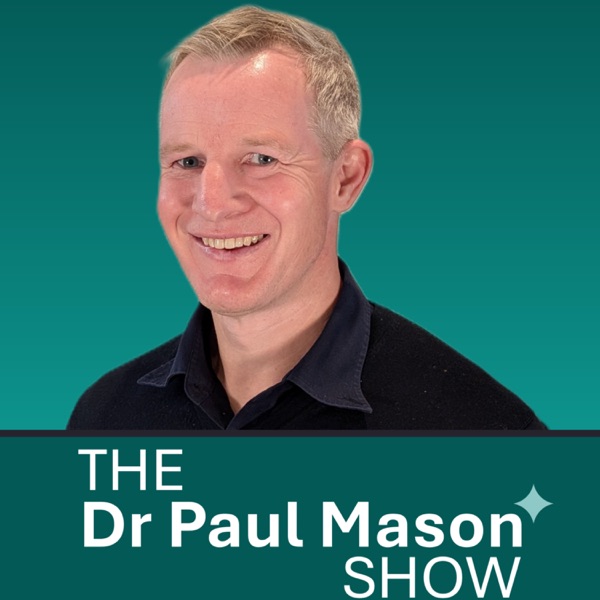
The Dr Paul Mason Show
You’ve watched the lectures. Now the real conversation begins.
Each episode, Dr Paul Mason and co-host Alison dive into one of Paul’s talks and unpack the comments: sharp questions, strong challenges, smart observations, and the occasional wild take. They tackle it all with clear evidence, zero dodging, and a healthy dose of humour.
Whether you’re already a fan of the lectures or just discovering evidence-based insights, this is where curiosity meets answers. Got an awkward question of your own? It might just get answered.
Real talk. Real evidence. No fluff.
- Episodes
- 7
- Releases
- Every two weeks
- Typical length
- 1 hr 6 min
- On air since
- 2026
- Latest episode
- 6 days ago
Episodes
7 episodes, newest first
-
1 hr 5 min
Ep 7: The Microbiome Special: Do You Really Need Fibre? Fungi, Coeliac Disease, Autoimmunity and Probiotics
Season 1, Episode 7
Show notes
The Microbiome Special. Dr Paul Mason and Alison go through Paul's microbiome lecture: what your microbiome does, why "no fibre, no microbiome" is a myth, the womb microbiome and IVF, endometriosis, treating partners for BV and sharing microbes at home. Then your comments: autoimmune disease and molecular mimicry, why fungi are so hard to treat, carnivore and Candida, sweeteners, the ice-cream sugar linked to a superbug, coeliac disease, dairy, tonsils, probiotics, glyphosate and fixing dysbiosis.
0:00 Do you really need fibre?
0:24 What is the microbiome?
1:55 The three jobs of your microbiome
4:11 Do we need fibre? Carnivores vs fibre
6:28 Why diet changes upset your gut for a week
9:38 Security guard and immune trainer
11:55 What a healthy microbiome looks like
12:44 Not just bacteria
13:24 The womb microbiome and IVF live births
15:30 Endometriosis and Fusobacterium
17:03 Is it contagious? Treating partners for BV
19:00 Sharing microbes with your household
21:07 A favour to ask
21:56 Autoimmune disease and molecular mimicry
24:55 How autoimmune disease is treated
26:20 Carnivore and autoimmune relief
27:22 Why fungi are our closest relatives
28:40 Why fungal infections are hard to treat
29:46 How a carnivore diet starves Candida
30:23 Do sweeteners change your gut?
31:03 The ice-cream sugar that fed a superbug
33:58 Coeliac disease and Candida
37:49 Dairy, casein and lactose
40:08 Lactose intolerance and coeliac disease
43:05 Casein, cheese, butter and yoghurt
44:51 Tonsils, fungi and autoimmunity
50:51 Probiotics that thrive on carnivore
52:24 Too many probiotics? Testing your microbiome
54:02 Glyphosate and your gut
56:52 Organic food and washing produce
58:20 Fixing dysbiosis: weed, replant, feed
59:59 The cover crop: B. infantis
62:56 E. coli Nissle for ulcerative colitis
63:49 Final comment and goodbyeLeave a comment or question on the YouTube version. Next episode is built from them.
This podcast is general information and education only, not medical advice. Always consult your own doctor before changing medication or treatment.
-
47 min
Ep 6: The Thyroid Special: Is Your 'Normal' TSH Really Normal? T3 vs T4, Hashimoto's, Iodine and Thyroid in Beef
Season 1, Episode 6
Show notes
The Thyroid Special. Dr Paul Mason and Alison work through your thyroid questions: why a "normal" TSH may not be optimal, T3 vs T4 and conversion, iodine and the Wolff-Chaikoff effect, T4 vs T3 prescribing and the T3 debate, how to tell if you're taking too much, synthetic vs natural desiccated thyroid, Hashimoto's antibodies and diet, gluten and dairy, and thyroid hormone resistance on low carb. Plus the hormone in beef that really did poison people, the 19-year-old who ate a cow's thyroid, and What I've Learned: the plant sterols in oysters, mussels and scallops.
(0:00) What happens if you eat a cow's thyroid?
(0:23) Welcome: has hormone-treated beef ever made anyone sick?
(2:02) The hormone in beef that did poison people
(3:56) Why thyroid was banned from food
(4:38) The farm case from Ontario
(5:50) The 19-year-old who ate a cow thyroid
(6:42) Is there thyroid in organ supplements?
(8:18) What thyroid hormone actually does
(10:49) How thyroid function is tested: TSH
(11:51) What is a normal TSH? Normal isn't optimal
(15:21) What T3 and T4 are
(16:53) How common are T4-to-T3 conversion problems?
(18:05) Iodine, selenium, zinc and vitamin A
(19:28) Too much iodine: the Wolff-Chaikoff effect
(21:50) T4 or T3: what to prescribe
(23:08) The T3 debate
(25:01) How do you know you're taking too much?
(25:57) Synthetic vs natural desiccated thyroid
(28:45) Thyroid antibodies: Hashimoto's and Graves'
(32:27) Can thyroid antibodies come down?
(34:06) Gluten, dairy and thyroid antibodies
(35:09) Thyroid hormone resistance and insulin resistance
(39:38) What I've learned: plant sterols in shellfish
(42:51) Should you eat oysters and scallops?
(44:19) Paul's probiotic deodorant experiment
(46:38) WrapLeave a comment or question on the YouTube version. Next episode is built from them.
This podcast is general information and education only, not medical advice. Always consult your own doctor before changing medication or treatment.
-
54 min
Ep 5: Worried About Hormones in Beef? Soy, the China Study, Ornish's Angiograms, BPA and Vitamin A
Episode 5
Show notes
Gram for gram, soy protein has at least a thousand times the estrogenic activity of hormone-treated beef. Dr Paul Mason and Alison work through your comments on the China Study and Denise Minger's reanalysis, Dean Ornish's 0.01 mm "reversal" of heart disease, eyeballed angiograms and stents, hormone growth promotants vs soy isoflavones, soy formula, lavender and tea tree oil, BPA on receipts and "BPA-free" plastics, feminised fish, polar bear vs beef liver, vitamin A and measles, oxalate dumping, and protein for hypoglycaemia. Plus two In the News segments: atrazine, and Novo's ZEUS trial on inflammation and heart disease.
(0:00) Worried about hormones in beef?
(0:21) Welcome
(0:56) Did 80% rice and vegetables keep China healthy?
(3:30) Denise Minger and the China Study data
(5:02) Dean Ornish and "reversing" heart disease
(6:27) Angiograms and 0.01 mm
(9:13) Eye vs computer: the 70% threshold
(10:11) Stents in stable heart disease
(11:04) Hormones in meat
(12:50) Soy isoflavones vs hormone-treated beef
(14:58) Soy infant formula
(16:52) Lavender, tea tree oil and boys
(18:22) BPA, receipts and BPS
(22:28) Sewage and feminised fish
(23:54) In the News: atrazine
(25:54) Vitamin A: polar bear vs beef liver
(31:01) Vitamin A and measles
(32:33) Oxalate dumping
(38:23) Oxalates and fat malabsorption
(39:30) In the News: Novo's ZEUS trial
(44:36) Is reducing inflammation ever good?
(47:33) Protein and hypoglycaemia
(50:09) What counts as hypoglycaemia?
(52:05) Cahill's fasting experiment
(54:00) WrapLeave a comment or question on the YouTube version. Next episode is built from them.
ANSWER: Put a little boogie into it.
This podcast is general information and education only, not medical advice. Always consult your own doctor before changing medication or treatment.
-
1 hr 6 min
How much Bacon gives you Cancer?
Season 1, Episode 4
Show notes
A 1991 study gave more than 4,000 rats nitrosamines in their drinking water over about 2.5 years. The lowest dose found to cause cancer, scaled to an equivalent dose for a 70 kg person, was about 126,000 kg of bacon. This works out to ~138 kg a day.Sydney doctor Dr Paul Mason and co-host Alison work through your comments: why beetroot has around 40 times the nitrate of bacon, whether "nitrate-free" bacon is any different, how cooking changes nitrosamines, whether there really is vitamin C in meat, the explorer who lived on meat alone, how much organ meat you actually need, HbA1c after giving blood, blood sugar spikes and the Kraft test, what happens going from carnivore to vegan, and gout on a ketogenic diet.Plus two new segments. What I've Learned: a high IgE, no allergy, and a dental infection ordinary X-rays missed. In the News: anaemia in pregnancy and baby brain size, and an antifungal study that could change how IBD is treated.CHAPTERS0:00 How much bacon gives you cancer?0:13 Welcome: "beetroot has more nitrate than bacon"1:06 The rat study behind the bacon and cancer scare2:52 Would 138 kg of bacon a day give you cancer?4:35 Is "nitrate-free" bacon any different?6:27 Does how you cook bacon matter?7:55 Does the vitamin C in vegetables change anything?9:52 Is there vitamin C in red meat?11:40 How much meat for your daily vitamin C?12:36 The explorer who lived on meat alone17:22 How much organ meat do you actually need?18:18 Why the fat in your meat matters21:02 Do meat eaters need less vitamin C?23:57 Can you get scurvy on keto or carnivore?26:32 Does giving blood change your HbA1c?30:02 Can HbA1c drop from 15 to 5 in three days?31:44 Warning if you take insulin or diabetes medication32:34 Big glucose spikes, normal fasting sugar35:23 The Kraft test: insulin resistance or insulin deficiency?38:08 Insulin timing, CGMs and oatmeal spikes42:12 Carnivore to vegan: what happens to your blood work?46:31 Gout, uric acid and ketones50:34 NEW: What I've Learned: high IgE and a hidden dental infection55:18 Dental CT scans and radiation56:22 NEW: In the News: anaemia in pregnancy and baby brain size58:54 In the News: fluconazole, IBD and gut fungus1:00:59 Making antifungal side effects easier1:03:43 What "high cholesterol" on a blood test measures1:04:49 Are we AI?Every question in this episode came from the comments. Leave yours below, it might end up on screen next episode.THINK PAUL'S GOT SOMETHING WRONG? Tell us, with a paper (PMID or link). Sharp challenges get answered on air.Please keep questions general. No personal medical questions.DISCLAIMER: This podcast is for general information and education only. It is not medical advice and does not replace consultation with your own doctor, who knows your individual circumstances. Never start, stop or change medication on the basis of a podcast.HOSTED BY: @alison_makes_sense#bacon #nitrates #drpaulmasonTags
-
1 hr 19 min
They Injected Rats With Rocket Fuel… Then Blamed the Red Meat | Dr Paul Mason Ep 3
Season 1, Episode 3
Show notes
The studies that "proved" red meat causes bowel cancer pre-injected the animals with rocket fuel, known to cause bowel cancer. The result? Red meat PROTECTED them. In this episode, Dr Paul Mason and co-host Alison dig into: -the rat studies behind the red meat–cancer scare-whether a vegan diet plus eggs stacks up-what a "normal" B12 and ferritin really tell you (and what they hide)-the strange case of high B6 on a carnivore diet-daily air-fryer chips and blood sugar, -what continuous glucose monitors actually measure.-low blood pressure-the shifting hypertension goalposts, -meal frequency, -ketones, -PPIs after heart attacks, -the real cause of gout,and the truth about the dying plant.CHAPTERS0:00 The rocket fuel cold open0:20 Welcome + "he should stay in his lane"7:28 Why are vegans hostile to low carb?8:23 Vegan plus eggs — does it stack up?9:53 "My B12 is 776 and ferritin 100" — what blood tests really show24:52 High B6 on a carnivore diet?! The gut bacteria explanation32:45 Air-fryer chips every day — what happens to blood sugar41:29 CGMs: what a glucose monitor really measures52:05 Blood pressure 94/64 — should you worry?55:19 Big Pharma & the moving hypertension goalposts (+ Paul's bodybuilding days)1:00:40 Should you eat five meals a day?1:03:38 Ketones: worth measuring?1:12:57 Do heart-attack patients stay on PPIs for life?1:15:10 Gout: blame the sugar, not the steak1:16:55 The dead plant confession1:19:03 Wrap-upEvery question in this episode came from the comments. Leave yours below - it might end up on screen next episode. (The plant thanks you for your concern.)DISCLAIMER: This podcast is for general information and education only. It is not medical advice and does not replace consultation with your own doctor, who knows your individual circumstances. Never start, stop or change medication on the basis of a podcast.HOSTED BY: @alison_makes_sense
Catch Dr Paul Mason at Carnivore Live, Adelaide — 12 September 2026
-
1 hr 46 min
What blood pressure do people who live past 100 actually have? Ep 2 - The Dr Paul Mason Show.
Season 1, Episode 2
Show notes
Studies of thousands of elderly patients have found the blood pressure associated with the longest life is about 129-130, a number many guidelines classify as stage 1 hypertension.Paul and Alison work through your comments from episode 1 and on Pauls' nutrition masterclass delivered to doctorsmasterclass.
00:00 Introduction to the Podcast and Its Purpose
02:09 Nutrition Masterclass Insights and Myth Busting
05:56 Understanding Vitamin B12 and Its Importance
15:49 Weight Loss Success Stories and Health Improvements
21:19 Blood Pressure Management and Its Implications
28:10 Deprescribing and Patient-Doctor Conversations
35:20 Lifestyle Changes and Patient Compliance
39:36 Informed Consent in Medical Decisions
43:52 H. Pylori and Its Treatment Challenges
48:49 Dietary Considerations and Water Intake
01:04:58 Traveling and Maintaining a Healthy Diet
01:08:40 Carnivore Diet Experiences and Cravings
01:15:57 The Concept of Treats in Diet
01:18:20 Fasting and Its Role in Health
01:21:28 Dietary Needs for Different Age Groups
01:26:01 Continuous Glucose Monitoring and Its Benefits
01:29:45 Pharmacological Effects of Foods
01:32:59 Herbal Medicine vs. Synthetic Drugs
01:37:24 Boron Deficiency and Its Implications
01:39:32 Animal Protein and Kidney Health
01:45:37 Conclusion and Future Topics
Topics including
• blood pressure targets
• deprescribing
• B12
• Helicobacter pylori infections
• boron
• electrolytes
• phytonutrients
• does protein really damages your kidneys.GOT A QUESTION FOR THE SHOW?Every question in this episode came from a comment. Drop yours below with your first name and city and we'll read the best ones out.
THINK PAUL'S GOT SOMETHING WRONG?Even better - sharp challenges will be addressed on air each fortnight.Please keep questions general. No personal medical questions.AWARDS NOMINATIONS ARE OPENSeen a vacuous are scare mongering claim with either no supporting evidence, or where the evidence has been misrepresented - nominate them for a NOTHING BURGER award.
This podcast is general information and education. It is not medical advice, and nothing here is a substitute for the advice of your own doctor. Never start, stop or change a medication without talking to your treating doctor.HOST: @alison_makes_sense
Catch Dr Paul Mason at Carnivore Live, Adelaide — 12 September 2026 - Tickets: https://www.trybooking.com/events/landing/1530545
-
1 hr 11 min
Dr. Paul Mason: Soft vs Hard Plaque, Saturated Fat & the Real Drivers of Heart Disease
Season 1, Episode 1
Show notes
In this eye-opening conversation, Dr. Paul Mason cuts through the noise on diet, cardiovascular disease, and the forces shaping medical guidelines.
He explains the critical difference between soft and hard plaque, why saturated fat has been unfairly blamed, the role of microbes and biofilms in arterial disease, and how industry funding, publication bias, and cognitive dissonance keep outdated advice alive. You’ll also hear practical insights on the limits of “calories in, calories out,” the risks of GLP-1 drugs, nutrient bioavailability, and how to break free from ultra-processed food addiction.
Essential listening for anyone interested in low-carb/ketogenic/paleo/carnivore nutrition, metabolic health, and evidence-based medicine.
In this episode:
• Cognitive dissonance in medical practice
• Why dietary guidelines fail sick patients
• Soft vs hard plaque and what CT calcium scores really mean
• Misconceptions about saturated fat and heart disease
• Limitations of Mendelian randomisation studies
• Microbes, biofilms and cardiovascular risk
• Industry influence, hidden research and publication bias
• Nutrient density, cost and accessibility of real food
• GLP-1 drugs and muscle/bone loss
• Breaking addictive eating patterns
• Ketosis vs ketoacidosis and metabolic healthChapters
00:00 – Introduction and context
02:06 – Cognitive dissonance: why doctors struggle with diet advice
04:00 – Why official dietary guidelines fail sick patients
05:11 – Using CT scans to assess coronary plaque
06:55 – Soft plaque vs hard plaque: what actually matters
11:56 – Risks of angiograms and calcium scoring
14:49 – Saturated fat and heart disease: the big misconceptions
20:06 – Genetic studies and the limits of proving causation
25:11 – Microbes, biofilms and cardiovascular disease
29:56 – Publication bias and research that never sees the light of day
34:52 – Industry influence and societal factors shaping health advice
39:50 – Cost and accessibility of nutrient-dense diets
45:13 – GLP-1 drugs: effects on muscle and bone
50:04 – Addiction to processed foods and societal drivers
55:03 – Breaking the cycle of addictive eating
59:53 – Scientific integrity and the importance of accurate information
01:04:55 – Why “calories in, calories out” falls short
01:08:03 – Ketosis, ketoacidosis and true metabolic health
01:09:56 – Final thoughts on health, industry and moving forwardKeywords
Dr Paul Mason, low carb, ketogenic diet, saturated fat, coronary plaque, cardiovascular health, metabolic health, nutrition science, food industry, dietary guidelines, inflammation, soft plaque, hard plaque, GLP-1, processed food addiction, carnivoreThis episode is for general educational purposes and is not medical advice. Always consult a qualified health professional before changing your diet, medication, or treatment.
Medicine lists
More Medicine shows picked out from the charts








More in Medicine
Placed highest on Apple Podcasts' Medicine chart right now