Podcast
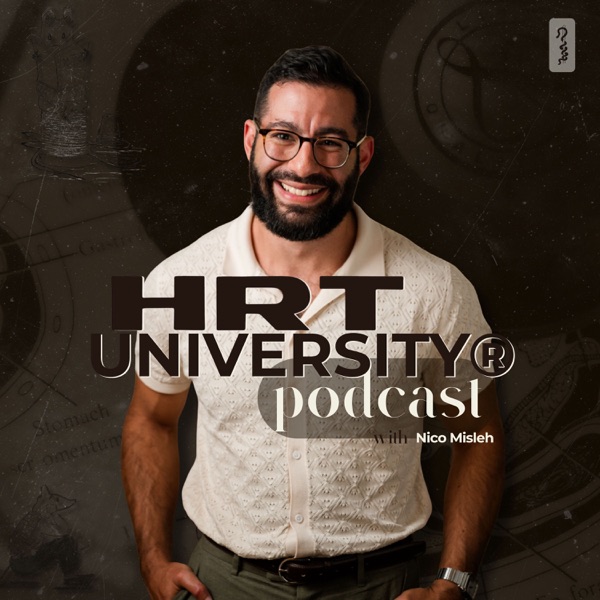
The HRT University® Podcast
Welcome to the HRT University® Podcast, where patient care meets the realities of building a thriving practice. Hosted by nurse practitioner and entrepreneur Nico Misleh, this podcast offers insights into hormone replacement therapy, cash-based clinics, and the business of wellness. Whether you're a provider navigating clinical care or an aspiring entrepreneur, Nico shares honest conversations, practical advice, and expert interviews to guide you. Tune in to redefine success for your patients and yourself.
Learn more about Nico and becoming an expert in HRT: https://bit.ly/4twBb0D
- Episodes
- 117
- Releases
- Weekly
- Typical length
- 40 min
- On air since
- 2024
- Latest episode
- 1 day ago
Episodes
117 episodes, newest first
-
38 min
Healthcare burnout: why a 30-patient day is a model problem
Episode 116
Show notes
On a good day she saw 30 patients. On a bad day, almost 40. She charted at home at night. A light day of 20 patients was the stressful one, because a string of them put her quarterly quota at risk.
In this episode, Nico Misleh, MSN, FNP-C makes the case that burnout in a high-volume clinic is usually a model problem. He is talking to NPs, PAs and MDs alike. He goes back to NP school, when he split his clinical hours between two physicians. One worked in an insurance-based family practice owned by a large company. The other ran his own cash-based practice. They saw the same kinds of patients with the same complaints, and the second physician's patients were getting better results.
The biggest difference was time. The cash-based physician had 20 or 30 minutes for a follow-up visit. She had maybe ten. A patient on levothyroxine asked her about desiccated thyroid. Afterward Nico asked why she did not prescribe it. She said it was a good question, and that she had never had the time to look into it. The volume model became the default because it is the only model most providers were ever shown. Better time management, earlier mornings and a scribe leave the structure underneath unchanged.
Then the practical side. Nico is not asking anyone to quit a job. Almost every provider he knows who made the shift kept a day job. They built a practice on evenings and weekends, from 10 patients a week to 20 and then 50. Then the day job became the side work. A private-pay model runs on fewer patients, longer visits and deeper clinical work. Patients will drive hours for care that no clinic near them offers.
If you have ever wondered whether the problem is you or the model, start with this episode.
The clinical depth a private-pay practice runs on is what the HRT University Master Course teaches. The course is jointly accredited by ACCME, ACPE and ANCC. Pinnacle Conference, LLC is the accredited provider, and HRT University plans and implements the course. Providers earn 30 CE hours, including 12 hours of pharmacology.
The Master Course is at https://bit.ly/4twBb0D
Find more episodes at https://hrtuniversity.com/hrtu-podcast/
Read the Second Opinion newsletter at https://nicomislehnp.kit.com/8050eeea5f
Join the provider community at https://www.facebook.com/groups/1179376819949373/
-
33 min
Clinical Reasoning in HRT: Why Principles Beat Protocols
Episode 115
Show notes
A patient sits down and tells you she is menopausal. She asks if you can help. You refer her out, because you are not sure you know this well enough. Then the voice in your head starts: maybe one more course.
In this episode, Nico Misleh, MSN, FNP-C makes the case that another course rarely fixes prescribing uncertainty, because the gap is in the quality of what providers were taught and the clinical reasoning it never built. A year or two into learning hormone therapy, he compared programs that ran from $200 to $7,000. Most taught the same dosing charts, similar lab reference ranges and the same candidate criteria under a new name. He bought one and finished it still uncertain.
Nico explains why. Much of HRT education is modeled on algorithm-driven medical training. Algorithms work for standardized problems like an appendectomy. Hormones and chronic care are more complex, and a protocol stops helping the moment a patient does not fit it. Information without a framework has nowhere to go, so another conference or course adds to the confusion. A physiology-first framework gives each new study a place to land, where it confirms, refines or corrects what you already know. Progesterone is his example. Most courses teach how to dose it. Very few teach what it is, what it does across the lifespan in men and women, or how it connects to other hormones.
Then the practical side. Nico answers the busy clinician who says there is no time for deeper study. Once the reasoning is in your head, decisions take seconds instead of a search through references, and the patient outside the protocol stops being a fresh source of doubt. Competency comes first, and confidence follows it. Mastery is never the sum of every course you have taken.
If you have patients you send elsewhere because you are not sure you know this well enough, this episode is for you.
Nico teaches this framework inside the HRT University Master Course, starting with energy, function and metabolism. The course is jointly accredited by ACCME, ACPE, and ANCC. Pinnacle Conference, LLC is the accredited provider, and HRT University plans and implements the course, so providers earn 30 CE hours, including 12 hours of pharmacology.
Master Course: https://bit.ly/4twBb0D
More episodes: https://hrtuniversity.com/hrtu-podcast/
Second Opinion newsletter: https://nicomislehnp.kit.com/8050eeea5f
Provider community: https://www.facebook.com/groups/1179376819949373/
-
44 min
Is HRT Safe? What to Tell Patients About Cancer and Clots
Episode 114
Show notes
Your patient is ready to start hormone therapy. Then she asks one question. My grandmother had breast cancer, so I can never take this, right? If the answer is not clear, she leaves. And she tells her family what she heard.
In this episode, Nico Misleh, MSN, FNP-C makes a case. Most of the safety questions patients bring to an HRT or TRT consult come from old data. He also argues that providers who can answer them calmly keep patients who would otherwise walk out. He works through the questions that stumped him early in practice and still catch providers today.
On the female side: why a family history of breast cancer is a risk factor to weigh. It is not a contraindication. Personal history and BRCA status matter more. Why the blood clot fear traces back to synthetic hormones, birth control pills and conjugated equine estrogen with progestins. Why a patient at 38 or 40 is not too young when symptoms and labs line up. Why waiting for 12 months without a period is a legacy rule.
On the male side: why lifestyle optimization and testosterone replacement are different projects. What TRT does to LH, FSH and spermatogenesis, and how hCG or enclomiphene keep fertility on the table. What the 2023 traverse trial found for major adverse cardiovascular events. How the saturation model replaced the 1941 Huggins hypothesis on prostate cancer. Why you should expect a small, stable PSA rise in the first 3 to 6 months of TRT.
Then the practical side. Nico reframes the question patients ask most: will I have to take this forever. His answer is replacement. It is not dependency. It sits in the same category as insulin or thyroid hormone. Stopping does not cause a rebound. Physiology returns to where it would have been without treatment. And he makes the case for answering these questions before the patient asks. Tell a man his PSA will rise before it does. Share the traverse data before his cardiologist raises it.
Some of your patients stall at the consult. Others start therapy and then hear doubt from family, friends or another provider. This episode is for you. It gives you the framework and the words to answer.
Nico teaches the physiology behind each of these answers inside the HRT University Master Course. The course is jointly accredited by ACCME, ACPE, and ANCC. Pinnacle Conference, LLC is the accredited provider, and HRT University plans and implements the course, so providers earn 30 CE hours, including 12 hours of pharmacology.
Learn more about the Master Course at https://hrtuniversity.com/hrtcourse/
Hear more episodes at https://hrtuniversity.com/hrtu-podcast/
Read the Second Opinion newsletter at https://nicomislehnp.kit.com/8050eeea5f
Join the provider community at https://www.facebook.com/groups/1179376819949373/
-
54 min
Leaving Your W-2 and What Year One Costs
Show notes
A W-2 feels safe. It is one client who can fire you.
That client can cut your role, change your comp model or sell the company, and your income goes with it. Ownership is not safer. It is a different risk profile.
In this episode, Nico Misleh, MSN, FNP-C makes the case that leaving a W-2 starts at home, long before the practice exists. He and Cherrell lived below their means, paid off every student loan, paid off their cars and drove them into the ground, and took no business loan. His rule is 12 months of household expenses in cash, kept separate from practice money. Months four through ten are usually the hard stretch. Patient volume runs slower than projected and the fixed costs keep coming. Every dollar of fixed monthly cost is a dollar of revenue you have to generate before you take any home.
Then the practical side. Decide which clinical problems you will solve better than anyone in your market. Set up the legal structure with an accountant or attorney. Know your state's practice authority and collaboration rules. Get malpractice coverage. Nico prefers occurrence-based over claims-made if you can afford it. Choose an EMR built for a small practice and a payment processor that handles cash pay.
A fully virtual practice can open for $3,500 to $5,000. Licensing across all 50 states runs closer to $15,000. A brick and mortar build-out with staff can run $50,000 to a quarter million, or more. At $200 a month, 20 to 50 patients on your panel is where it starts to work.
Year one is not the freedom year. Expect more hours than your W-2, and build so the practice can run without you from day one. Be frugal without being cheap.
If you are a prescriber weighing this move, start with your household numbers before you write a business plan.
The HRT University Master Course is clinical and does not teach practice setup. Practice ownership lives here on the podcast and on the blog. The course is jointly accredited by ACCME, ACPE, and ANCC. Pinnacle Conference, LLC is the accredited provider, and HRT University plans and implements the course, so providers earn 30 CE hours, including 12 hours of pharmacology.
See the clinical Master Course: https://hrtuniversity.com/hrtcourse/
Browse more episodes: https://hrtuniversity.com/hrtu-podcast/
Hear Cherrell's debt-free practice story in Ep 109: https://open.spotify.com/episode/2kS6UnxOpHDgWP7kY3KDBn
Get the Second Opinion newsletter: https://nicomislehnp.kit.com/8050eeea5f
Join the provider community: https://www.facebook.com/groups/1179376819949373/
Read more about practice ownership: https://hrtuniversity.com/hrt-blog/
-
53 min
Ferritin: The Iron Marker Nobody Reads Right
Episode 112
Show notes
A ferritin of 15 clears the reference range. The patient is still exhausted. She is shedding hair at the crown and the temples, her sleep is fine, and three providers have told her the CBC looks great.
In this episode, Nico Misleh, MSN, FNP-C makes the case that ferritin is the most useful iron marker a provider can order and one of the most consistently misread. Labs build those reference ranges from populations that include plenty of symptomatic people. The bottom of the range marks what is common, not what is well.
Serum iron is a snapshot. It moves with meals, time of day, and stress. TIBC and transferrin saturation tell you how many trucks are on the road and how full they are. Hemoglobin and hematocrit are the finished product, and by the time those two drop the deficiency has been running for months.
The window Nico wants providers to catch is iron deficiency without anemia. Storage is falling, the CBC still looks clean, and the symptoms have already started. He walks the mechanism. Iron carries oxygen. It is a cofactor for thyroid peroxidase, so low iron blunts T4 to T3 conversion. Starve the cell of iron and it cannot run oxidative phosphorylation properly, so it drops toward inefficient glycolysis. That is why fatigue, air hunger, hair shedding, restless legs, and low mood show up together. It is also why providers file them under anxiety, low progesterone, or low testosterone instead.
Then the practical side. The ferritin levels Nico treats to in women and in men. Why heavy cycles and blood donation outrun anything a diet can replace. How low stomach acid, PPIs, and chronic inflammation shut down absorption at the gut wall through hepcidin. Why patients abandon ferrous sulfate and stay on iron bisglycinate. What the current evidence says about alternate day dosing. And how to work up a ferritin of 300 without assuming overload.
If you have patients on well dosed hormones who still report exhaustion, check iron before you change the dose. Hormones cannot do their work when the substrate is missing.
Nico teaches ferritin in depth inside the HRT University Master Course. The course is jointly accredited through Pinnacle Conference, LLC, with ACCME, ACPE, and ANCC accreditation, and providers earn 30 CE hours, including 12 hours of pharmacology.
Master Course: https://hrtuniversity.com/hrtcourse/
More episodes: https://hrtuniversity.com/hrtu-podcast/
Second Opinion newsletter: https://nicomislehnp.kit.com/8050eeea5f
Provider community: https://www.facebook.com/groups/1179376819949373/
-
41 min
Postpartum Psychosis Is an Endocrine Event
Episode 111
Show notes
A labor and delivery nurse was prescribed 13 psychiatric medications over four months. This is the Lindsay Clancy case. This episode asks a hard question: could thyroid screening and a hormone-aware postpartum plan have caught something during those months of psychiatric prescribing, when no one addressed the underlying hormone shift?
Postpartum psychosis affects 1 to 2 women per 1,000 births. Onset is fast: usually within the first two weeks, often within 72 hours. It looks nothing like the slower build of postpartum depression. Confusion, mania, disorganized thought, sometimes delusions. Risk is higher with a history of bipolar disorder, prior postpartum psychosis, a family history of bipolar disorder, or autoimmune disease, including thyroiditis. It remains a psychiatric emergency that requires hospitalization. Nico Misleh, MSN, FNP-C, walks through why current thyroid and hormone screening misses the shift that begins in the first 48 hours after delivery.
Progesterone falls from roughly 100 to 150 ng/mL at term to near zero within 48 hours of delivery. Allopregnanolone, the progesterone metabolite that acts on GABA-A receptors, falls with it. The FDA has approved two drugs built on that mechanism for postpartum depression: brexanolone in 2019 (since withdrawn from the market) and zuranolone in 2023. Misleh frames progesterone to soften that crash in high-risk women, not to treat psychosis once it starts, as mechanism-based and off-label, with no controlled trials behind it yet. He also makes the case for a full postpartum thyroid panel: TSH, free T4, free T3, and TPO antibodies. A single TSH at six weeks misses the picture.
Nico Misleh, MSN, FNP-C, hosts the HRT University Podcast. Recorded before the September 4, 2026 mistrial in the Clancy case.
-
1 hr 14 min
TRT and Fertility: The Myth That Keeps Young Men Untreated
Episode 110
Show notes
Zach's testosterone came back at 302, in a range that runs from 300 to 1000, and his endocrinologist told him he was fine. He had brain fog, no energy, and no sex drive. In his words, she was judging him off an app.
On this episode, Nico Misleh, MSN, FNP-C, talks with Zach, a patient and a friend. Zach gives the side of this story providers rarely hear firsthand.
They talk about a belief that keeps young men out of care, the idea that testosterone ends fertility. Zach started treatment anyway. He came off testosterone before herniated disc surgery. He restarted his own production on Clomid, and his numbers were back within about 90 days. He has a 15 month old now, and another on the way. Nico explains why he moved away from Clomid. He also thinks that leaving a symptomatic man untreated for a decade causes more harm than treating him.
Zach is just as clear about what testosterone did not fix. A hard stretch at work was a work problem, not a dose problem, and no amount of testosterone changed that.
If you have young men asking about testosterone and fertility in the same visit, this conversation gives you the patient's side of it.
Male testosterone therapy is module two of the HRT University Master Course. The course is jointly accredited through Pinnacle Conference, LLC, with ACCME, ACPE, and ANCC accreditation, and providers earn 30 CE hours, including 12 hours of pharmacology.
The Master Course, the podcast archive, the Second Opinion newsletter, and the provider community are all linked below.
Master Course: https://hrtuniversity.com/hrtcourse/
More episodes: https://hrtuniversity.com/hrtu-podcast/
Second Opinion newsletter: https://nicomislehnp.kit.com/8050eeea5f
Provider community: https://www.facebook.com/groups/1179376819949373/
-
1 hr 2 min
How to Start an HRT Clinic Debt Free: Savings First, Staff Later
Season 1, Episode 109
Show notes
Nico Misleh sits down again with his wife, Cherrell, who runs the money and operations side of Apollo Health Optimization and HRT University, to talk about what it actually takes to build a business together without going into debt.
They dive into how they opened their first clinic with savings instead of loans, why they waited to hire their first administrator until the revenue could cover her salary, and how they set a runway before Nico left his 1099 job. Cherrell shares her perspective on running the books, why she needed the five o'clock rule more than Nico did, and how they protect family time when the business starts asking for more.
They also discuss why Nico believes a business acts like a member of your family whether you plan for it or not, why a spouse needs an honest picture of how the practice is doing, and what success looks like once the money question is settled.
Whether you're getting ready to open your own clinic, already running one, or just curious how we divide it all up at home, this episode is an honest look at what has worked for us and what we've had to figure out along the way.
If you have questions for Cherrell, come find us in the Facebook group!
The HRT University® Master Course is jointly accredited through Pinnacle Conference, LLC (ACCME, ACPE, ANCC). Earn 30 CE hours, including 12 hours of pharmacology.
Master Course: https://hrtuniversity.com/hrtcourse/
More episodes: https://hrtuniversity.com/hrtu-podcast/
The Second Opinion Newsletter: https://nicomislehnp.kit.com/8050eeea5f
Provider community: https://www.facebook.com/groups/1179376819949373/
-
1 hr 14 min
Low Testosterone and Depression: A First Responder’s Story
Show notes
This episode includes discussion of PTSD, suicidal ideation, and alcohol use.
Garrett spent 18 years as a deputy sheriff and police officer, all of it on night shift. Over that career he was part of about a dozen calls involving dead children. He gave CPR to an eight week old and lost. He never took a day for any of it. There was no policy in his agency that offered one, and no version of asking that did not feel like a risk to his badge.
It caught up with him when he had his own kids. He would hold his baby and start to come apart. He describes the thought that stayed with him: if a monster broke into my house I would destroy that monster, so what happens when you are the monster in the house. He says plainly that he was getting suicidal. His wife gave him an ultimatum, and he spent the next four years in therapy without telling his agency, his parents, or anyone but her. He refused psychiatric medication the whole way. Partly the fear of feeling like a zombie, partly that his dreams were already bad enough that he would not gamble on what a medication might do to them, and partly something prescribers rarely think about. He carried a firearm, and nobody could tell him what being on something would mean for a drug screen after a critical incident or a fitness for duty review.
Somewhere in there his primary care ran a testosterone level and told him he was fine. Nobody mentioned there was a second number. Nobody drew a free testosterone. He closed that door and left it closed for years. When he and Nico Misleh, MSN, FNP-C finally met, the fuller workup came back with low vitamin D, very low B vitamins, and a testosterone level Nico described to him at the time as lower than a 75 year old man would carry.
Nico walks his read of why. Years of head trauma from martial arts, football, car accidents with airbags, and the physical side of the job. Inflammation that started acute and became chronic. Eighteen years of nights. Sleep the PTSD was already wrecking, so no recovery anywhere in the system. His conclusion is that the signaling between the brain and the testicles had been degraded by all of it at once, which is exactly the picture a single total testosterone will not show you.
Garrett is honest about the timeline. He expected to wake up a racehorse and the first weeks were quieter than that. What shifted first was not energy, it was the dreams. Four to five years on he says he has not had one of the bad ones in about a year, and he credits the testosterone, the vitamin repletion, and the therapy together, not any one alone. Nico is equally clear on the limits. This is a tool, not a cure, and he has watched it go the other direction in men who are not doing the work on the other side.
Garrett has the plainest line in the episode, and it is aimed at providers. Most of these guys and girls are not trying to get jacked. They just want to be able to sleep at night.
Male testosterone therapy is module two of the HRT University Master Course.
The Master Course is jointly accredited through Pinnacle Conference, LLC (ACCME, ACPE, ANCC). Earn 30 CE hours, including 12 hours of pharmacology.
Master Course: https://hrtuniversity.com/hrtcourse/
More episodes: https://hrtuniversity.com/hrtu-podcast/
The Second Opinion Newsletter: https://nicomislehnp.kit.com/8050eeea5f
Provider community: https://www.facebook.com/groups/1179376819949373/
-
42 min
Testosterone for Women and Men: What Providers Should Order
Episode 107
Show notes
Testosterone is the hormone nobody checks in women. Nico Misleh, MSN, FNP-C sat in an OB-GYN office with his wife not long ago and watched it play out. Nobody ordered it. It did not come up. He checks it on every female patient he has, his students all check it, and inside that bubble it starts to feel like standard practice. It isn't.
So the first half of this episode is women. Testosterone isn't a male hormone that women happen to carry a little of. They have it by design. It's doing work on lean body mass, on body composition, on cognition and mental clarity, on drive through a dopaminergic pathway, on libido. Bone too. It has effects on bone mineral density that don't run through estrogen, and progesterone does the same thing to bone, so this isn't a testosterone-only story. The woman on estradiol and progesterone can be a lot better and still not be all the way there. Her hot flashes eased and her sleep improved. Her libido is still flat, and she can't hold muscle no matter how hard she trains. That's frequently a testosterone story, and it stays unnamed. Testosterone did not come up once in his own NP program. Not for women, not for men.
Androgenic side effects come up. They're real at supraphysiologic doses and uncommon at replacement doses handled carefully. The reference range is the harder problem. It was built on a population that includes symptomatic women, so it can tell you what's typical and it can't tell you what's optimal. His line: we're the cardiologists who never got taught how to use an EKG.
Men get the second half. His position is that testosterone is still under-prescribed in men, and that where it does get prescribed, it's often done badly. Total testosterone is probably the least useful number on the panel. Free testosterone is what the cell can actually use. SHBG is the little protein he calls a Pac-Man, binding testosterone up and holding it hostage where tissue can't reach it, and in his opinion you can't interpret a testosterone level without it. He walks a case. Total of 5 or 600, SHBG north of 100, free testosterone nobody ordered. That man has low testosterone and it will never show up on paper, because the value that would have caught it was never drawn. Nico is plain about not having known what SHBG was either. In his words, we're all in this boat together.
Then the hands-on stretch. Intramuscular versus subcutaneous and what the head-to-head data actually showed, needle gauge and length, post-injection pain and how to settle it, compounded creams and gels, why he isn't a fan of pellets in either sex, and the dosing philosophy he teaches. You aim for the maximum effective dose, not the smallest one that moves a lab value, because you're restoring a molecule the body already makes.
Male testosterone therapy is module two of the HRT University® Master Course. Testosterone in women is the testosterone section of module three, the female module. SHBG runs through both.
The Master Course is jointly accredited through Pinnacle Conference, LLC (ACCME, ACPE, ANCC). Earn 30 CE hours, including 12 hours of pharmacology.
Master Course: https://hrtuniversity.com/hrtcourse/
More episodes: https://hrtuniversity.com/hrtu-podcast/
The Second Opinion Newsletter: https://nicomislehnp.kit.com/8050eeea5f
Provider community: https://www.facebook.com/groups/1179376819949373/
-
41 min
Progesterone for Men and Women: Why the Uterus Was Never the Point
Season 1, Episode 106
Show notes
Progesterone gets filed under women's health, and inside that, under uterine health. Nico Misleh, MSN, FNP-C argues that both filings are too narrow and that a provider prescribing progesterone only for endometrial protection is working with roughly a quarter of the picture.
The mechanism he builds the episode on is allopregnanolone. Progesterone converts through 5-alpha reductase into a neurosteroid that acts as a positive allosteric modulator at GABA-A receptors. GABA is the brake of the brain. When progesterone falls, that braking capacity falls with it, which is why anxiety, irritability, and fractured sleep tend to arrive in the same patient. He also separates progesterone from progestins, since medroxyprogesterone acetate is testosterone-derived, cannot convert to allopregnanolone, and binds androgen, glucocorticoid, and mineralocorticoid receptors, which is where its side effect profile comes from.
Then he turns to men. Men make progesterone. Nico covers neuroprotection, sleep through that same pathway, cortisol buffering, and prostate tissue, along with the presentations where he reaches for it most: anxiety, traumatic brain injury, PTSD, and BPH. Male dosing is not female dosing, and he is candid that his own hesitation kept him from using it for years.
If you have men with optimized testosterone and thyroid who still sleep badly and still feel wired, this is the variable worth adding to the picture.
Progesterone is taught in depth across the advanced female and adjunct hormone modules of the HRT University Master Course.
The HRT University® Master Course is jointly accredited through Pinnacle Conference, LLC (ACCME, ACPE, ANCC). Earn 30 CE hours, including 12 hours of pharmacology.
Master Course: https://hrtuniversity.com/hrtcourse/
More episodes: https://hrtuniversity.com/hrtu-podcast/
Nico's clinical email: https://nicomislehnp.kit.com/8050eeea5f
Provider community: https://www.facebook.com/groups/1179376819949373/
-
39 min
Hair Loss and DHT, Why DHT Is Not the Real Problem
Episode 104
Show notes
DHT gets blamed for hair loss more than almost anything else, and Nico Misleh, MSN, FNP-C thinks that blame is misplaced. In this episode he makes the case that dihydrotestosterone is not the villain it has been made out to be. It is a necessary hormone that keeps doing real work long after puberty, and for a patient who is losing hair it is usually a downstream signal rather than the thing actually driving the problem.
DHT does bind androgen-sensitive follicles and it does play a part in miniaturization. That piece is real. The question that almost never gets asked is why 5-alpha reductase, the enzyme that turns testosterone into DHT, is running high in the first place. That is where the clinical opportunity lives. Nico ties elevated 5-alpha reductase back to what he teaches inside the Big Five of metabolic dysfunction: insulin resistance and hyperinsulinemia, chronic inflammation, histamine, cortisol, and low thyroid function. Hair loss turns out to be one more way that same broken terrain shows itself.
He also clears up something that often gets taught backward. Estrogen does not push 5-alpha reductase up on its own. In a healthy balance it holds it down. It is estrogen dominance, dragging progesterone lower and pushing blood sugar higher, that moves the needle. That is also why a serum DHT value can point you the wrong way, and why Nico leans on fasting insulin, free T3, cortisol, and a hard look at gut and metabolic health instead. Improve the terrain and DHT often settles on its own.
Then he gets practical. Why he will not put a patient, man or woman, on oral finasteride or dutasteride after seeing what post-finasteride syndrome can do. Where low-dose topical finasteride and minoxidil honestly land, and where they fall short. And the pro-metabolic route he actually uses, including the compounded hair serum he built around progesterone, caffeine, melatonin, and thyroid to outcompete DHT at the follicle and calm the inflammation while supporting the energy a follicle needs to grow. It is slow work, so give it three to six months before you judge it.
If you have a patient stuck getting the same block-DHT answer over and over, this episode hands you a better way to read the case. Hair loss is a symptom worth listening to, not just a part of getting older.
Hair loss sits inside Nico's Big Five framework, the backbone of Module 1 in the HRT University Master Course.
Read the full article: https://hrtuniversity.com/dht-causes-hair-loss/
More episodes: https://hrtuniversity.com/hrtu-podcast/
The HRT University Master Course is jointly accredited through Pinnacle Conference, LLC (ACCME, ACPE, ANCC). Earn 30 CE hours, including 12 hours of pharmacology.
Master Course: https://hrtuniversity.com/hrtcourse/
Nico's weekly clinical email: https://nicomislehnp.kit.com/8050eeea5f
Provider community: https://www.facebook.com/groups/1179376819949373/
-
42 min
Cortisol and Hormones, a Signal Not the Problem
Episode 104
Show notes
Cortisol is one of the most misunderstood hormones in practice, and one of the most over-tested. In this episode, Nico Misleh, MSN, FNP-C makes the case that cortisol is a signal, not the root problem. You rarely need to measure it directly. What you do need to understand is what chronic cortisol is quietly doing to every hormone you're trying to optimize.
Nico walks through the mechanism. Chronically elevated cortisol tanks free testosterone in men through competition at the hypothalamic level and blunted GnRH signaling. In women it suppresses ovulation and shortens the luteal phase, and that is the real reason progesterone stays low, not the old pregnenolone steal theory. It shunts T4 away from free T3 toward reverse T3, which is why a normal TSH tells you so little and free T3 tells you almost everything. Over time it dysregulates blood sugar, drives visceral fat, and feeds a slow inflammatory flywheel.
Then the practical side. Why serum and salivary cortisol testing so often fail to line up with how a patient actually feels. Why cortisol dysfunction is almost always downstream of a broken metabolic environment. And what Nico treats instead: the terrain itself, thyroid and free T3, the sex hormones, gut and metabolic health, sleep, stress load, and eating patterns, with HRT as the backbone of that restoration. This is not an adrenal fatigue protocol.
If you have a few patients who never quite respond to HRT the way the rest do, cortisol belongs on your differential, not as a lab to run, but as a lifestyle and metabolic picture to read.
Cortisol sits inside Nico's Big Five framework, the organizing model of Module 1 in the HRT University Master Course.
The HRT University® Master Course is jointly accredited through Pinnacle Conference, LLC (ACCME, ACPE, ANCC). Earn 30 CE hours, including 12 hours of pharmacology.
Master Course: https://bit.ly/4twBb0D
Nico's weekly clinical email: https://nicomislehnp.kit.com/8050eeea5f
Provider community: https://www.facebook.com/groups/1179376819949373/
-
40 min
Seed Oils and Your Patients’ Hormones: The PUFA Problem Behind Stalled HRT
Season 1, Episode 103
Show notes
You have a patient who is doing everything right on paper. Hormones optimized, sleep handled, xenoestrogen exposure coming down. And still the weight will not move, the thyroid numbers look off, and the inflammation lingers. In this episode Nico Misleh, MSN, FNP-C, makes the case that the missing variable is often sitting in the patient’s diet: seed oils, and the polyunsaturated fatty acids, or PUFAs, they deliver.
Seed oils are the base fat in nearly every processed and restaurant food, and per capita linoleic acid intake has roughly tripled since the early 1900s. Nico walks through why that matters at the level of the cell. Using the cast iron versus stainless steel analogy from Module 1, he explains how PUFAs oxidize, form oxidized linoleic acid metabolites known as OXLAMs, and damage the mitochondria that every steroid hormone depends on. When mitochondria leak energy, cells drop from oxidative phosphorylation into inefficient glycolysis, progesterone and pregnenolone synthesis falls, thyroid signaling suffers at the receptor, and aromatase climbs. This is PUFAs, number four of the Big Five, and it compounds with endotoxin, cortisol, estrogen, and serotonin.
He also separates what is mechanistically settled from what the clinical trial literature has not yet caught up to, explains why linoleic acid stored in fat has a half life close to two years, and shows how to raise diet with patients without tipping them into fear. This is the mechanism-first explanation for why some patients stall on a textbook HRT protocol, and what to do about it.
Hosted by Nico Misleh, MSN, FNP-C, founder of HRT University. The HRT University® Podcast is provider-facing hormone education grounded in physiology and mechanism. For the full framework, including the PUFA and Big Five sections in Module 1, explore the HRT University Master Course, jointly accredited through Pinnacle Conference LLC (ACCME, ACPE, ANCC).
Master Course: https://bit.ly/4twBb0D
Newsletter: https://nicomislenp.kit.com/8050eeea5f
Provider community: https://www.facebook.com/groups/1179376819949373/
-
36 min
Early Puberty and Xenoestrogens: What It Means for Your HRT Patients
Episode 102
Show notes
A century ago the average girl reached her first period at 16 or 17. Today it is closer to 12, and breast development is turning up routinely at 6, 7, even 8 years old. Genetics do not move that fast. Something in the environment is switching the reproductive axis on years ahead of schedule, and in this episode Nico Misleh, MSN, FNP-C, makes the case that the driver is xenoestrogens, and that it lands directly in your exam room.
Xenoestrogens are estrogens from outside the body: the parabens, phthalates, pesticides, plastics, fragrances, and even some essential oils that bind estrogen receptors closely enough that the receptor cannot reliably tell them apart from the real thing. Exposure begins in utero and never fully stops, so it is both continuous and cumulative. Nico connects that early and prolonged estrogen signaling to the patients now arriving in HRT clinics in their 20s and 30s with pronounced estrogen dominance and progesterone deficiency, at times more severe than the perimenopausal patients down the hall.
He reframes age of menarche and environmental exposure history as clinical variables that belong on the intake form, explains why some patients fail to respond to progesterone because of receptor competition rather than a dosing problem, and walks through the exposure-reduction conversation that lets the hormones you prescribe actually win at the receptor. This is the lifespan view of the Big Five: the same xenoestrogen load that pulled puberty early keeps shaping estrogen dominance, PCOS, and endometriosis in adults.
Hosted by Nico Misleh, MSN, FNP-C, founder of HRT University. The HRT University Podcast is provider-facing hormone education grounded in physiology and mechanism. For the full clinical framework, including the xenoestrogen section in Module 1, explore the HRT University Master Course, jointly accredited through Pinnacle Conference LLC (ACCME, ACPE, ANCC): https://bit.ly/4twBb0D
Newsletter: https://nicomislenp.kit.com/8050eeea5f
Provider community: https://www.facebook.com/groups/1179376819949373/ -
42 min
The Estrobolome: How Your Patient's Gut Is Recycling Estrogen
Episode 101
Show notes
You have seen this patient. Her estrogen reads optimal. You have checked it two or three times. And she is still bloated, still constipated, still dealing with breast tenderness, heavy bleeding, and the irritability that shows up like clockwork before her period. The labs say one thing. The woman in front of you says another.
In this episode, Nico Misleh, MSN, FNP-C breaks down the estrobolome: the collection of gut bacteria and bacterial genes that decide whether estrogen leaves the body or gets sent back into circulation. The liver does its job. It conjugates estrogen and packages it for excretion through bile and stool. Then beta-glucuronidase, produced by a disrupted microbiome, cleaves that package open and frees the estrogen to reabsorb through the gut wall and travel back to the liver. This is enterohepatic recirculation, and it is a problem of accumulation. It builds quietly for years, then surfaces as estrogen dominance, PCOS, PMDD, fibroids, and elevated breast cancer risk.
Nico connects the mechanism to what you can actually do. Why industrialized guts carry higher beta-glucuronidase capacity. Why a menopausal woman can run higher circulating estrogen than expected with no progesterone to counterbalance it. Why a patient who reacts to a low dose of estrogen may have a gut problem, not a dosing problem. Then he walks through the targeted interventions he reaches for first: the raw carrot, coffee and gut motility, glycine and taurine for phase two liver detoxification, and the role of progesterone and thyroid in clearing estrogen instead of recycling it.
HRT University is a physiology-first clinical education program for licensed providers. Jointly accredited through Pinnacle Conference LLC (ACCME, ACPE, ANCC) for 30 CEUs.
Learn more about the Master Course: https://bit.ly/4twBb0D HRTU Newsletter: https://nicomislenp.kit.com/8050eeea5f Join the HRT University Facebook Group: https://www.facebook.com/groups/1179376819949373/
-
43 min
PCOS Is Now PMOS, What the Rename Means
Episode 100
Show notes
Polycystic ovary syndrome is no longer called polycystic ovary syndrome. A landmark consensus study in The Lancet, built on 22,000 clinicians and patients across 11 years of global consultation, has renamed the condition polyendocrine metabolic ovarian syndrome, or PMOS. The cysts were never the story. The metabolism was. The hormones were. The gut was.
In our 100th episode, Nico Misleh, MSN, FNP-C breaks down what the rename actually means. Why the old name pointed providers toward the wrong organ and the wrong mechanism. Why so many women with every sign of the condition were told they did not have it because their ovaries looked clear. And why the framework HRT University has taught from the start, relative estrogen dominance layered on sluggish detoxification, gut-driven estrogen recycling, compromised thyroid, and a metabolic engine forced into glycolysis, is the same physiology the new name finally reflects.
If you have been treating PCOS the way you were taught and something never sat right, this episode is the reframe. The name changed. The mechanism did not.
The HRT University Master Course is jointly accredited through Pinnacle Conference, LLC (ACCME, ACPE, ANCC). Earn 30 CE hours, including 12 hours of pharmacology.
Master Course: https://bit.ly/4twBb0D
Nico's weekly clinical email: https://nicomislehnp.kit.com/8050eeea5f
Provider community: https://www.facebook.com/groups/1179376819949373/
-
33 min
How to Market a Medical Practice: Email, Social Media, and Storytelling
Episode 99
Show notes
You hired a logo designer, picked your brand colors, maybe even named your clinic something clever. And now you are ready to hand the whole thing to an ad agency and watch the patients roll in. Except that is not how it works. Not even close.
In this episode, Nico Misleh, MSN, FNP-C walks through how to market a medical practice from scratch, and why spending money on agencies before you have done the foundational work is one of the fastest ways to burn cash as a new practice owner. He talks about the daily email practice that shaped his own voice over eighteen months, the Facebook group strategy that builds community without feeling like a sales pitch, and why your social media content is probably talking to your colleagues instead of your patients.
He also breaks down the esthetics example that keeps showing up in provider marketing: the Moxi 3000 announcement that impresses other clinicians and confuses every cold lead who reads it. Then he flips it into a story-driven version that actually speaks to the patient sitting on the other side of the screen.
If you have been wondering why your content is not converting or why your marketing feels like it is missing something, this episode lays out the organic playbook that comes before the ad spend.
HRT University is a physiology-first clinical education program for licensed providers. Jointly accredited through Pinnacle Conference LLC (ACCME, ACPE, ANCC) for 30 CEUs.
Learn more about HRT University: https://bit.ly/4twBb0D
HRTU Newsletter: https://nicomislenp.kit.com/8050eeea5f
Facebook Group: https://www.facebook.com/groups/1179376819949373/
-
35 min
The Cash-Pay HRT Practice: What Actually Works
Episode 98
Show notes
This week I'm switching from clinical to business. I want to talk about the stuff nobody told me when I was building my own clinic. Apollo Health Optimization is three years in now, and it's been the best decision of my life, professionally and personally. Most providers approach building a cash-pay HRT clinic backwards. They start with the brand, the marketing, the website, and treat the clinical work as something they'll catch up on once patients are flowing in. The clinical foundation is not a prerequisite for the business. It IS the business.
In this episode I walk through the mug analogy, the surgeon analogy, why patients can feel the difference between real clinical mastery and the performance of it, and why my friend Ashley got 200 patients in her first year doing almost no traditional marketing. I get into the donut-shop comparison for why word of mouth runs medicine, the brick-and-mortar to virtual transition I made at Apollo, why geography is now irrelevant for a cash-pay HRT clinic, and the predatory equipment sales and marketing agencies you should not be writing checks to in year one. I close with the four-step sequence I'd follow if I were starting today: clinical mastery, then reps with patients, then a practice model that emerges from the clinical work, then the brand on top of all of it.
If you're a provider weighing the move out of insurance, or you've already made it and the practice isn't building the way you thought it would, this one is for you.
00:00 Switching from clinical to business, the stuff nobody told me01:32 Apollo three years in, the best decision of my life02:14 The Field of Dreams approach and why providers get it backwards04:08 The clinical foundation IS the business05:10 The mug analogy06:46 Built on clinical depth, no traditional marketing07:11 The surgeon analogy, why patients can feel confidence08:30 My friend Ashley and 200 patients in year one08:57 What happens when you fake it for too long09:41 My NP school primary care rotation11:54 Studying hormones obsessively, building the framework12:33 Hormones as a symphony, not separate parts14:26 Word of mouth in medicine vs. the donut shop16:40 Patients call it Nico's Place18:59 The brick-and-mortar to virtual transition20:31 Geography is irrelevant, patients fly in from everywhere22:53 Predatory laser and ultrasound reps23:56 Step one of the sequence: clinical foundation, for real25:01 Step two: actually treat patients, competency builds confidence27:10 Step three: let the practice model emerge from the clinical work29:04 Step four: build the brand last, the whiteboard story31:20 Mastery, practice model, marketing, in that order
The HRT University(R) Master Course is jointly accredited through Pinnacle Conference LLC (ACCME, ACPE, ANCC) for 30 CE hours including 12 hours of pharmacology. Course: https://bit.ly/4twBb0D. Newsletter: https://nicomislenp.kit.com/8050eeea5f. Community: https://www.facebook.com/groups/1179376819949373/.
About the host. Nico Misleh, MSN, FNP-C, is a nurse practitioner, the founder of HRT University, and the owner of Apollo Health Optimization.
-
34 min
Birth Control is Not Treatment: What Providers Should Use instead
Episode 97
Show notes
A 16-year-old walks into your office with acne and walks out with a birth control script. So does the 28-year-old with heavy periods, the 35-year-old with PMS, and the 42-year-old with migraines. Same prescription for almost every female symptom that touches the cycle. Most of us write it without thinking, and most of us were trained to.
In this episode, Nico Misleh, MSN, FNP-C makes the case that birth control isn't medicine for any of those things. It's medicine for pregnancy prevention. For everything else we use it for, it's suppression, and it costs the patient the diagnostic information you needed to actually treat what's wrong. He walks through what hormonal contraception is doing to the HPO axis, why synthetic progestins aren't the same compound as bioidentical progesterone, and what a real PCOS (now renamed PMOS) workup looks like when the pill isn't the first move. He's also honest about the cognitive dissonance providers run into when they realize the prescription they've written thousands of times might not have been the right call, and reframes that moment as the start of better practice, not a verdict on what came before.
The HRT University Master Course is jointly accredited through Pinnacle Conference LLC (ACCME, ACPE, ANCC) and offers 30 CE credits across six modules, including the Female and Advanced Female sections that cover hormonal contraception, bioidentical progesterone, and PMOS in clinical depth.
Explore the Master Course: https://bit.ly/4twBb0D
Join the Free Newsletter: https://nicomislenp.kit.com/8050eeea5f
Facebook Community: https://www.facebook.com/groups/1179376819949373/
Website: https://hrtuniversity.com
Follow HRT University on Instagram: @hrtuniversity
Standard Links
Medicine lists
More Medicine shows picked out from the charts


More in Medicine
Placed highest on Apple Podcasts' Medicine chart right now