Podcast
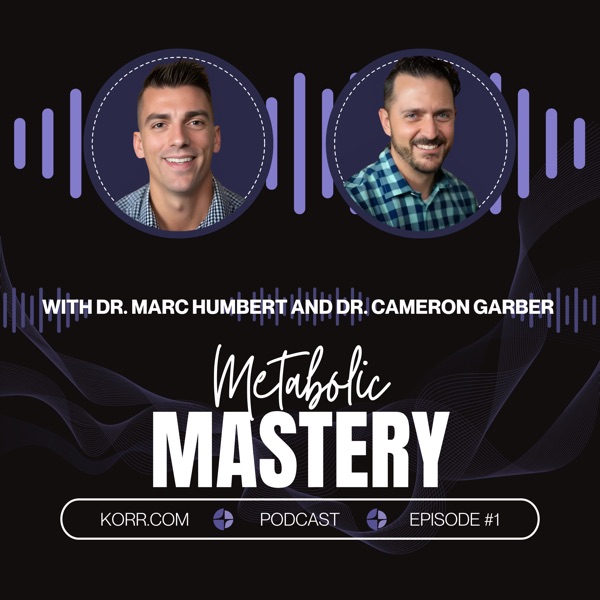
Metabolic Mastery
Metabolic Mastery, brought to you by KORR Medical Technologies, is the podcast about everything VO2 Max and beyond. Tips on testing, new research, and much more. Hosted by Dr. Marc Humbert and Dr. Cameron Garber Doctors of Physical Therapy (DPT)
- Episodes
- 79
- Releases
- Weekly
- Typical length
- 1 hr 5 min
- On air since
- 2025
- Latest episode
- 19 hours ago
Episodes
79 episodes, newest first
-
53 min
Ep 78: Dr. Gains (Michael Kamalu): Why Generic Workouts Fail: The Science of Personalized Training
Show notes
Most fitness advice was written for the “average body,” and nobody is average from head to toe. In this episode of Metabolic Mastery, hosts Dr. Marc Humbert and Dr. Cameron Garber sit down with Michael Kamalu, founder of Dr. Gains, to explain why generic workouts fail and what truly personalized training looks like.
Michael shares his path from a skinny eighth-grade basketball player with a string of injuries to Mayo Clinic Medical School, and how that led him to build tools and a facility around one idea: your training should match your anatomy, your metabolism, your goals, and your constraints.
They cover how body proportions and even the number of lumbar vertebrae change how you should lift, why the “best” recovery tool depends on your goal, and how diagnostics like metabolic testing can feed a plan built for you. They also get into blood flow restriction training, rotational loading, and why muscles grow unevenly.
You Will Learn:
• Why generic fitness advice is written for the “average body,” and how anatomical variations (like having four, five, or six lumbar vertebrae) change how you should squat and lift
• How limb proportions affect the load your muscles actually feel, and why comparing lifts between two people can mislead you
• Why the same recovery tool can help one goal and hurt another, such as a cold plunge after training helping strength but potentially blunting muscle growth
• How metabolic testing, muscle function testing, and other diagnostics can combine into one personalized plan instead of ten disconnected opinions
• Why “perfect” training and recovery plans fail if they don’t fit your life, your timeline, and your constraints
• How blood flow restriction (BFR) training lets you build size, strength, and endurance with lighter weights, and why measuring arterial occlusion pressure matters
• Why rotational training is missing from most routines, and how it ties to rotator cuff health and injury prevention
• How regional muscle activation works, and why varying your exercises prevents weak points and injuries
• Why muscles adapt faster than tendons and joint capsules, and how to train for long-term resilience instead of short-term gains -
1 hr 8 min
Ep. 77: More Data Isn’t Better: Making Sense of Metabolic Test Results
Show notes
Get A Demo: https://korr.com/contact/video-demo/
Metabolic testing can feel overwhelming, but it starts with just four measurements.
In this episode of Metabolic Mastery, hosts Dr. Marc Humbert and Dr. Cameron Garber walk through how the cardio coach turns oxygen, carbon dioxide, flow, and heart rate into a deep physiological picture.
They sort that data into tiers of reliability, from directly measured values to estimates, and explain how to troubleshoot a test that looks “wrong.” Then they bring it back to simplicity: how to turn complex results into small, sustainable changes that fit a client’s real life, using frameworks like the aggregation of marginal gains and frequency, duration, then intensity.
You Will Learn:
• The four core measurements behind every test (O2, CO2, flow, and heart rate) and how they produce dozens of outputs
• Why a fixed-orifice differential pneumotach with no moving parts keeps flow measurement accurate without constant recalibration
• The tiers of data reliability: measured values, calculated values, values using known constants, estimates, thresholds, and normative comparisons
• Why a measured RMR beats predictive equations, which can be off by 200-400 calories either way
• Why “the numbers have to be wrong” is usually a setup, protocol, or client-prep issue, and the fasted, rested, unstimulated rule of thumb for reliable baselines
• How aerobic and anaerobic thresholds are frameworks applied to real physiological inflection points, not single measured values
• Why a high VO2 max that is dropping can be a worse sign than a lower one that is climbing, using a real client example
• How to turn complex data into a simple plan with the aggregation of marginal gains and the “90% confidence” test for any new habit
• Why to build frequency first, then duration, then intensity, and how to meet each client where they are -
1 hr 15 min
Ep. 76: Heart Rate Zones Explained: Why Zone 2 Means Different Things to Everyone
Show notes
Get A Demo: https://korr.com/contact/video-demo/
Heart rate zones might be the most misunderstood concept in fitness — and in this episode of Metabolic Mastery, hosts Dr. Marc Humbert and Dr. Cameron Garber take a deep dive into exactly why.
From elite Olympic athletes using completely different zone systems to say the same thing, to the century-old misunderstanding behind "anaerobic threshold," they break down how heart rate zones are actually derived, why physiology is a continuum rather than an on/off switch, and how to use testing data (not guesswork or wearable estimates) to train for the adaptations that actually matter.
You Will Learn:
• Why "zone 2" means something completely different depending on whether you're using a 3-zone, 4-zone, or 5-zone system — and why that causes so much confusion online
• The real story behind "aerobic" and "anaerobic" thresholds, and why lactate is actually produced continuously, even aerobically
• Why percentage-based zoning (like 220-minus-age or % of VO2 max) can lead to large individual errors compared to physiology-based zoning
• Why wearable VO2 max estimates are a "prediction of a prediction" and can mislead you about your actual fitness
• Why zone 3 is often "the no-progress zone" — hard enough to require recovery, but not hard enough to drive real adaptation
• The specific physiological adaptations happening in each zone: capillarization and mitochondrial density in zone 1-2, cardiac output improvements, and top-end power and mitochondrial efficiency in zones 4-5
• Why consistency (not intensity) is the real driver of long-term change, and how training every day — even lightly — beats sporadic hard efforts
• The difference between performance and resilience, and why "surviving" a training program doesn't mean it was optimal
• How to use RPE, pace, and power as anchors to your heart rate zones for better self-awareness and auto-regulation -
1 hr 35 min
Ep. 75 - Dr. Craig Broeder: The Metabolic Cart Secrets: Why Most Devices Get It Wrong
Show notes
Get A Demo: https://korr.com/contact/video-demo/
Dr. Craig Broeder has spent 45 years at the top of exercise physiology and metabolic testing, training under legends like Jack Wilmore, David Costill, and George Brooks, running biopsy-heavy research trials, and leading elite performance projects for Red Bull's world-class athletes.
In this episode of Metabolic Mastery, hosts Dr. Marc Humbert and Dr. Cameron Garber sit down with Dr. Broeder to unpack decades of hard-won lessons on what separates accurate metabolic testing from guesswork, from calibration pitfalls to genetic limits on VO2 max, and why so many popular fitness devices get it dangerously wrong.
You Will Learn:
• How Dr. Broeder's path from professional musician to exercise physiologist began, and the mentors (Wilmore, Costill, Ivy, Coyle) who shaped his career
• Why mixing chamber, breath-by-breath, and mini mixing chamber metabolic systems each have unique strengths and blind spots
• The real-world calibration mistakes (temperature, humidity, drying lines) that silently corrupt test data
• Shocking accuracy findings from a published Cardio Coach validation study — including one popular consumer system with error rates up to 16.9%
• Inside the Heritage Project: what large-scale genetic research reveals about how much of your VO2 max improvement is really genetics vs. training
• Behind-the-scenes stories from Red Bull's altitude performance research with elite cyclists and runners
• Why knowing a client's history, goals, and psychological comfort with testing is just as important as the protocol itself
• How Dr. Broeder used metabolic testing to help a client recover from a severely underfed metabolism (800 to 1,290 calories) without weight-loss drugs -
54 min
Ep. 74 - Daniel Crumback: The Zoning Mistake: Why Your Heart Rate Zones May Be Wrong
Show notes
Get Daniel's PTAP Course: https://strategichealthperformance.inspire360.com/p/ptap-foundations
Get A Demo: https://korr.com/contact/video-demo/
Most people buying a metabolic analyzer have no idea how much data they're leaving on the table. In this episode of Metabolic Mastery, hosts Dr. Marc Humbert and Dr. Cameron Garber sit down with Daniel Crumback, KORR's Director of International Sales and a certified exercise physiologist, chartered physiotherapist, and strength and conditioning specialist with 30 years of testing experience, to break down how to get the absolute most out of your cardio coach.
They cover why VO2 max alone only tells half the story, the hidden difference between metabolic and ventilatory zoning methods, the testing mistakes that quietly wreck your data, and why retesting (not just testing) is where the real transformation happens.
You Will Learn:
• Why VO2 max is just "the sexy thing to sell", and what data actually drives real programming decisions
• The critical difference between metabolic (RER-based) and ventilatory (VE/VO2, VE/VCO2) zoning methods, and why they can produce zones 20-30 beats apart
• How to identify a client's true physiological limiter (cardiovascular, respiratory, or metabolic) and zone accordingly
• Why "peak" and "max" aren't the same thing, and how missing a true max (RER of 1.15+) leaves critical zone-five data off the table
• The proper testing protocol: a 5-minute low-intensity warm-up, correctly sized increments, and tests lasting 9-12 minutes
• Why RMR and VO2 max testing should never be done in isolation from each other
• How VO2 pulse and peak VO2/breathing frequency can reveal undiagnosed cardiac and respiratory issues
• Why retesting, not a one-and-done test, is what truly drives client retention and long-term results
• How mismatched fat/carb utilization at rest vs. during exercise points directly to nutrition issues -
1 hr 13 min
Ep. 73-Dr.Thomas George: The Doctor Who Lost 120 Pounds:Inside the Science of Adaptive Thermogenesis
Show notes
Get A Demo: https://korr.com/contact/video-demo/
Dr. Thomas George didn't set out to become an obesity medicine specialist — a traumatic brain injury and a 120-pound weight gain got him there. In this episode of Metabolic Mastery, Dr. Mark Humbert and Dr. Cameron Garber sit down with Dr. George, founder of Wellspring Weight and Wellness, to unpack the science and story behind sustainable weight management.
Dr. George shares his own journey from competitive martial artist to 330 pounds and back, and how a neuroendocrinologist's diagnosis changed the way he sees — and treats — obesity. The conversation dives deep into adipocyte biology, why "it's not about the weight," the real data behind adaptive thermogenesis, and why so many patients on GLP-1 medications still hit frustrating plateaus.
You Will Learn:
• Why obesity is best understood as a "disease of diseases" and what that means for treatment
• How the personal fat threshold and adipocyte hypertrophy drive metabolic dysfunction
• What resting energy expenditure testing reveals about adaptive thermogenesis — and why its effects can persist up to six years
• Why GLP-1/GIP medications don't fix metabolism on their own, and what's missing from many prescribing plans
• How building metabolically healthy muscle protects against weight regain and sarcopenia
• Why exercise matters more for maintenance than for initial weight loss
• How cultural food patterns (Mediterranean, Inuit, Hispanic heritage diets) inform sustainable eating
• Why calorie quality, density, and dosage matter more than any single "diet"Subscribe: https://www.youtube.com/@korrmed
-
50 min
Ep. 72 - How to Warm Up Clients for Accurate VO2 Max & Metabolic Testing
Show notes
Get A Demo: https://korr.com/contact/video-demo/
Should every client do a warm-up before a VO2 max test? In this episode of Metabolic Mastery, Dr. Marc Humbert and Dr. Cameron Garber tackle a question that's surprisingly underexplored in the exercise science literature: how to properly warm up a client before metabolic testing.
They break down the three main purposes of a warm-up — transition, familiarization, and priming — and introduce their practical R.E.A.D.Y. framework to help practitioners decide exactly how much (or how little) warm-up a given client needs. From elite athletes to deconditioned beginners, from ramp protocols to fat max testing, Marc and Cameron walk through real-world scenarios, mask familiarization tips, and how to use heart rate as a readiness indicator before you ever hit "start" on the test.
You Will Learn:
• The three primary purposes of a warm-up: transition, familiarization, and priming
• Why "it depends" is the right answer for whether a client needs a warm-up
• The R.E.A.D.Y. framework: Reason, Estimate, Acclimate, Dose, and confirming they're ready
• How to use heart rate stability as a signal that a client is ready to begin testing
• Why building the warm-up into the protocol can save time without sacrificing data quality
• Tips for helping clients get comfortable with the mask and equipment before testing starts
• How to document warm-up protocols in Cardio Coach software for consistent repeat testing
• When elite athletes need a separate warm-up vs. when to skip it for deconditioned clients -
49 min
Ep. 71 - Jody Nelson: Why "Healthy" Habits Aren't Working: A Postpartum VO2 Max Case Study
Show notes
Get A Demo: https://korr.com/contact/video-demo/
On this episode of Metabolic Mastery, hosts Dr. Marc Humbert and Dr. Cameron Garber are joined by Jody Nelson — KORR's resident metabolic testing expert with a decade of experience and a degree in exercise science — to break down a real client case study.
The client: an otherwise fit woman, 18 months postpartum, doing everything "right" — solid nutrition, consistent low-intensity walking — yet stuck in a frustrating weight loss plateau. Her VO2 max test revealed something unexpected: a surprisingly narrow fat-burning zone, a rapid heart rate spike when transitioning from walking to running, and a respiratory pattern that told a much bigger story than the numbers alone.
Marc, Cameron, and Jody walk through the respiratory rate and tidal volume graphs in real time, showing how early-test hyperventilation and anxiety can skew substrate utilization data — and why the device is almost never "wrong." They dig into the difference between being fit and being healthy, why perceived exertion is an unreliable guide, and how major hormonal shifts (postpartum, pregnancy, menopause) can scramble a client's ability to accurately read their own body.
You Will Learn:
• Why a narrow fat-burning zone doesn't always mean poor metabolic health — and what else could be going on
• How to read respiratory rate and tidal volume graphs to spot hyperventilation and test anxiety
• Why "the device is broken" is almost never the right conclusion when a test result looks unusual
• The critical difference between being cardiovascularly fit and being metabolically/physically healthy
• Why perceived exertion is an unreliable training guide and how heart rate data corrects it
• How hormonal changes during postpartum, pregnancy, and menopause affect metabolic test results
• Why testing what you intend to measure (and training for the adaptations you want) matters
• How to ask better follow-up questions instead of jumping to blood work or invasive testing
• Why "fit" doesn't always mean "healthy" — and what that means for injury risk and longevity -
1 hr
Ep. 70 - Part 2: How to Design the Perfect HIIT Workout (Using Real VO2 Max Data)
Show notes
Get A Demo: https://korr.com/contact/video-demo/
In part two of this two-part series, Metabolic Mastery hosts Dr. Marc Humbert and Dr. Cameron Garber shift gears from low intensity training to high intensity — breaking down exactly what HIIT does physiologically, why it works, and how to design intervals that actually match your goals.
They start by revisiting the "three zone" model (comfortable, comfortably uncomfortable, and uncomfortable) and explain why moderate intensity — the "no progress zone" — often doesn't drive much adaptation for people who already live there. From there, they dig into the real benefits of high intensity work: rapid VO2 max improvements, stronger cardiovascular pumping, better lactate shuttling, and improved top-end speed and power.
A major focus of this episode is debunking the lactic acid myth — lactate isn't a waste product causing muscle burn, it's a valuable fuel source, and understanding how it's produced, transported, and used is key to designing smarter workouts. Marc and Cameron also walk through the "three dials" (oxidative, glycolytic, neuromuscular) and "three clocks" (time under load, interval length, recovery time) framework for designing HIIT workouts with intention — plus why heart rate alone isn't a reliable guide at high intensities, and how VO2 max testing data can pinpoint the exact speed or power to target for real adaptation.
You Will Learn:
• The difference between "comfortable," "comfortably uncomfortable," and "uncomfortable" training zones — and why the middle zone often delivers the least return
• Why lactate is a fuel source, not a fatigue-causing waste product — and how the body actually clears and uses it
• The real benefits of high intensity interval training, including rapid VO2 max gains and improved mitochondrial efficiency
• How to use the "three dials" (oxidative, glycolytic, neuromuscular) to design intervals for specific adaptations
• Why heart rate lags at high intensity and why speed/power targets (from VO2 max testing) are more reliable
• How interval length and recovery time change which energy systems you're actually training
• Why "short term hard, long term easy" beats chasing quick fixes when it comes to fitness and health
• How to avoid junk volume by matching your training to your actual physiology instead of generic templates
• The difference between HIIT-style intervals and longer threshold work — and when to use each -
55 min
Ep. 70 - Part 1: The Best Workout Doesn’t Exist Here’s What Works Instead
Show notes
Get A Demo:https://korr.com/contact/video-demo/
Is Zone 2 training the answer or should you spend your limited workout time doing high-intensity intervals? The research can make almost any popular workout sound like the best option, but that advice often overlooks the most important variable: the individual doing the training.
In this episode of Metabolic Mastery, Dr. Marc Humbert and Dr. Cameron Garber explain why effective exercise prescription begins with your goals, physiology, injury history, available time, recovery capacity, and current fitness. They break down how the body’s energy systems work together, why heart rate zone terminology creates confusion, and how social media can turn narrow research findings into sweeping recommendations.
You’ll also learn how frequency, duration, and intensity shape an effective training plan; why progressive overload must be balanced with recovery; and what low-intensity exercise uniquely contributes to aerobic capacity, mitochondrial function, and consistency. Marc and Cameron also discuss how metabolic testing with CardioCoach can provide individualized data for selecting the training methods most relevant to a person’s needs.
The goal is not to choose the winning exercise camp. It is to find the right combination—and the right dose—for the person in front of you.
What You Will Learn
• Why there is no single best workout for every person or goal
• How goals, time, recovery, and injury history influence exercise selection
• Why the body’s energy systems behave more like dials than switches
• What different heart rate zone models mean when they refer to “Zone 2”
• How social media can overgeneralize narrowly focused exercise research
• Why frequency and duration often matter before increasing intensity
• How progressive overload drives adaptation—and when training becomes too much
• What low-intensity exercise does for aerobic metabolism and mitochondrial function
• Why moderate-intensity training may produce fewer new adaptations for some people
• How metabolic testing can support a more personalized exercise prescriptionChapters
00:00 Is there a best workout?
02:23 Why popular workouts become universal recommendations
04:45 Building a personalized exercise prescription
07:00 Energy systems work together
09:28 How the body uses different fuels
11:55 Matching energy systems to your goals
14:18 Why “Zone 2” can mean different things
16:34 What HIIT research does—and does not—tell us
18:55 Frequency, duration, and intensity
21:19 How your training history changes your starting point
23:36 Looking beyond fitness advice on social media
26:02 Adapting exercise to individual limitations
30:43 Treating exercise like a precise prescription
32:59 Specific adaptation and progressive overload
35:08 Finding the right training dose
37:31 The benefits of low-intensity exercise
39:49 Volume, adaptation, and injury risk
42:08 Balancing training stimulus with recovery
44:34 The limitations of moderate-intensity training
46:59 Choosing intensity based on time and goals
49:23 Progressing from walking to higher intensity
51:49 Using individualized data to guide training
54:11 Stop choosing camps and start choosing the right dose -
1 hr 26 min
Ep. 69 - Rethinking Calories & Metabolism with Dr. Carol Ireton Jones
Episode 69
Show notes
Get A Demo:https://korr.com/contact/video-demo/
The conversation begins with an introduction and background, followed by a discussion of Carol Ireton-Jones's career journey and development. The conversation then delves into research and mentorship, followed by a focus on nutrition and dietary practices. Finally, the discussion explores the concept of food as fuel and satisfaction. The conversation covers the impact of environment on food choices, the role of nutrition in GI health, and the process of creating educational resources for dietitians. It emphasizes the importance of understanding individual health history, financial constraints, and the influence of supermarket environments on food choices. Additionally, it explores the management of GI symptoms, the impact of GI disorders on quality of life, and the role of psychology in GI health. The conversation also delves into the process of creating textbooks and the impact of academic and clinical books on nutrition and GI health. The conversation covered the importance of expertise and nuance in health and nutrition, the value of admitting uncertainty, myths and misinformation in nutrition, challenges of weight loss medications, and how to connect with the expert. The discussion emphasized the need for a multidisciplinary approach to weight loss and the impact of misinformation on health and quality of life.
Takeaways
• Career development in nutrition and dietetics
• Importance of research and mentorship in the field
• Understanding food as fuel and satisfaction Understanding the influence of environment on food choices
• The role of nutrition in managing GI health Admitting uncertainty earns trust and respect
• Individualized dietary recommendations are crucial for health
• A multidisciplinary approach is essential for sustainable weight loss
•Chapters
• 00:00 Introduction and Background
• 05:22 Career Journey and Development
• 13:15 Research and Mentorship
• 20:31 Nutrition and Dietary Practices
• 27:26 Food as Fuel and Satisfaction
• 29:55 The Impact of Environment on Food Choices
• 36:31 Nutrition and GI Health
• 52:47 Creating Educational Resources for Dietitians
• 01:01:40 Expertise and Nuance in Health and Nutrition
• 01:06:01 The Importance of Admitting Uncertainty
• 01:13:20 Myths and Misinformation in Nutrition
• 01:25:33 Challenges of Weight Loss Medications
• 01:30:01 Connecting with the Expert -
48 min
Ep. 68 - Muscle Fiber Types & Training: How to Trigger the Right Adaptations for Your Goals
Show notes
Get A Demo: https://korr.com/contact/video-demo/
Ever wonder what's actually changing in your body when VO2 max stays flat but your performance improves? In this episode, we break down the hidden adaptations happening at the biochemical, cellular, and tissue levels—and why patience with your training matters more than you think.
We dive deep into energy systems (phosphocreatine, glycolytic, and oxidative pathways), explore how different muscle fiber types adapt to training stress, and reveal why rest intervals between workouts can completely change your results. Plus, discover why central fatigue, sleep, and nutrition are often the real limiting factors in your performance.
You Will Learn:
• What metabolic changes occur BEFORE you see improvements in VO2 max
• How the three energy systems work and which training style targets each one
• Why rest intervals between sets determine whether you build endurance or power
• The critical role of muscle fiber type adaptations in athletic performance
• How sleep deprivation can sabotage your training adaptations (even when everything else is perfect)
• Why your training plateau might actually be a lifestyle factor, not a programming issue
• The difference between peripheral fatigue and central nervous system fatigue
• How to individualize training based on your unique physiology and constraints
• The importance of metabolic testing beyond just VO2 max numbers
• Practical frameworks for designing training that actually produces results -
57 min
Ep. 67 - The 6 Pillars of Health: Reverse Aging Without Extreme Exercise
Show notes
Get A Demo: https://korr.com/contact/video-demo/
Is maintenance really possible, or is it a lie? In this episode, we debunk the myth that doing the same fitness routine forever keeps you healthy. Discover why progressive overload matters more than you think, and how the SAID principle (specific adaptation to imposed demands) explains why your body adapts—or declines—based on the demands you place on it.
We explore the six pillars of sustainable health, real-world examples of staying young at 90+, and why metabolic testing is your crystal ball for future fitness. Learn how to design a maintenance program that actually works, prevent the 10% VO2 max decline per decade, and combat muscle loss with actionable strategies.
You Will Learn:
• Why "maintenance" requires continuous progression, not repetition
• How the SAID principle drives aging and fitness adaptations
• The six pillars of health and how to optimize each one
• Real data: VO2 max, muscle mass, and metabolic rate changes with age
• Why activity levels matter more than genetics for longevity
• How metabolic testing reveals your fitness future and prevents burnout
• Practical strategies to stay active across all life stages
• Why your 93-year-old neighbor stays younger than people half his age -
57 min
Ep. 66 - VO2 Max vs VLAMax: The Missing Piece in Your Training Program with Sebastian Weber
Show notes
Learn More From Sebastian: http://inscyd.com
Get A Demo: https://korr.com/contact/video-demo/
Join hosts Dr. Marc Humbert and Dr. Cameron Garber as we explore advanced metabolic testing, energy systems training, and performance optimization with industry-leading experts.
In this episode, we dive deep into energy metabolism with Sebastian Weber, founder of Inside and renowned sports scientist. Discover why your current training zones might be limiting your progress, how lactate testing reveals hidden training insights, and the practical applications that separate elite athletes from everyone else.
You Will Learn:
• Why standardized training zones fail (and what actually works)
• The difference between VO2 Max and VLAMax — and why both matter
• How lactate production and clearance determine race strategy
• Muscle fiber recruitment patterns and why you can't neglect glycolytic power
• Real case studies: Programming for HyROX athletes, cyclists, and endurance performers
• The truth about fasted training, periodization, and training variation
• How metabolic data creates a "crystal ball" into what athletes have been doing
• Why understanding the mechanism behind training beats following trendsPerfect for coaches, athletes, fitness professionals, and anyone serious about optimizing performance through science.
-
1 hr 6 min
Ep. 65 - Is VO2 Max Testing Just a Fitness Fad? (The Truth)
Show notes
Get A Demo: https://korr.com/contact/video-demo/
Is VO2 max testing the real deal, or is it just another fitness fad riding a social media wave? In this episode of Metabolic Mastery, Dr. Marc Humbert and Dr. Cameron Garber pull from their "Fitness Fad Decoder" framework 10 practical questions anyone can use to separate real, sustainable science from hype and apply them directly to VO2 max testing, zone training, and cardiopulmonary exercise testing (CPET).
They break down why VO2 max is a powerful, well-validated number, but a dangerous one to chase in isolation and what actually determines whether VO2 max testing will help you build lasting fitness or just become this decade's fleeting trend.
You Will Learn:
• The 10-question "Fitness Fad Decoder" framework for evaluating any health or fitness trend
• Why VO2 max is a great indicator of fitness but not a complete picture of health or longevity
• The difference between population-based heart rate zones and physiology-based training zones
• Why chasing a single VO2 max score can actually increase injury and burnout risk
• How fat oxidation (fat-burn zone) differs from fat loss — and why the two get confused
• What determines whether high-intensity training like the Norwegian 4x4 is right for you right now
• How symptom-limited and submaximal testing can safely inform training for nearly any population
• Why cardiovascular reserve and muscle mass both matter for long-term health, not just VO2 max
• How to evaluate research claims and identify influencer overclaims around fitness trends
• Why investing in accurate metabolic testing may be one of the highest-ROI decisions for your health or your practice -
1 hr
Ep. 64 - The VO2 Revolution in Performance & Longevity with Stephen Olson of Benchmark Body Metrics
Show notes
Follow Stephen:
Instagram: _stephenolson
Get A Demo: https://korr.com/contact/video-demo/
In this episode, Cameron Garber dives deep into metabolic testing with Stephen Olson, founder of Benchmark Body Metrics. Discover why your smartwatch's VO2 estimate might be 20% off, how to build an aerobic base that transforms endurance performance, and the often-overlooked breathing patterns that limit fitness gains.
From testing Everest summiteers to diagnosing why runners plateau despite consistent training, Stephen reveals the clinical secrets that separate generic fitness advice from data-driven results.
You Will Learn:
• Why VO2 max correlates with longevity (and what it actually means)
• The 3 metabolic testing methods that replace guesswork in your training program
• How to identify your true fat-burning zone—without an expensive device
• The respiratory limitation that cost one Boston Marathon qualifier 2 years of progress
• Why testing yourself 200+ times is the fastest path to coaching mastery
• How to use metabolic data to sell premium coaching packages (business angle)
• The fat oxidation graph that makes clients immediately "get" their training zones
• Why 95% of people will choose premium packages when you show them this data first -
1 hr 10 min
Ep. 63 - Why Your Smartwatch's VO2 Max Is Wrong With Daniel Crumback
Show notes
Get A Demo: https://korr.com/contact/video-demo/
Wearables and influencers have made VO2 max a household term but most of what's being said about it is misleading, oversimplified, or flat-out wrong. In this episode, Dr. Marc Humbert sits down with Daniel Crumback Director of International Sales at KORR, certified exercise physiologist, chartered physiotherapist, and strength and conditioning specialist to cut through the noise around VO2 max, zone training, and metabolic testing.
Daniel breaks down why devices measuring O2 only can't actually calculate a true VO2 max, why a high VO2 max doesn't mean someone is metabolically healthy, and how misapplied protocols like the Norwegian 4x4 can do more harm than good when they ignore an individual's actual limiters. Using a real case study a high-performing executive whose cardiovascular numbers looked great but whose metabolic health was quietly falling apart Daniel shows why testing without proper analysis is nearly worthless.
You Will Learn:
• Why VO2 max and VO2 peak are not the same thing, and why that distinction matters
• Why O2-only devices can't truly measure VO2 max (and what gets lost in the algorithm)
• How to identify which system — cardiovascular, respiratory, or metabolic — is actually limiting performance
• Why "zone two" and "zone five" training aren't competing philosophies but serve different physiological purposes
• What near-infrared spectroscopy (NIRS) can and can't tell you about performance
• Why lactate testing has real limits — and where marketing claims cross into dishonesty
• How AI-generated fitness advice can sound convincing while being physiologically inaccurate
• Why testing to the modality (rather than testing to find true limitations) leads to bad programming
• How proper zoning through metabolic testing can prevent long-term issues like metabolic disease
• What separates a trustworthy fitness expert from an untrustworthy one (hint: they say "it depends") -
1 hr 11 min
Ep. 62 - How We Helped a Injured Runner Lose 20 Lbs Without a Weight Loss Program (Real Case Study)
Show notes
In this episode of Metabolic Mastery, Dr. Marc Humbert and Dr. Cameron Garber walk through a real-world case study of a female runner in her 40s one who was stuck in a cycle of injuries, told to stop running, and struggling to lose weight despite years of effort. Using resting metabolic rate (RMR) testing, VO2 max data, and evidence-based exercise prescription, they break down exactly how they designed a program focused on injury prevention and performance, and how weight loss followed naturally as a byproduct.
You Will Learn:
• Why telling injured runners to "rest it away" creates a vicious cycle that destroys tissue capacity over time
• How RMR data revealed this client preserved muscle mass during 12%+ body weight loss
• Why metabolic adaptation causes RMR to drop 5–30% beyond what fat loss alone explains and how to track it
• The load vs. capacity framework that allowed this client to run every single day for a year injury-free
• How Zone 2 training reduced injury risk while actually improving race paces at age 41
• Why adherence not the "optimal" program is the single biggest predictor of weight loss success
• How protein intake (1.6g/kg) and resistance training protect fat-free mass during weight loss
• The danger of false dichotomies in fitness (HIIT vs. Zone 2, cardio vs. strength) and why both are needed
• Why bone stress injuries are usually an under-fueling problem, not an overuse problem
• How to use metabolic retesting to iterate your coaching when results aren't going as expected -
1 hr 9 min
Ep. 61 - Why Research Alone Can't Save You: Applying Science to YOUR Body (N of 1 Explained)
Show notes
Get A Demo: https://korr.com/contact/video-demo/
In this episode of Metabolic Mastery, hosts Dr. Marc Humbert and Dr. Cameron Garber tackle one of the most misunderstood challenges in health and fitness: how to take population-based research and actually apply it to the individual in front of you — the "N of 1." With an overwhelming flood of new studies published daily, it's easy to either over-rely on research or dismiss it entirely. Marc and Cameron walk through a practical framework for reading research critically, understanding study design, and using metabolic testing data — including VO2 max and resting metabolic rate — to personalize care and training in the real world.
You Will Learn:
• What "N of 1" means and why it matters for your health and training
• How to evaluate research quality, including study design, population relevance, and statistical vs. clinical significance
• Why your VO2 max or RMR result may look "normal" but still be telling an important story about your individual trajectory
• The difference between a research roadmap and a blueprint — and how to stop confusing the two
• How Bayesian reasoning can help you update your beliefs without flip-flopping on every new study
• Why placebo effect, natural disease history, and confirmation bias can fool even experienced clinicians
• How the "evidence-based medicine funnel" works: best available research → clinical expertise → individual goals and constraints
• Real examples of how metabolic testing reveals outliers that population averages would completely miss
• Why effect size matters just as much as statistical significance when evaluating any intervention
• How to run your own mini N of 1 experiments over time using repeat metabolic testingFollow KORR:
Instagram: https://www.instagram.com/korrmedical/
Facebook: https://www.facebook.com/korrmedical/
LinkedIn: https://www.linkedin.com/company/korrmedical
Listen to the Metabolic Mastery Podcast:
Apple Podcast: https://podcasts.apple.com/us/podcast/metabolic-mastery/id1812972674
Spotify: https://open.spotify.com/show/2sgLMFv1Z8DwEz87yUpapI?si=29a177a6c6ca4ed4
YouTube: https://www.youtube.com/@korrmed/podcasts
YouTube Music: https://music.youtube.com/playlist?list=PLVCRWXBDdFo_S0OeaAsPv8xTnfajTLc75&si=d4wVUA0jqajkbukB
Amazon: https://music.amazon.com/podcasts/d76834b7-c11a-485f-8010-32b490d49e57/metabolic-mastery
-
1 hr 9 min
Ep. 60 - What Your Breath Actually Tells Us About Your Body (And Why It Matters)
Show notes
Get A Demo: https://korr.com/contact/video-demo/
Have you ever wondered how a device that just measures your breath can tell you how many calories you're burning, what fuel your body is using, and how well your heart, lungs, and muscles are working together? In this episode of Metabolic Mastery, Dr. Marc Humbert and Dr. Cameron Garber break down the fascinating science behind indirect calorimetry and the CardioCoach — in plain language anyone can understand and explain.
You Will Learn:
• What metabolism actually is — and why it's so much bigger than just weight loss or fat burning
• How your body's three energy systems (ATP-PCr, glycolytic, and oxidative) work together at every intensity level
• Why the Krebs cycle and electron transport chain matter for your fitness — explained simply
• What the Respiratory Exchange Ratio (RER) is and how it reveals whether you're burning fat or carbohydrates
• How indirect calorimetry calculates calories burned from just your breath — and the foundational science behind it
• What VO2, VCO2, and VO2 pulse actually mean and what they tell us about your cardiovascular health
• Why metabolic testing isn't just for elite athletes — and how it can help anyone exercise smarter and live longerFollow KORR:
Instagram: https://www.instagram.com/korrmedical/
Facebook: https://www.facebook.com/korrmedical/
LinkedIn: https://www.linkedin.com/company/korrmedical
Listen to the Metabolic Mastery Podcast:
Apple Podcast: https://podcasts.apple.com/us/podcast/metabolic-mastery/id1812972674
Spotify: https://open.spotify.com/show/2sgLMFv1Z8DwEz87yUpapI?si=29a177a6c6ca4ed4
YouTube: https://www.youtube.com/@korrmed/podcasts
YouTube Music: https://music.youtube.com/playlist?list=PLVCRWXBDdFo_S0OeaAsPv8xTnfajTLc75&si=d4wVUA0jqajkbukB
Amazon: https://music.amazon.com/podcasts/d76834b7-c11a-485f-8010-32b490d49e57/metabolic-mastery
Nutrition lists
More Nutrition shows picked out from the charts











More in Nutrition
Placed highest on Apple Podcasts' Nutrition chart right now