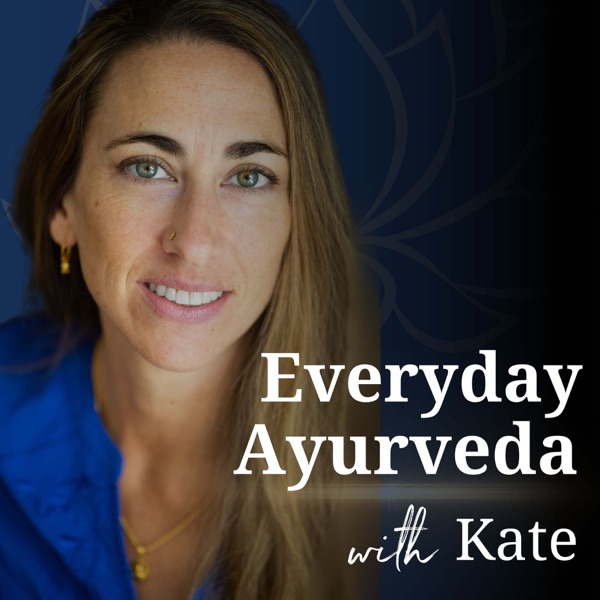
Podcast
Everyday Ayurveda with Kate
Welcome to Everyday Ayurveda, a podcast by Kate O’Donnell, renowned Ayurvedic practitioner, bestselling author, and founder of the Ayurvedic Living Institute. Join Kate as she demystifies the ancient wisdom of Ayurveda and translates it into practical, everyday practices for modern living.
In each episode, Kate shares her deep knowledge and personal experiences from over two decades of studying Ayurveda in India. Whether you’re new to Ayurveda or a seasoned practitioner, you’ll discover valuable insights on diet, lifestyle, self-care, and holistic health.
Everyday Ayurveda is your go-to resource for integrating the timeless principles of Ayurveda into your daily routine, fostering a life of balance, health, and happiness. Subscribe now and start your journey towards radiant well-being with Kate O’Donnell.
Listen, learn, and transform with Everyday Ayurveda – because true health begins with the choices we make every day.
- Episodes
- 108
- Releases
- Weekly
- Typical length
- 39 min
- On air since
- 2024
- Latest episode
- 6 days ago
Episodes
108 episodes, newest first
-
1 hr 1 min
108. Why Resting Isn't Lazy: 4 Mental Hindrances That Keep You From Rest
Episode 108
Show notes
When was the last time anyone gave you a trophy for resting? Nobody does, and that's part of the problem. In this episode, Kate sits down with her colleague Lizzie Lasater, daughter of restorative yoga teacher Judith Hanson Lasater and co-author of Savasana: The Practice of Radical Rest, just as the Northern Hemisphere heads into its season of long nights.
Lizzie is honest about why she wrote the book: not because rest comes easily, but because she is a self-described high-achieving workaholic who finds it hard. Together, she and Kate explore why teachers and students sign up for restorative training and then don't practice, why rest feels frightening, and how rest can be a stand-alone practice rather than the five minutes at the end of class.
In this episode:
• Why Savasana is described as yoga's most powerful pose, and why the book calls rest "radical"
• Restorative yoga in two minutes: comfort, props, and supporting the body's own intelligence for rest
• You don't need props or training: resting on the floor or in a side-lying couch Savasana
• Hindrance one: "I'm too busy to rest," and what busyness protects us from feeling
• Hindrance two: "Resting is selfish," and the case that our nervous systems co-regulate each other
• Hindrance three: "I'm afraid of the dark," including fear of the void, of what might surface, and of death
• Hindrance four: "Resting means I'm lazy," and Lizzie's "inner Protestant voice"
• The shift from "I don't have time" to "I'm not making time"
• Why a spacious life needs a spacious calendar
• Strength and recovery as partners, not competitors
• How rest has become slippery in the age of phones, scrolling and AI
• The Savasana Summit, a five-day event starting in December
• Rapid-fire: Lizzie's morning, first drink of the day, and wind-down routineTake-home practices:
• Pause at the "I could do, do, do, or I could not" moment, and try choosing not-doing as an experiment
• Swap "I don't have time" for "I'm not making time" and notice what changes
• Protect one boundary this weekend (no email, no posting) and see what happens
• Try a side-lying Savasana on the couch with the pillows you already have
• Remember that 15 to 20 minutes of Savasana can be your whole practice for a dayAbout Lizzie Lasater: Lizzie grew up in a yoga household (her mother has taught since 1971), began her own practice at 18, and now leads retreats and teacher trainings and an online yoga community with her mother. She studied architecture and has a master's in design, and she lives in Austria. Savasana: The Practice of Radical Rest is her first book and her mother's twelfth.
Links:
• Lizzie Lasater: Instagram @lizzie.lasater
• Lasater Yoga online community and Savasana Summit registration: lasater.yoga
• Savasana: The Practice of Radical RestHealth disclaimer: The information shared on Everyday Ayurveda with Kate is for educational purposes only and is not a substitute for medical advice, diagnosis, or treatment. Always consult a qualified healthcare provider before making changes to your diet, supplements, movement, or wellness routine.
Connect with Kate:https://www.healwithkate.org/https://www.healwithkate.org
Culinary Training in India
https://ayurvedicliving.institute/ayurvedic-culinary-nutrition-trainingFall Cleanse
https://ayurvedicliving.institute/kitchari-cleanse-ayurveda-fallAyurvedic Living Institute Membership: https://ayurvedicliving.institute/membership
Women's Health Collection: https://courses.ayurvedicliving.institute/collections/womens-healthhttps://courses.ayurvedicliving.institute/products/courses/copy-of-fall-community-cleanse-2024https://courses.ayurvedicliving.institute/courses/self-care-workshop-deep-winter
Panchakarma in India: https://ayurvedicliving.institute/panchakarma-in-indiaThanks to our Sponsors:
Banyan Botanicals
https://alnk.to/eOQb34qTriphala Support:
https://alnk.to/bPhiKjx -
39 min
107. What to Eat in Fall When You Don’t Know What to Eat: Easy Ayurvedic Meals
Episode 107
Show notes
When the weather turns dry and cold, the bowl-of-salad habit stops working. Your digestion starts asking for food that is warm, cooked, soft, and a little moist. In this solo episode, Kate answers the question “what do I actually eat?” with the quick, repeatable go-tos she uses every fall.
Kate explains why fall calls for warm and moist qualities to balance the dryness and coldness of the season, and how that dryness can show up in hair, skin, nails, thirst, and sluggish elimination. Then she gets practical: three kitchen tools, three breakfasts, a prep-ahead routine, soups, pickles, protein, and simple sides, all designed for people who like homemade food but don’t want to spend hours at the stove.
What we cover
• Why fall eating shifts toward warm, cooked, and moist foods, and what dryness can look like in the body
• Kate’s three fall kitchen tools: immersion blender, toaster oven, and Instant Pot (including the delay-start trick and why hers lives on the porch)
• The warm smoothie method: warmed milk, a rotating seed, a touch of sweetness, vanilla, ghee, and warming spices
• Kate’s warming spice mix: equal parts ginger and cinnamon with about a quarter part cardamom
• Pumpkin cacao: the variation with pumpkin puree and raw cacao (plus where protein powder fits)
• Why a teaspoon of ghee in breakfast keeps Kate satisfied longer
• Morning prep: cooking small beans (split mung or red lentils) for later
• Baking winter squash and sweet potatoes in batches, and the many ways to use them
• A hearty soup of squash, lentils or mung beans, coconut milk, and fresh ginger (stovetop or Instant Pot)
• Condiments that make soup satisfying: toasted pumpkin seeds with tamari, seaweed, and the wasabi pea trick
• Beets: pressure-cook, peel easily, and pickle in apple cider vinegar for a quick digestive-friendly condiment
• Baked tofu with ghee, tamari, nutritional yeast, or tahini, and the ramekin trick for softening cold ghee
• Baby kale and spinach as the “when I don’t know what to eat” grab-and-wilt green
• Seared Brussels sprouts with tamari and fresh Parmesan
• Swapping the water bottle for a thermos of warm, spiced cumin-coriander-fennel waterHealth disclaimer
The information shared on Everyday Ayurveda with Kate is for educational purposes only and is not a substitute for medical advice, diagnosis, or treatment. Always consult a qualified healthcare provider before making changes to your diet, supplements, or wellness routine.
Connect with Kate:https://www.healwithkate.org/https://www.healwithkate.org
Culinary Training in India
https://ayurvedicliving.institute/ayurvedic-culinary-nutrition-trainingFall Cleanse
https://ayurvedicliving.institute/kitchari-cleanse-ayurveda-fallAyurvedic Living Institute Membership: https://ayurvedicliving.institute/membership
Women's Health Collection: https://courses.ayurvedicliving.institute/collections/womens-healthhttps://courses.ayurvedicliving.institute/products/courses/copy-of-fall-community-cleanse-2024https://courses.ayurvedicliving.institute/courses/self-care-workshop-deep-winter
Panchakarma in India: https://ayurvedicliving.institute/panchakarma-in-indiaThanks to our Sponsors:
Banyan Botanicals
https://alnk.to/eOQb34qTriphala Support:
https://alnk.to/bPhiKjx -
50 min
106. Soil Health and Your Health: Pat Miletich on What Your Food Was Grown In
Episode 106
Show notes
If our food isn't "full power," will we feel full power? In this conversation, Kate talks with Pat Miletich, a UFC champion, martial arts coach, and Hall of Famer whose life mission is now soil health. Pat shares how a childhood of respiratory illness set him on a lifelong search for answers, and how that search led from human performance to the soil that grows our food and our herbal medicines.
Kate and Pat explore why they see soil as a living ecosystem, how they see the diversity of microbes in soil mirroring the microbiome in our gut, and why Pat believes mineral diversity in soil matters for the plants, animals, and people who depend on it. They talk about what organic and regenerative labels may leave out, what to ask the grower at your farmers market, and what you can do whether you have a backyard, a tiny plot, or no garden at all.
What We Cover
• Why Kate keeps coming back to the soil, and how it connects to Ayurveda's "you are what you eat"
• Pat's journey from childhood illness to UFC champion to soil advocate
• What soil health actually means: minerals, microorganisms, and the web of relationships beneath your food
• How Pat compares soil biology and the human microbiome
• Weeds and medicinal herbs as signals of what the soil is missing
• Why the questions "organic?" and "regenerative?" may not be the whole story
• Grounding and walking barefoot: why Pat says to know your soil first
• Starting or renewing a backyard garden, including small plots
• Why Pat says flavor is a clue to nutrient density
• Planting a food forest of berries and fruit trees instead of purely ornamentals
• What to do if you don't grow your own food
• The farmers market question: "What was used to grow this?"
• Prana, vitality, and stewardship of the land
• Rapid-fire questions: morning prayer, first drink of the day, and a very non-standard wind-downTake-Home Practices
• Ask your grower how the food was grown: herbicides, fungicides, synthetic NPK fertilizer, or truly organic
• If you have any space at all, plant edibles (berries, fruit trees, bushes) in place of purely ornamental plants
• If you practice grounding, learn what is in the soil you're standing on
• Notice flavor. Pat says real nutrient density tastes like something.
• Visit soilsaviors.org to explore Pat's Art and Science of Soil course.About Pat Miletich Pat Miletich is a UFC champion, martial arts coach, and Hall of Famer who grew up in Bettendorf, Iowa. Following a childhood shaped by respiratory illness, he spent decades researching health, performance, and nutrition. Today his mission is soil health: regenerating the soil that grows our food and our herbal medicines.
Links
• Soil Saviors: soilsaviors.org
• Cell Saviors: cellsaviors.orgHealth Disclaimer: The information shared on Everyday Ayurveda with Kate is for educational purposes only and is not a substitute for medical advice, diagnosis, or treatment. Always consult a qualified healthcare provider before making changes to your diet, supplements, or wellness routine.
Connect with Kate:https://www.healwithkate.org/https://www.healwithkate.org
Culinary Training in India
https://ayurvedicliving.institute/ayurvedic-culinary-nutrition-trainingFall Cleanse
https://ayurvedicliving.institute/kitchari-cleanse-ayurveda-fallAyurvedic Living Institute Membership: https://ayurvedicliving.institute/membership
Women's Health Collection: https://courses.ayurvedicliving.institute/collections/womens-healthhttps://courses.ayurvedicliving.institute/products/courses/copy-of-fall-community-cleanse-2024https://courses.ayurvedicliving.institute/courses/self-care-workshop-deep-winter
Panchakarma in India: https://ayurvedicliving.institute/panchakarma-in-indiaThanks to our Sponsors:
Banyan Botanicals
https://alnk.to/eOQb34qTriphala Support:
https://alnk.to/bPhiKjx -
29 min
105. Apples in Ayurveda: Are They Good for You? Cooling, Cooked & Easier to Digest
Episode 105
Show notes
Are apples good for you according to Ayurveda? It depends on your digestion, and on how you prepare them. In this solo episode, Kate O'Donnell explains why apples are one of the best fall foods for cooling excess heat (pitta), why a raw, crisp apple can feel hard on a cold or sensitive gut, and how to cook apples so you get all of the medicine and none of the bloat.
Kate starts with the Ayurvedic qualities of apples: cold, hard, juicy and fibrous. She explains why those qualities calm pitta and move the bowels, and why they can aggravate vata and kapha when the apple is eaten raw. Then she shares the principle behind her "Apple Madness" recipes. Knowing a food's qualities is step one. Step two is how you process it: raw or cooked, pureed, warm or cold, with or without digestive spices.
From there, it's a tour of her fall kitchen: gingered applesauce with the skins left on (pink is a feature), stewed apple compote, stuffed baked apples with cider and dried fruit, apples stir-fried in ghee, apple crisp with an oat and almond flour topping, grated-apple overnight oats and gingerbread chia pudding, a curried apple butternut squash soup, and a simple apple cup filled with nut butter and spice.
In this episode:
• Why apples are a pitta-balancing fall fruit (and when they aggravate vata and kapha)
• The Ayurvedic qualities of apples: cold, hard, juicy, fibrous
• Why cooking, pureeing and warming spices change how apples digest
• Apple skin, pectin and the prebiotic fiber that supports gut health
• Why moisture and fiber make apples a gentle fall "get things moving" food
• Pears vs. apples, plus cooling fruits from India: custard apple, chikoo (sapote) and melons
• Why bananas are tricky: cool, heavy and moist (and why ripeness matters)
• Gingered applesauce: why cinnamon and ginger are non-negotiable
• Stewed apple compote and the baked apple with cider and dried fruit
• Ghee-sautéed apples, apple crisp, apple overnight oats and gingerbread apple chia pudding
• Curried apple butternut squash soup
• The easy "apple cup" snack, from Laura Olson
• A simple tip for food combining: cook fruit with spices and serve it warmTake-home tip: If a raw apple feels cold and hard on your belly, don't skip it. Cook it, puree it, or warm it with ginger and cinnamon.
Mentioned in this episode:
• Ayurveda Fall Community Cleanse, October 17–26 — 10 days of nourishing meals, daily routines and mindful practices, all online with Kate (dates are flexible if needed). Learn more and save your spot at ayurvedicliving.institute
• Kate's cookbooks (gingered apple butter and ghee-sautéed apples)
• The earlier episode on fruit digestion (search "fruit" in your podcast app)Share your Apple Madness: Tag Kate on Instagram at @kateodonnell.ayurveda, leave a comment on your podcast platform, or email hello@ayurvedicliving.institute.
This podcast is for educational purposes only and is not a substitute for medical advice. Consult a qualified healthcare provider before changing your diet or wellness routine.
Connect with Kate:https://www.healwithkate.org/https://www.healwithkate.org
Culinary Training in India
https://ayurvedicliving.institute/ayurvedic-culinary-nutrition-trainingFall Cleanse
https://ayurvedicliving.institute/kitchari-cleanse-ayurveda-fallAyurvedic Living Institute Membership: https://ayurvedicliving.institute/membership
Women's Health Collection: https://courses.ayurvedicliving.institute/collections/womens-healthhttps://courses.ayurvedicliving.institute/products/courses/copy-of-fall-community-cleanse-2024https://courses.ayurvedicliving.institute/courses/self-care-workshop-deep-winter
Panchakarma in India: https://ayurvedicliving.institute/panchakarma-in-indiaThanks to our Sponsors:
Banyan Botanicals
https://alnk.to/eOQb34qTriphala Support:
https://alnk.to/bPhiKjx -
1 hr 3 min
104. How GLP-1 Drugs Really Work (and Where Ayurveda Fits In)
Episode 104
Show notes
So many of you have written in asking about GLP-1s, the Ozempic class of drugs. This week Kate talks with Dr. Sheena Sooraj, chief clinical officer at Kerala Ayurveda Academy and Wellness Center, who sees clients on these medications every month. Dr. Sheena explains how GLP-1s work in the pancreas, stomach and brain, who tends to need them long term and who may be able to come off them with their doctor, and how Ayurveda supports digestion, hydration and the enjoyment of food while someone is on them. This isn't a conversation about Ayurveda versus modern medicine. It's a clinician's honest look at the pros, the cons, and where the two can work together. Stay for Kate's post-roll on the vata imbalances that can come with rapid weight loss.
What We Cover
• What the natural GLP-1 hormone does in the body
• How GLP-1 medications act on the pancreas, the stomach and the brain
• The three groups of people Dr. Sheena sees: those postponing the medication, those managing side effects, and those hoping to come off it someday
• Why family history shapes whether someone may need to stay on the medication (Ayurveda calls diabetes a kulaja vyadhi, a condition with strong hereditary influence)
• A client story: how Ayurveda and Ozempic worked together for one busy, globe-trotting client
• The core conflict: Ayurveda strengthens agni, GLP-1s quiet it
• Why reduced thirst matters, and how to hydrate on purpose
• Meal timing, a lighter dinner before sunset, and easy-to-digest foods
• Ayurvedic support for coming off GLP-1s, including body therapies like udwartana (dry powder massage)
• Emotional eating, hormone transitions and weight gain across a woman's life
• Guilt, lost appetite and missing the joy of food, and how nasya can help
• Kate's post-roll: vata imbalance and dhatu kshaya (tissue depletion) during rapid weight loss
• Dr. Sheena's morning gratitude practice and evening wind-down routineAbout Dr. Sheena Sooraj
Vaidya Sheena Sooraj is the Chief Clinical Officer, Ayurvedic Specialist, and Academy Faculty at Kerala Ayurveda Academy in Milpitas, California.Coming from a family with a strong Ayurvedic heritage, Vaidya Sheena developed a deep connection with Ayurveda from an early age. Her grandfather, a respected Ayurvedic physician and astrologer, played an important role in shaping her interest in and commitment to the traditional science of healing.
She holds a Bachelor of Ayurvedic Medical Sciences (BAMS) from Mahatma Gandhi University, Kerala, and brings 23 years of experience in clinical practice, patient care, education, and professional training. Throughout her career, she has been dedicated to bringing the wisdom of classical Ayurvedic principles into contemporary clinical practice and wellness. As a clinician and educator, she is passionate about making Ayurveda accessible, practical, and relevant to modern healthcare and everyday life.
Her work encompasses clinical care, Ayurvedic education, practitioner training, wellness program development, and community education, with a particular interest in translating traditional Ayurvedic knowledge into meaningful, evidence-informed approaches for modern health and well-being.
Website:https://keralaayurveda.us/
Instagram: https://www.instagram.com/drsheenasooraj
Please work with your healthcare provider and a qualified Ayurvedic practitioner before changing any medication, starting herbs, or trying nasya.
Mentioned in This Episode
• Ayurvedic Fall Community Cleanse, October 17–26, 2026. Ten days of nourishing meals, daily routines and community support, all online with Kate. Learn more and reserve your spot at ayurvedicliving.institute
Health Disclaimer
The information shared on Everyday Ayurveda with Kate is for educational purposes only and is not a substitute for medical advice, diagnosis or treatment. Never stop, start or change a prescribed medication without talking to your healthcare provider.
Connect with Kate:https://www.healwithkate.org/https://www.healwithkate.org
Culinary Training in India
https://ayurvedicliving.institute/ayurvedic-culinary-nutrition-trainingFall Cleanse
https://ayurvedicliving.institute/kitchari-cleanse-ayurveda-fallAyurvedic Living Institute Membership: https://ayurvedicliving.institute/membership
Women's Health Collection: https://courses.ayurvedicliving.institute/collections/womens-healthhttps://courses.ayurvedicliving.institute/products/courses/copy-of-fall-community-cleanse-2024https://courses.ayurvedicliving.institute/courses/self-care-workshop-deep-winter
Panchakarma in India: https://ayurvedicliving.institute/panchakarma-in-indiaThanks to our Sponsors:
Banyan Botanicals
https://alnk.to/eOQb34qTriphala Support:
https://alnk.to/bPhiKjx -
35 min
103. The Ayurvedic Signs You're Out of Balance This Fall (and What to Do)
Episode 103
Show notes
Every year around this time, Kate notices it first in her eyes. A little heat, a little dryness, a little irritation — the same early signal, right on schedule. In this solo episode, she uses that personal example to explain one of Ayurveda's most practical seasonal concepts: sandhi, the juncture between seasons, when the body is considered most vulnerable to imbalance.
Kate walks through why the accumulated heat (pitta) of summer can tip into aggravation as the weather turns — through hot, acidic foods and drinks, alcohol, iced coffee, or plain old stress — and why that aggravation shows up differently in every body. For her, it's the eyes. For someone else, it might be skin, digestion, headaches, or mood. She explains the physiology behind fall allergies, heartburn, irritability, and looser digestion, and why catching these signs now — rather than waiting two months — makes all the difference. She also covers why the incoming dryness and wind of vata season (heaters, cold air) can quietly make pitta symptoms worse, and walks through her full fall reset: oiling the skin, a simple at-home ghee nasya for the nose, bringing ghee back into meals to support digestion and detox, and leaning on naturally pacifying foods. She closes with a reminder that none of this requires doing everything at once — and an invitation to join her Ayurvedic Fall Community Cleanse if a more structured reset is what's needed.
In this episode:
• What sandhi (the seasonal juncture) means in Ayurveda, and why the body is considered most vulnerable during it
• How a hot, acidic, or high-stress summer builds excess pitta — and sets up fall imbalance
• The early-warning signs of pitta aggravation: hot or irritated eyes, skin sensitivity or rashes, heartburn, fall allergies, loose stools, hot-natured headaches
• Why symptoms show up differently for everyone — and how to identify your own body's "weak link"
• How incoming vata (cold, dry, windy air, heaters turning on) can intensify pitta symptoms
• Why ghee is the star of the fall routine — for digestion, detoxification, and skin and nasal oiling
• How to do a simple ghee nasya (nasal oiling) at home
• Foods that pacify pitta this time of year: pomegranate, cranberry, coconut water, cooked greens, apples, figs, and rose hydrosol
• Why sitting down to eat — even for a quick snack — changes digestion
• Details on Kate's Ayurvedic Fall Community Cleanse, October 17–26Mentioned in this episode:
• Kate's four published books on bringing Ayurveda into everyday life
• Ayurvedic Fall Community Cleanse — 10 days, October 17–26. Learn more and enroll at ayurvedicliving.instituteHealth Disclaimer
The information shared on Everyday Ayurveda with Kate is for educational purposes only and is not a substitute for medical advice, diagnosis, or treatment. Always consult a qualified healthcare provider before making changes to your diet, supplements, or wellness routine.
Connect with Kate:https://www.healwithkate.org/https://www.healwithkate.org
Culinary Training in India
https://ayurvedicliving.institute/ayurvedic-culinary-nutrition-trainingFall Cleanse
https://ayurvedicliving.institute/kitchari-cleanse-ayurveda-fallAyurvedic Living Institute Membership: https://ayurvedicliving.institute/membership
Women's Health Collection: https://courses.ayurvedicliving.institute/collections/womens-healthhttps://courses.ayurvedicliving.institute/products/courses/copy-of-fall-community-cleanse-2024https://courses.ayurvedicliving.institute/courses/self-care-workshop-deep-winter
Panchakarma in India: https://ayurvedicliving.institute/panchakarma-in-indiaThanks to our Sponsors:
Banyan Botanicals
https://alnk.to/eOQb34qTriphala Support:
https://alnk.to/bPhiKjx -
1 hr 3 min
102. 15 Years, 4 Books, One Photographer: The Story Behind Everyday Ayurveda
Episode 102
Show notes
For fifteen years, Cara Brostrom has been the photographer — and co-author — behind every one of Kate's Everyday Ayurveda books. In this episode, Kate and Cara sit down together for the first time to tell the whole story: how a free PDF of five spring recipes and five photographs, made on a whim and shared on early Facebook, racked up 30,000 downloads and landed in front of an acquiring editor — and became The Everyday Ayurveda Cookbook, now a perennial classic translated into seven languages.
From there, they walk book by book through the evolution of the series and Cara's own evolving relationship to the materials she was photographing:
• The Everyday Ayurveda Cookbook — described by Kate as "party time": bright color, Indian textiles (including Kate's own saris), and a sensory introduction to the full range of Ayurvedic tastes and foods.
• Everyday Ayurveda for a Calm, Clear Mind — a deliberate shift to simplicity, mirroring sattvic cooking itself, including the now-legendary challenge of making congee look photogenic.
• The Everyday Ayurveda Guide to Self-Care — a turn toward dravya guna, the Ayurvedic science of substance, where Cara found herself photographing milks, ghee, and medicinal substances so closely that she began ingesting and living with them herself. This is also where Cara first felt the tension of photographing plants — like neem and shatavari — that don't grow where she lives in New England, a tension that quietly started pulling her toward Western herbalism.
• Everyday Ayurveda for Women's Health — built around lunar and seasonal rhythms, this book took Cara out into the field across all four seasons, photographing plants like motherwort and echinacea in local gardens. It was on one of these shoots that she met the herbalist she'd go on to apprentice with for years — and it became the last book she photographed before pivoting fully into writing and herbalism.Cara also shares an early look at her forthcoming book (title still under wraps for now, expected to be announced around January), which brings together 19th-century poetry, plant lore from her own Anglo-European lineage, and present-day Western herbalism practice — including a surprising thread she's uncovered about how 19th-century New England housewife manuals centered almost entirely on digestion.
The episode closes with a fun rapid-fire round: Cara's morning tongue-scraping and oil-pulling ritual, her go-to first drink of the day, and her seasonal wind-down (bare feet in the grass in summer, wood stove in winter).
About Cara Brostrom:
Cara Brostrom is a writer, artist, and herbalist, and co-author of The Everyday Ayurveda Cookbook, a perennial classic translated into seven languages. She is a Nautilus Book Award Gold Winner, and her creative work has been recognized by the National Endowment for the Arts. Cara holds a Master of Arts from Aberystwyth University, where she conducted practice-based research on landscape narratives, performance documentation, and the archive; her performance art and installations have been shown at festivals across the US, England, Wales, Scotland, Canada, and Finland, and her photography has appeared in group shows in Boston, New York, and San Francisco. Her words and photography have been published in The Boston Globe, Wildling Magazine, Origin, Mother Earth Living, t.e.l.l. New England, and others. She has spent many years in apprenticeship and study with master herbalists in the Northeast, and now teaches workshops on herbalism and folklore. Cara lives in Western Massachusetts.
Connect with Cara: https://linktr.ee/carabros
Mentioned in this episode:
• The Everyday Ayurveda Cookbook (co-authored by Cara Brostrom), Everyday Ayurveda for a Calm, Clear Mind, The Everyday Ayurveda Guide to Self-Care, and Everyday Ayurveda for Women's Health — all by Kate O'Donnell
• Hannah Marano, the herbalist Cara apprenticed with
• India Culinary & Nutrition Immersion, February 2027 — a 10-day immersion in Mysore. Learn more and enroll at ayurvedicliving.instituteThis episode is supported by:
Banyan Botanicals — Triphala tablets for digestion and daily detox: https://alnk.to/bPhiKjx
Connect with Kate:https://www.healwithkate.org/https://www.healwithkate.org
Culinary Training in India
https://ayurvedicliving.institute/ayurvedic-culinary-nutrition-trainingFall Cleanse
https://ayurvedicliving.institute/kitchari-cleanse-ayurveda-fallAyurvedic Living Institute Membership: https://ayurvedicliving.institute/membership
Women's Health Collection: https://courses.ayurvedicliving.institute/collections/womens-healthhttps://courses.ayurvedicliving.institute/products/courses/copy-of-fall-community-cleanse-2024https://courses.ayurvedicliving.institute/courses/self-care-workshop-deep-winter
Panchakarma in India: https://ayurvedicliving.institute/panchakarma-in-indiaThanks to our Sponsors:
Banyan Botanicals
https://alnk.to/eOQb34qTriphala Support:
https://alnk.to/bPhiKjx -
25 min
101. Sync Your Life to the Moon: A 28-Day Guide to Energy and Rest
Episode 101
Show notes
Did you know the moon moves through a full cycle — dark to full and back again — in about 28 days, which is also the length of the average menstrual cycle? In this solo episode, Kate explores lunar rhythms: one of her favorite topics, and a subject she covers in Chapter 9 of her book Everyday Ayurveda for Women's Health.
Ayurveda already asks us to live in tune with daily rhythms (sun up, sun down) and seasonal rhythms (what grows and changes through the year). The lunar rhythm sits alongside both of these — a roughly two-week arc of waxing energy followed by a two-week arc of waning energy, repeating all month long. Kate explains why attuning to this cycle matters for everyone, not just people who menstruate: it connects us to something larger than our day-to-day worries, and it offers a built-in, nature-guided balance of activity and rest that modern "always-on" life tends to erase.
Kate walks through the physical logic, too — the same gravitational pull that raises ocean tides and draws moisture into topsoil (which is why farmers plant near the full moon) also affects the water element in our own bodies, which is part of why energy can feel more "juicy" as the moon waxes. She maps out what to focus on during each phase: building, moving, and socializing during the waxing moon; celebrating, baking, and gathering at the full moon; tapering down and finishing projects during the waning moon; and resting, self-care, and simplifying food at the new moon. She also addresses how this maps — or doesn't — onto an individual menstrual cycle, and what to prioritize if the two aren't in sync.
In this episode:
• Why Ayurveda pairs daily, seasonal, and lunar rhythms together
• The uncanny overlap between the ~28-day lunar cycle and the average menstrual cycle
• Two reasons lunar attunement is grounding, even for those no longer menstruating
• How the moon's pull on water explains tides, farming by the full moon, and feeling "juicier"
• What to prioritize during the waxing moon: movement, socializing, starting projects
• Full moon practices: celebration, baking, making ghee, growing sprouts
• Waning moon practices: finishing projects, tapering activity, simplifying meals
• New moon practices: rest, self-care, and the traditional practice of fasting
• Whether to follow your menstrual cycle or the moon's cycle when the two don't align
• How to start tracking your own patterns over the next several monthsMentioned in this episode:
• Kate's book, Everyday Ayurveda for Women's Health (Chapter 9), which includes recipes for the soups and treats referenced in this episode.
Have you noticed your own patterns with the moon? Kate would love to hear about it — leave a comment or send her a message.
Connect with Kate:https://www.healwithkate.org/https://www.healwithkate.org
Culinary Training in India
https://ayurvedicliving.institute/ayurvedic-culinary-nutrition-trainingFall Cleanse
https://ayurvedicliving.institute/kitchari-cleanse-ayurveda-fallAyurvedic Living Institute Membership: https://ayurvedicliving.institute/membership
Women's Health Collection: https://courses.ayurvedicliving.institute/collections/womens-healthhttps://courses.ayurvedicliving.institute/products/courses/copy-of-fall-community-cleanse-2024https://courses.ayurvedicliving.institute/courses/self-care-workshop-deep-winter
Panchakarma in India: https://ayurvedicliving.institute/panchakarma-in-indiaThanks to our Sponsors:
Banyan Botanicals
https://alnk.to/eOQb34qTriphala Support:
https://alnk.to/bPhiKjx -
1 hr 1 min
100. How to Talk to Your Doctor About Perimenopause and Menopause
Episode 100
Show notes
Ever leave the doctor's office feeling like you didn't get to say what you actually needed to say? In this episode, Kate sits down with Dr. Elizabeth Bostock — a practicing OBGYN for 30 years, a yogi, an Ayurvedic counselor, and a contributor to Kate's book Everyday Ayurveda for Women's Health — to talk about self-advocacy in the doctor's office, especially around perimenopause and menopause.
Dr. Bostock shares what she's seen across three decades and hundreds of thousands of patients: the number one thing women tell her is that they haven't felt heard. She and Kate break down how symptoms shift by decade, why perimenopause often starts quietly in the late 30s, and why menopause care doesn't end at menopause — it extends through your entire life. Dr. Bostock offers a simple set of questions to bring into any appointment, explains when and how to ask for a referral, and makes the case for symptom tracking (with pen and paper, an app, or your wearable data) so you can walk in prepared instead of going blank.
The conversation also covers the current, more nuanced understanding of hormone therapy — where the evidence is strong, where it isn't yet, and why the framing of "who do you want to be at 80" matters more than chasing a number on a chart. They talk through the cost and insurance side of hormone therapy and physical therapy too, plus Dr. Bostock's take on movement: it should be fun, and it's never too late to start.
In this episode:
• Why "I haven't been heard" is the most common thing patients tell Dr. Bostock
• How symptoms and health priorities shift decade by decade, from the teens through the 80s
• Why menopause care is really a lifelong conversation, not a single life stage
• Three questions to bring to your next doctor's visit — and a fourth for sexual health
• What to do (and say) if your provider isn't the right fit
• Why tracking symptoms — on paper, in an app, or via wearables — changes the conversation with your doctor
• The most common perimenopause and menopause symptoms, including lesser-known ones like formication and early joint pain
• A clearer, more current look at menopause hormone therapy (MHT): where it helps most, and the guidance on timing
• How family health history (and the Ayurvedic idea of prakriti) plays into these decisions
• The "menopausal Barbie" trend and GLP-1s: Dr. Bostock's honest take
• Why she thinks of physical activity as play, not a prescription
• Navigating cost: hormone therapy affordability, generic options, and why physical therapy access is still a gap
• Dr. Bostock's morning and evening routines, including her "Jamba Juice" anti-inflammatory tonicAbout Dr. Elizabeth Bostock:
Elizabeth is a practicing OBGYN, yogi, Ayurvedic counselor, and women's health leader and advocate who believes that combining medical traditions in a "yes, and" way gives the best of all worlds. She weaves together real science and human living to explore how we all live healthier, happier, more contented lives — and is a fierce advocate for helping people figure out who they are, find their path forward, and speak up for themselves.
Connect with Dr. Bostock:
Instagram: https://instagram.com/empoweredwomanshealthmd
YouTube: https://youtube.com/empoweredwomanshealthmd
LinkedIn: https://linkedin.com/elizabethbostock
Substack: https://substack.com/@elizabethbostockmdphd
Mentioned in this episode:
• Everyday Ayurveda for Women's Health by Kate O'Donnell — paperback edition releases September 16
• The Menopause Society (provider directory and patient resources)
• The American College of Obstetricians and Gynecologists (ACOG)
• Mayo Clinic (patient education resources)
• GoodRx and Cost Plus Drugs (referred to in conversation as "Mark Cuban Pharmacy") for prescription discounts
• Dr. Bostock's "Jamba Juice" tonic: whole lemon, ginger, turmeric, star anise, and cayenne, simmered and blended
• Dr. Bostock's current read: The Empire of Gold
• A preview of an upcoming episode on GLP-1s, out in two weeksThis episode is supported by:
Banyan Botanicals — Triphala tablets for digestion and daily detox. Get it here: https://alnk.to/bPhiKjx
Health Disclaimer:
The information shared on Everyday Ayurveda with Kate is for educational purposes only and is not a substitute for medical advice, diagnosis, or treatment. Always consult a qualified healthcare provider — including regarding hormone therapy — before making changes to your diet, supplements, or wellness routine.
Connect with Kate:https://www.healwithkate.org/https://www.healwithkate.org
Culinary Training in India
https://ayurvedicliving.institute/ayurvedic-culinary-nutrition-trainingFall Cleanse
https://ayurvedicliving.institute/kitchari-cleanse-ayurveda-fallAyurvedic Living Institute Membership: https://ayurvedicliving.institute/membership
Women's Health Collection: https://courses.ayurvedicliving.institute/collections/womens-healthhttps://courses.ayurvedicliving.institute/products/courses/copy-of-fall-community-cleanse-2024https://courses.ayurvedicliving.institute/courses/self-care-workshop-deep-winter
Panchakarma in India: https://ayurvedicliving.institute/panchakarma-in-indiaThanks to our Sponsors:
Banyan Botanicals
https://alnk.to/eOQb34qTriphala Support:
https://alnk.to/bPhiKjx -
33 min
99. The Ayurvedic Guide to Preserving Summer's Bumper Crops
Episode 99
Show notes
The farmers market is overflowing right now — but how do you keep all that fresh, local food from going to waste before you can eat it? In this solo episode, Kate answers a listener question about preserving the late-summer and early-fall haul, and shares the exact kitchen tricks she uses to make her produce last.
Kate tackles the question she gets every time she mentions saving or freezing food: doesn't Ayurveda say no leftovers, no frozen food? Her answer is a grounded, seasonal one. When you live where the growing season is short, local food that's been thoughtfully preserved carries far more prana (life force) than "fresh" produce trucked in from thousands of miles away. Short-term freezing has its place — and so does eating with the wheel of the year.
From there, Kate walks through her whole late-summer kitchen: heirloom and cherry tomatoes (and the traditional parboil method that removes the acidity Ayurveda cautions against), the parboil-and-freeze trick for kale, kale pesto in jars, and her famous jar-and-towel storage method that keeps hardy greens and fresh herbs alive for up to three weeks. She covers herbs all winter, zucchini and summer squash, pickling root vegetables to build digestive fire in the cold months, freezing berries and making fruit compotes, and storing winter squash in a root cellar (or a pretty bowl on the counter).
In this episode:
• Why Ayurveda's "no frozen food" rule needs a seasonal, local-first reframe
• The prana argument for preserving local food over buying shipped "fresh" produce
• Tomatoes two ways: heirloom on sourdough + roasted cherry tomato compote
• The traditional parboil method to make tomatoes easier to digest
• How to parboil and freeze kale (and why it stays in perfect leaves)
• Kale pesto you can freeze in single-serve jars
• The jar-and-towel trick: keep greens & herbs fresh for up to 3 weeks
• Keeping fresh herbs going all winter, indoors and in the fridge
• Zucchini & summer squash: kitchari, soups, and eating them fast
• Pickling beets, carrots & beans — and why pickles warm you in winter
• Freezing berries, stone-fruit compotes, and easy crisps
• Storing winter squash + the case for decorative "eat me" bowls
• The Ayurvedic principle: food grown closest to home is most nourishingMentioned in this episode:
• Kate's fall cleanse (beet pickle recipe included)
• Kate's four books (variations on beet pickle & seasonal recipes)
• India Culinary & Nutrition Immersion, February 2027 — a 10-day immersion in Mysore. Learn more and enroll at ayurvedicliving.instituteThis episode is supported by:
• Dr. Tung's — natural oral care, including their popular Smart Floss. New customers get 15% off at drtungs.com.
• Banyan Botanicals Menopause Balance — Ayurvedic herbal support for perimenopause, menopause, and post-menopause. Find it at banyanbotanicals.com/kate.Have a preservation trick Kate didn't mention? She'd love to hear it — leave a comment or send her a message.
Connect with Kate:https://www.healwithkate.org/https://www.healwithkate.org
Culinary Training in India
https://ayurvedicliving.institute/ayurvedic-culinary-nutrition-trainingFall Cleanse
https://ayurvedicliving.institute/kitchari-cleanse-ayurveda-fallAyurvedic Living Institute Membership: https://ayurvedicliving.institute/membership
Women's Health Collection: https://courses.ayurvedicliving.institute/collections/womens-healthhttps://courses.ayurvedicliving.institute/products/courses/copy-of-fall-community-cleanse-2024https://courses.ayurvedicliving.institute/courses/self-care-workshop-deep-winter
Panchakarma in India: https://ayurvedicliving.institute/panchakarma-in-indiaThanks to our Sponsors:
Banyan Botanicals
https://alnk.to/eOQb34qTriphala Support:
https://alnk.to/bPhiKjx -
1 hr 1 min
98. Perfectionism Disguised as Wellness: Rethinking What Health Really Means | with Nidhi Sunil
Episode 98
Show notes
Model Nidhi Sunil — Vogue India Model of the Year and the first Indian global ambassador for L'Oréal Paris — joins Kate for a very candid conversation about how her work affected her mental and physical health. After more than a decade of image-building, red-eye flights to Paris and back, and relentless external pressure, Nidhi hit a full-body burnout in 2022. In this episode, she opens up about depletion, self-worth, complex trauma, colorism in the fashion industry, and the slow, honest work of healing — beginning with a simple bowl of kitchari.
Together, Kate and Nidhi explore how Ayurveda "decentralizes" the pressure to optimize, why ojas (our life-force reserve) matters more than output, and what it looks like to put the "juice" first. A grounding, deeply relatable listen for anyone in a season of transition, exhaustion, or reevaluation.
In this episode:
• The real lifestyle behind international modeling — and its hidden cost on the body
• How burnout actually arrives: insomnia, panic, depletion, a lost menstrual cycle
• Food as the first tool: why kitchari was the portal back to sleep
• Self-worth, shame, and outsourcing our value to productivity
• Colorism in the fashion industry and the "colonial hangover"
• "Perfectionism disguised as wellness" and why optimization can harm
• Ojas, plumpness, and the Ayurvedic permission to simply be human
• Learning to lead with your "yes" and your "no" from a place of abundanceThe information shared on Everyday Ayurveda with Kate is for educational purposes only and is not a substitute for medical advice, diagnosis, or treatment. Always consult a qualified healthcare provider before making changes to your diet, supplements, or wellness routine.
Connect with Kate:https://www.healwithkate.org/https://www.healwithkate.org
Culinary Training in India
https://ayurvedicliving.institute/ayurvedic-culinary-nutrition-trainingFall Cleanse
https://ayurvedicliving.institute/kitchari-cleanse-ayurveda-fallAyurvedic Living Institute Membership: https://ayurvedicliving.institute/membership
Women's Health Collection: https://courses.ayurvedicliving.institute/collections/womens-healthhttps://courses.ayurvedicliving.institute/products/courses/copy-of-fall-community-cleanse-2024https://courses.ayurvedicliving.institute/courses/self-care-workshop-deep-winter
Panchakarma in India: https://ayurvedicliving.institute/panchakarma-in-indiaThanks to our Sponsors:
Banyan Botanicals
https://alnk.to/eOQb34qTriphala Support:
https://alnk.to/bPhiKjx -
29 min
97. Is Your Phone Making You Crazy? The Ayurvedic Fix Isn't a Detox
Episode 96
Show notes
Is your phone making you a little crazy? Kate opens this episode with a confession: even as a longtime Ayurveda teacher, she has to actively manage her relationship with her phone — because the device, and the apps on it, are engineered to keep you glued. If she's working at it, most of us are too.
The heart of this episode is a reframe. We tend to swing to all-or-nothing: "I need to throw my phone in the desert," or nothing changes at all. Kate makes the case that what we actually need is steady, doable boundaries at specific times of day — not a fundamentalist detox overhaul.
From an Ayurvedic perspective, the reason phones are so taxing is the nervous system. The sense organs — eyes, ears, skin, tongue, nose — are windows into the mind. The phone is relentlessly stimulating through the eyes (and ears), which is essentially non-stop sensory consumption. As Kate points out, you wouldn't eat food all day long; why do we consume information and stimulation all day long? Rest, in Ayurveda, is when the senses finally power down — which is exactly why winding down on a stimulating screen backfires, especially for sleep.
In this episode, Kate shares:
• Why it's boundaries, not a detox — and how to set them at the times of day that matter most • The sense-organ / nervous-system model that explains why scrolling feels restful but isn't • Her non-negotiable phone-free zones: the bedroom, the bathroom, mealtimes, and time in nature • Why a $5 old-school alarm clock may be the single highest-leverage change you can make • Turning off push notifications and the lock screen so you have to choose to check in • Using timers for intentional phone time (yes, even for Instagram) and putting it down when they ring • Booking one hour of silence a day — all at once or in 20-minute pieces
• Bookending your day: dinacharya before the phone comes on in the morning, phone off ~7–7:30pm at night • Meeting boredom by attuning to nature — what you can smell, hear, and feel — instead of reaching for the screen
• Analog allies: real books, a paper planner, keeping one social platform, and leaving the phone in another roomIf your phone use is nudging you toward overwhelm or a mental-health imbalance — increasingly common — Kate offers the Ayurvedic counterweight: nature. Attuning the senses to the natural world is the opposite energy of the phone, and an easier on-ramp than forcing yourself into silence.
Come study at the source. Join Kate in India next February for a 10-day culinary and nutrition immersion (2027) in Mysore — cook, study, and come home confident to make food your medicine. Learn more and enroll at ayurvedicliving.institute.
Connect with Kate:https://www.healwithkate.org/https://www.healwithkate.org
Culinary Training in India
https://ayurvedicliving.institute/ayurvedic-culinary-nutrition-trainingFall Cleanse
https://ayurvedicliving.institute/kitchari-cleanse-ayurveda-fallAyurvedic Living Institute Membership: https://ayurvedicliving.institute/membership
Women's Health Collection: https://courses.ayurvedicliving.institute/collections/womens-healthhttps://courses.ayurvedicliving.institute/products/courses/copy-of-fall-community-cleanse-2024https://courses.ayurvedicliving.institute/courses/self-care-workshop-deep-winter
Panchakarma in India: https://ayurvedicliving.institute/panchakarma-in-indiaThanks to our Sponsors:
Banyan Botanicals
https://alnk.to/eOQb34qTriphala Support:
https://alnk.to/bPhiKjx -
58 min
96. Lift Heavy, Then Glide: A Smarter Recovery Plan for Women Over 40 | with Karen Kirkness
Episode 96
Show notes
Dr. Karen Kirkness has spent decades in the yoga world and the last ten-plus years in anatomy labs earning a master's in clinical anatomy and a PhD in medical sciences. In this episode she and Kate go straight into fascia — not as packing material, but as a signaling system — and into hyaluronan, the molecule that makes your tissue juicy.
The surprise: more lubrication is not better. Fresh, long-chain hyaluronan tells your cells everything is regulated. But movement shears those chains into fragments, and fragments are inflammatory. Clearing them matters as much as making them. That's what a recovery day is actually for.
Karen breaks down what changes at perimenopause and after, why losing lean muscle and mitochondria puts the brakes on your body's own hydration, and what to do about it: vigorous training a few times a week, active recovery in between, and 'movement snacks' scattered through the day — the twist, the reach, the sprint to the stop sign.
Find Karen at spiralsyllabus.com and on Instagram at SpiralSyllabus or Karen Kirkness.
Questions for a follow-up episode? Email hello@ayurvedicliving.institute or leave a comment on your podcast platform.
Referenced in this episode
Links:
https://www.instagram.com/karenkirkness
https://www.instagram.com/spiralsyllabus
https://orcid.org/0000-0002-1649-7221
Latest paper:The Myofascial Rheostat: H
yaluronan Molecular Weight Dynamics and Purinergic Signalling as a Physiological Feedback System
https://www.spiralsyllabus.com/
Work with Karen:Experience Spiral Motion Autumn Program
KEY REFERENCES
Caon, I., Bartolini, B., Moretto, P., Parnigoni, A., Caravà, E., Vitale, D. L., et al. (2020).
Sirtuin 1 reduces hyaluronan synthase 2 expression by inhibiting nuclear translocation
of NF-kB and expression of the long-noncoding RNA HAS2–AS1. J. Biol. Chem. 295,
3485–3496. doi: 10.1074/jbc.RA119.011982
Caon, I., Parnigoni, A., Viola, M., Karousou, E., Passi, A., and Vigetti, D. (2021). Cell
energy metabolism and hyaluronan synthesis. J. Histochem. Cytochem. 69, 35–47.
doi: 10.1369/0022155420929772
Kirkness, K. B., and Scarlata, S. (2025). Understanding fascial tissue on the molecular
level—how its unique properties enable adaptation or dysfunction. Int. J. Mol. Sci. 27,
• doi: 10.3390/ijms27010160
Kirkness, K.B., da Silva, Schleip,R, Cruvinel-Júnior R., and Scarlata, S. (2026). The Myofascial Rheostat: Hyaluronan Molecular Weight Dynamics and Purinergic Signalling as a Physiological Feedback System. Frontiers in Physiology 17 (June 2026).https://doi.org/10.3389/fphys.2026.1854585.
Raghavan, P. (2018). Emerging therapies for spastic movement disorder. Phys. Med.
Rehabil. Clin. N. Am. 29, 633–644. doi: 10.1016/j.pmr.2018.04.004
Raghavan, P. (2025). Muscle physiology in spasticity and muscle stiffness. Toxicon 259,
• doi: 10.1016/j.toxicon.2025.108350
Raghavan, P., Lu, Y., Mirchandani, M., and Stecco, A. (2016). Human recombinant
hyaluronidase injections for upper limb muscle stiffness in individuals with cerebral
injury: A case series. eBioMedicine 9, 306–313. doi: 10.1016/j.ebiom.2016.05.014
Rauhala, L., Jokela, T., Kärnä, R., Bart, G., Takabe, P., Oikari, S., et al. (2018).
Extracellular ATP activates hyaluronan synthase 2 (HAS2) in epidermal keratinocytes
via P2Y2, Ca2+ signaling, and MAPK pathways. Biochem. J. 475, 1755–1772.
doi: 10.1042/BCJ20180054
Slater, A. M., Barclay, S. J., Granfar, R. M. S., and Pratt, R. L. (2024). Fascia as a
regulatory system in health and disease. Front. Neurol. 15. doi: 10.3389/
fneur.2024.1458385
Stecco, C., Pratt, R., Nemetz, L. D., Schleip, R., Stecco, A., and Theise, N. D. (2025).
Towards a comprehensive definition of the human fascial system. J. Anat. 246, 1084–
• doi: 10.1111/joa.14212
Stecco, A., Stecco, C., and Raghavan, P. (2014). Peripheral mechanisms contributing to
spasticity and implications for treatment. Curr. Phys. Med. Rehabil. Rep. 2, 121–127.
doi: 10.1007/s40141-014-0052-3
Stecco, A., Stern, R., Fantoni, I., De Caro, R., and Stecco, C. (2016). Fascial disorders:
Implications for treatment. PM&R 8, 161–168. doi: 10.1016/j.pmrj.2015.06.006
Theise, N. D., Kohnehshahri, M. N., Chiriboga, L. A., Fyfe, B., Cao, W., Zee, S., Imam, R., Pichler-Sekulic, S., and Wells, R. G. (2025). Evidence of interstitial continuity within and beyond the human pancreas. Human Pathology 161, 105855. doi: 10.1016/j.humpath.2025.105855
Vigetti, D., Clerici, M., Deleonibus, S., Karousou, E., Viola, M., Moretto, P., et al. (2011).
Hyaluronan synthesis is inhibited by adenosine monophosphate-activated protein
kinase through the regulation of HAS2 activity in human aortic smooth muscle cells.
• Biol. Chem. 286, 7917–7924. doi: 10.1074/jbc.M110.193656
Vigetti, D., Deleonibus, S., Moretto, P., Bowen, T., Fischer, J. W., Grandoch, M., et al.
(2014). Natural antisense transcript for hyaluronan synthase 2 (HAS2-AS1) induces
transcription of HAS2 via protein
Connect with Kate:https://www.healwithkate.org/https://www.healwithkate.org
Culinary Training in India
https://ayurvedicliving.institute/ayurvedic-culinary-nutrition-trainingFall Cleanse
https://ayurvedicliving.institute/kitchari-cleanse-ayurveda-fallAyurvedic Living Institute Membership: https://ayurvedicliving.institute/membership
Women's Health Collection: https://courses.ayurvedicliving.institute/collections/womens-healthhttps://courses.ayurvedicliving.institute/products/courses/copy-of-fall-community-cleanse-2024https://courses.ayurvedicliving.institute/courses/self-care-workshop-deep-winter
Panchakarma in India: https://ayurvedicliving.institute/panchakarma-in-indiaThanks to our Sponsors:
Banyan Botanicals
https://alnk.to/eOQb34qTriphala Support:
https://alnk.to/bPhiKjx -
36 min
95. Pitta Season Survival: Ayurvedic Tips for Managing Summer Heat in Your Body
Episode 95
Show notes
If summer heat is leaving you irritable, bloated, broken out, or just plain wiped out, this solo episode is for you. Kate O'Donnell offers a midsummer check-in through the lens of Ayurveda — explaining why this particular point in the season is such an important juncture, and what to do now to keep summer's heat from setting the stage for a fall burnout.
Kate walks through the Ayurvedic concept of samprapti — the slow, predictable way a dosha moves out of balance — and helps you recognize the early signs of pitta accumulation: heat, sharpness (acidity), spreading (prickly heat, breakouts, itchy skin), dryness, loose stools, and a short emotional fuse. She explains how accumulation turns into aggravation, and why that unchecked heat can cause real imbalances like acid reflux and inflammation down the line.
Drawing on hard lessons from her own burnout last fall, Kate shares exactly what she's doing differently this year — from lying on the cool basement floor and eating her big meal at 10am, to giving up cold and raw foods, adding dry ginger to smoothies, and "slowing her roll" with a stay-home day each week. She also speaks directly to those in perimenopause and menopause about why extreme temperatures feel harder to manage now, and why that's something to be aware of rather than fixed.
In this episode:
• Why midsummer is a critical juncture in the Ayurvedic year
• The signs of pitta accumulation vs. aggravation
• How heat, cortisol, and inflammation connect
• Perimenopause and why heat (and cold food) hit differently now
• Kate's practical toolkit: cooling the body, eating for the season, and slowing down
• Why warm, cooked food may be the fix for summer bloatMentioned in this episode:
• Dr. Tung's natural oral care — drtungs.com (new customers get 15% off)
• Banyan Botanicals Beauty Balm — banyanbotanicals.com/kate
• Ayurvedic Living Institute — India Culinary & Nutrition Immersion, February 2027 — ayurvedicliving.institute
• The Fall Cleanse (offered each October)
• LifeSpa grass-fed whey protein powder
• https://store.lifespa.com/?ref=16841
• Save $10 with code KATE10If you're navigating perimenopause or menopause and summer feels harder than it used to — this one's for you. Keep in touch, and I'll see you next time.
Connect with Kate:https://www.healwithkate.org/https://www.healwithkate.org
Culinary Training in India
https://ayurvedicliving.institute/ayurvedic-culinary-nutrition-trainingFall Cleanse
https://ayurvedicliving.institute/kitchari-cleanse-ayurveda-fallAyurvedic Living Institute Membership: https://ayurvedicliving.institute/membership
Women's Health Collection: https://courses.ayurvedicliving.institute/collections/womens-healthhttps://courses.ayurvedicliving.institute/products/courses/copy-of-fall-community-cleanse-2024https://courses.ayurvedicliving.institute/courses/self-care-workshop-deep-winter
Panchakarma in India: https://ayurvedicliving.institute/panchakarma-in-indiaThanks to our Sponsors:
Banyan Botanicals
https://alnk.to/eOQb34qTriphala Support:
https://alnk.to/bPhiKjx -
59 min
94. A Naturopathic Doctor Reads My Real Lab Results | with Dr. Stephen Cabral
Episode 94
Show notes
This week, Kate is joined by Dr. Stephen Cabral, a board-certified naturopathic physician, bestselling author, and founder of EquiLife and the Integrative Health Practitioner Institute. Dr. Cabral shares the health crisis that launched his career — a cascade of autoimmune diagnoses at age 17 — and how naturopathic medicine, functional lab testing, and his clinical training in Ayurveda helped him fully recover.
The heart of the episode is a live read of Kate's own hair minerals and metals test, the same test that was the first lab Dr. Cabral ever ran on himself. He walks through her electrolyte ratios, mineral levels, and heavy metal results in real time, translating what each pattern means for stress, thyroid function, and detoxification. They also cover his concept of Personomics — personalized medicine built on lab data rather than one-size-fits-all protocols — and dig into why cortisol, progesterone, and estrogen have to be read together rather than in isolation, illustrated through a client case study.
What We Cover
• Dr. Cabral's health crisis at 17 (autoimmune conditions, Addison's disease, rheumatoid arthritis, type 2 diabetes) and how he recovered
• His clinical internships in Ayurvedic medicine in India and Sri Lanka
• Personomics: why foundational health protocols only go so far, and personalized lab data closes the gap
• Why blood work shows a disease state but not the underlying root cause
• Reading Kate's live hair minerals and metals test: electrolyte ratios, stress patterns, zinc/copper balance, and elevated lead
• Why cortisol, progesterone, and estrogen must be read together, illustrated through a perimenopause case study
• Practical first steps for reducing heavy metal exposure (air, water, food)
• Dr. Cabral's morning routine, first food of the day, and evening wind-down routineGuest Bio: Dr. Stephen Cabral
Dr. Stephen Cabral is a Board Certified Doctor of Naturopathy, bestselling author, and founder of EquiLife and the Integrative Health Practitioner Institute. He specializes in personalized Integrative Health & Functional Medicine, at-home lab testing, and data-driven wellness protocols, and has seen over 300,000 clients in his practice to help them restore their health in both mind and body. He is the author of The Rain Barrel Effect and Personomics.
Website: stephencabral.com | Podcast: The Cabral Concept Podcast
Lab Discount for Your Audience
For 50% off labs, listeners can use StephenCabral.com/Kate to receive the discount on the Hair, Minerals, and Metals Test.
About the Hair, Minerals, and Metals Test
Mineral deficiencies can deplete energy, while toxic heavy metals often cause bodily inflammation. This simple at-home test — the first one Dr. Cabral ever ran to help restore his own health — provides insight into chronic issues like low energy, anxiety, and brain fog by measuring:
• Electrolyte Markers: Calcium, Magnesium, Sodium, Potassium
• Thyroid & Mitochondria: Copper
• Hidden Stress: Manganese
• Immune & Metabolism: Zinc
• Thyroid & Detox: Selenium
• Blood Sugar: Chromium
• Bone & Muscle Loss: Phosphorus
• Toxic Heavy Metals: Lead, Cadmium, Mercury, Arsenic, AluminumTake-Home Practices
• Run a hair minerals and metals test as a low-cost entry point into functional lab testing
• Support zinc/copper balance with a daily multivitamin at a 15:1 ratio rather than supplementing zinc alone
• If cortisol runs high in the evening, consider an adaptogen blend (ashwagandha, phosphatidylserine, L-theanine) alongside a wind-down routine
• Reduce heavy metal exposure by prioritizing air filtration, a reverse osmosis water filter, and third-party-tested herbal supplements
• Read hormone panels as a set (cortisol, DHEA, estrogen, progesterone) rather than a single number in isolation
• Anchor circadian rhythm with a consistent 30-minute sleep/wake windowRelevant Links
• Dr. Stephen Cabral: stephencabral.com
• Lab discount (50% off): StephenCabral.com/Kate
• The Rain Barrel Effect: store.stephencabral.com/freebook
• Personomics: personomics.io/book
• The Cabral Concept Podcast: stephencabral.com/podcasts
• Kate O'Donnell: healwithkate.orgCall to Action
If this episode has you curious about your own mineral and stress patterns, run your own hair minerals and metals test at half off using StephenCabral.com/Kate, and subscribe to Everyday Ayurveda with Kate for more conversations at the intersection of Ayurveda and integrative health. Visit healwithkate.org to go deeper.
Health Disclaimer
The information shared on Everyday Ayurveda with Kate is for educational purposes only and is not a substitute for medical advice, diagnosis, or treatment. Always consult a qualified healthcare provider before making changes to your diet, supplements, or wellness routine.
Connect with Kate:https://www.healwithkate.org/https://www.healwithkate.org
Culinary Training in India
https://ayurvedicliving.institute/ayurvedic-culinary-nutrition-trainingFall Cleanse
https://ayurvedicliving.institute/kitchari-cleanse-ayurveda-fallAyurvedic Living Institute Membership: https://ayurvedicliving.institute/membership
Women's Health Collection: https://courses.ayurvedicliving.institute/collections/womens-healthhttps://courses.ayurvedicliving.institute/products/courses/copy-of-fall-community-cleanse-2024https://courses.ayurvedicliving.institute/courses/self-care-workshop-deep-winter
Panchakarma in India: https://ayurvedicliving.institute/panchakarma-in-indiaThanks to our Sponsors:
Banyan Botanicals
https://alnk.to/eOQb34qTriphala Support:
https://alnk.to/bPhiKjx -
45 min
93. When Should You Actually Eat Fruit? An Ayurvedic Timing Guide
Episode 93
Show notes
Fruit has more Ayurvedic baggage than almost any other food group — and in this solo episode, Kate O'Donnell tackles it head-on. Prompted by one of the questions she hears most often from students around the world, Kate breaks down where the popular "fruit rules" actually come from, which ones hold up, and why timing and digestion — not willpower — are the real story. Along the way she shares a personal (and slightly painful) lesson from a winter in India spent eating papaya and yogurt, and lays out practical, dosha-aware guidance for eating fruit without the bloat, burps, or breakouts.
What We Cover
• Where common fruit rules (no fruit for dessert, no fruit with dairy, no fruit in smoothies) actually come from
• Why fruit digests faster than most other foods — and why that matters
• The "sour" byproduct of fermentation and its link to skin issues like rashes, bumps, and cystic breakouts
• Kate's own story of developing boils from mixing papaya and yogurt in a hot climate
• Why bananas are heavy and slow to digest, and how to eat them well
• Why melons are the fastest-digesting fruit and should never be dessert
• How kapha dosha affects whether fruit is a good breakfast choice
• The three-ingredient smoothie rule Kate now lives by
• Why cooking fruit into meals (like apple crisp) can make it easier to digest
• How to pay attention to your own body instead of following rules blindlyResources Mentioned
• The Everyday Ayurveda Cookbook — Kate O'Donnell
• Everyday Ayurveda for Women's Health — Kate O'DonnellCall to Action
Have a fruit question of your own? Send it to Kate on Instagram at @kateodonnell.ayurveda[ or leave it in your podcast platform's comments — she's keeping the fruit conversation going. And if you've ever dreamed of studying Ayurveda at the source, join Kate in India next February or a 10-day culinary and nutrition immersion in Mysore. Learn more and enroll at ayurvedicliving.institute.
Health Disclaimer
The information shared on Everyday Ayurveda with Kate is for educational purposes only and is not a substitute for medical advice, diagnosis, or treatment. Always consult a qualified healthcare provider before making changes to your diet, supplements, or wellness routine.
Connect with Kate:https://www.healwithkate.org/https://www.healwithkate.org
Culinary Training in India
https://ayurvedicliving.institute/ayurvedic-culinary-nutrition-trainingFall Cleanse
https://ayurvedicliving.institute/kitchari-cleanse-ayurveda-fallAyurvedic Living Institute Membership: https://ayurvedicliving.institute/membership
Women's Health Collection: https://courses.ayurvedicliving.institute/collections/womens-healthhttps://courses.ayurvedicliving.institute/products/courses/copy-of-fall-community-cleanse-2024https://courses.ayurvedicliving.institute/courses/self-care-workshop-deep-winter
Panchakarma in India: https://ayurvedicliving.institute/panchakarma-in-indiaThanks to our Sponsors:
Banyan Botanicals
https://alnk.to/eOQb34qTriphala Support:
https://alnk.to/bPhiKjx -
54 min
92. 63 and Still Kicking A**: Reinventing Your Work After Menopause
Episode 92
Show notes
Kate sits down with her longtime colleague Susan Weis-Bohlen — author of three bestselling books on Ayurveda — for one of the most candid conversations on the show. At 63, Susan offers straight talk on menopause, hormone therapy, and why Ayurveda alone wasn’t enough for her, alongside the unlikely path that took her from journalism in Israel to a new-age bookstore to bestselling author. They also explore how your dosha shapes the way you write and create, and why evolving your work isn’t giving up — it’s growing up.
IN THIS EPISODE
• Susan’s path: journalism in Israel, owning a bookstore, and finding Ayurveda at 42
• The Panchakarma experience that led to a 60-pound transformation
• How your dosha shapes your creative process and writing practice
• Why personal story is the portal that makes Ayurveda land for Western readers
• Candid menopause talk: “emotional hot flashes,” sleep, and marriage
• Ayurvedic herbs, shatavari, and a beloved discontinued formula
• The decision at 60 to begin menopause hormone therapy (MHT)
• Seeking permission from an Ayurvedic teacher to combine MHT with practice
• Reframing aging: spending half our lives post-menopause
• Rapid-fire morning, food, and wind-down routinesCONNECT WITH SUSAN WEIS-BOHLEN
Website: susanweisbohlen.com
Email: susan@susanweisbohlen.com
Facebook: https://www.facebook.com/groups/1542583953225370
Instagram: https://www.instagram.com/susanweisbohlen/
Connect with Kate:https://www.healwithkate.org/https://www.healwithkate.org
Culinary Training in India
https://ayurvedicliving.institute/ayurvedic-culinary-nutrition-trainingFall Cleanse
https://ayurvedicliving.institute/kitchari-cleanse-ayurveda-fallAyurvedic Living Institute Membership: https://ayurvedicliving.institute/membership
Women's Health Collection: https://courses.ayurvedicliving.institute/collections/womens-healthhttps://courses.ayurvedicliving.institute/products/courses/copy-of-fall-community-cleanse-2024https://courses.ayurvedicliving.institute/courses/self-care-workshop-deep-winter
Panchakarma in India: https://ayurvedicliving.institute/panchakarma-in-indiaThanks to our Sponsors:
Banyan Botanicals
https://alnk.to/eOQb34qTriphala Support:
https://alnk.to/bPhiKjx -
38 min
91. The Truth About Summer Sunscreen: An Ayurvedic Approach to Sun Care
Episode 91
Show notes
In this solo episode, Kate unpacks the summer sunscreen debate through an Ayurvedic lens. Her surprising first principle: use less sunscreen. She shares the daily skin-oiling practice that bolsters the body before sun exposure, why she now covers up with sun shirts and a big hat (and what Ayurveda says about keeping the head cool), and the difference between chemical and mineral sunscreens — including why she swore off chemical formulas two years ago. You'll learn what to look for on a label: reef-safe, non-nano zinc, and recognizable, oil-based ingredients. Kate also shares her current favorite, a tallow-based mineral sunscreen from Sky & Sol, and why its richness solves the dryness most mineral sunscreens cause.
In this episode:
• Why "use less sunscreen" is Kate's first principle
• The Ayurvedic skin-oiling ritual to do before sun exposure
• Covering up: sun shirts, big hats, and keeping the head cool
• Chemical vs. mineral sunscreen — how each actually works
• Reading a label: reef-safe, non-nano zinc, clean ingredients
• Why Kate's top pick is a tallow-based mineral sunscreenSponsor / Resource:
Sky & Sol tallow-based mineral sunscreen — Kate's current favorite. Shop Sky & Sol Use code KATEO at checkout.
This episode is for educational purposes only and is not a substitute for medical advice.
Connect with Kate:https://www.healwithkate.org/https://www.healwithkate.org
Culinary Training in India
https://ayurvedicliving.institute/ayurvedic-culinary-nutrition-trainingFall Cleanse
https://ayurvedicliving.institute/kitchari-cleanse-ayurveda-fallAyurvedic Living Institute Membership: https://ayurvedicliving.institute/membership
Women's Health Collection: https://courses.ayurvedicliving.institute/collections/womens-healthhttps://courses.ayurvedicliving.institute/products/courses/copy-of-fall-community-cleanse-2024https://courses.ayurvedicliving.institute/courses/self-care-workshop-deep-winter
Panchakarma in India: https://ayurvedicliving.institute/panchakarma-in-indiaThanks to our Sponsors:
Banyan Botanicals
https://alnk.to/eOQb34qTriphala Support:
https://alnk.to/bPhiKjx -
49 min
90. Your Daily Oral Care Routine, Backed by Ayurveda and Naturopathy
Episode 90
Show notes
We spend a lot of time thinking about wellness — what we eat, how we sleep, how we manage stress — but one part of the picture often gets left out: the mouth. In this conversation, Kate welcomes naturopathic doctor Dr. Michael Murray, who has spent more than four decades studying natural approaches to health and healing and authored over 30 books, including The Encyclopedia of Natural Medicine and The Magic of Food.
Dr. Murray opens with the heart of naturopathic medicine: the healing power of nature, removing obstacles to health, and treating the cause rather than only the symptom. He shares the story that drew him into this work — watching natural therapies restore his father's facial movement after Bell's palsy and bring strength back to his own injured knee — and explains why he believes the medicine of the future will lean heavily on food, herbs, and lifestyle.
From there, the conversation turns to oral health. Dr. Murray makes the case that, as Hippocrates suggested, health begins in the gut — and the gut begins in the mouth. He introduces the idea of "leaky gum": when gums are inflamed and form pockets, that highly absorptive tissue can let undesirable compounds into the bloodstream and seed harmful bacteria further down the digestive tract. He walks through the research connecting the oral microbiome to systemic inflammation, rising colon health concerns, and even the gingipain theory associated with Alzheimer's research.
Practically, the two cover what actually helps: tongue scraping, oil pulling (which Dr. Murray frames as both mechanical cleaning and a way to draw out fat-soluble toxins), and smart flossing. They also dig into what to avoid — flosses coated in PFAS "forever chemicals," abrasive microplastics once used in toothpaste, and harsh conventional mouthwashes that can wipe out the beneficial oral microbiome. Dr. Murray highlights the value of Ayurvedic herbs like neem, the role of xylitol, and the importance of a flavonoid-rich diet for healthy gums and collagen.
Kate shares her own experience: facing a periodontist referral for gum recession, she committed to oil pulling (gandusha) and tongue scraping, and six months later her dentist confirmed the recession had stopped — a result that has held for two years. Together, she and Dr. Murray reassure listeners that the exact order of a routine matters less than doing it consistently.
The episode closes with Dr. Murray's broader mission — training practitioners, writing, and his free Thrive program — and a warm rapid-fire round on his own daily rhythms, ending with a gratitude and intention practice he learned from his grandmother.
Topics covered:
• Naturopathic medicine and root-cause healing
• The oral microbiome and the mouth-body connection
• "Leaky gum" and systemic inflammation
• Oral health links to colon health and Alzheimer's research (gingipain theory)
• PFAS in floss, microplastics in toothpaste, and harsh mouthwash
• Oil pulling, tongue scraping, neem, and xylitol
• Flavonoid-rich foods for gum and collagen health
• Kate's oil pulling experience and stopping gum recession
• Building a daily oral care routine that lastsResources & Links:
• Dr. Michael Murray: drmurray.com | @dr.michaelmurray
• Free Thrive program: drmurray.comHealth Disclaimer
The information shared on Everyday Ayurveda with Kate is for educational purposes only and is not a substitute for medical advice, diagnosis, or treatment. Always consult a qualified healthcare provider before making changes to your diet, supplements, or wellness routine.
Connect with Kate:https://www.healwithkate.org/https://www.healwithkate.org
Culinary Training in India
https://ayurvedicliving.institute/ayurvedic-culinary-nutrition-trainingFall Cleanse
https://ayurvedicliving.institute/kitchari-cleanse-ayurveda-fallAyurvedic Living Institute Membership: https://ayurvedicliving.institute/membership
Women's Health Collection: https://courses.ayurvedicliving.institute/collections/womens-healthhttps://courses.ayurvedicliving.institute/products/courses/copy-of-fall-community-cleanse-2024https://courses.ayurvedicliving.institute/courses/self-care-workshop-deep-winter
Panchakarma in India: https://ayurvedicliving.institute/panchakarma-in-indiaThanks to our Sponsors:
Banyan Botanicals
https://alnk.to/eOQb34qTriphala Support:
https://alnk.to/bPhiKjx -
34 min
89. What To Eat When It's Too Hot To Cook: Kate's Summer Meal Formula
Episode 89
Show notes
Ever stare at the kitchen in the dog days of July and go completely blank? Kate O'Donnell has. And in this solo episode, she opens up her real summer kitchen — not the aspirational one, but the actual one — full of quick meals, prepped-ahead staples, and cooling drinks she's been making for decades.
Summer is Pitta season in Ayurveda, which means the digestive fire is strong but easily overwhelmed by heat, heaviness, and poor food choices. The solution isn't complicated. It's about working with the season: more fiber, more bitter and astringent foods, less oil and heat, and smarter hydration.
What Kate covers in this episode:
DIGESTION AND SUMMER FIBER
Summer warmth and humidity support the breakdown of high-fiber foods like beans and vegetables that might cause bloating in fall. Kate explains how to take advantage of this seasonal window.
LIQUID NOURISHMENT FOR HOT AFTERNOONS
Kate's afternoon strategy: cooling blender drinks between meals to manage blood sugar without overloading digestion. Highlights include black grape juice with cardamom, cantaloupe-cinnamon cooler, and watermelon with fresh basil.
CHANA DOSA: THE SUMMER FRIDGE STAPLE
Chickpea flour, water, yogurt, and salt. Kate whisks it together, keeps it in the fridge for five days, and fries up a couple at a moment's notice alongside summer soups. High protein, high fiber, endlessly adaptable.
WARM SUMMER SOUPS
Even in summer, Kate leans warm. Her rotation includes corn chowder with chipotle and coconut milk, the "only zucchini soup" (ghee, zucchini, salt, pepper, blended), and creamy green soups with coconut milk and fresh herbs.
QUINOA SALAD FOR THE BEACH BAG
Kate's most portable summer meal — quinoa with steamed vegetables, a simple olive oil and lemon dressing, and a tabbouleh version with parsley and Sun Gold tomatoes. Pairs perfectly with tahini sauce from a jar.
COOLING CREAMY DRINKS
When fruit drinks aren't enough, Kate turns to cardamom lassi (yogurt + water + cardamom + sweetener) and homemade cardamom almond milk — both cooling, nourishing, and easy on digestion.
THE CUCUMINT MOCKTAIL
Two cucumbers, two cups of coconut water, the juice of a lime, a few sprigs of mint. Blended, not strained. Served with a lime wedge, optionally salted or tajín-rimmed. Kate's go-to for hot summer evenings.
Resources mentioned:
• healwithkate.org
• Kate's book Everyday Ayurveda for Women's Health (seaweed gomasio recipe)
• Banyan Botanicals Beauty Balm: banyanbotanicals.com/kate
• Dr. Tung's oral care: drtungs.com (15% off for new customers)Health Disclaimer: The information shared on Everyday Ayurveda with Kate is for educational purposes only and is not a substitute for medical advice, diagnosis, or treatment. Always consult a qualified healthcare provider before making changes to your diet, supplements, or wellness routine.
Connect with Kate:https://www.healwithkate.org/https://www.healwithkate.org
Culinary Training in India
https://ayurvedicliving.institute/ayurvedic-culinary-nutrition-trainingFall Cleanse
https://ayurvedicliving.institute/kitchari-cleanse-ayurveda-fallAyurvedic Living Institute Membership: https://ayurvedicliving.institute/membership
Women's Health Collection: https://courses.ayurvedicliving.institute/collections/womens-healthhttps://courses.ayurvedicliving.institute/products/courses/copy-of-fall-community-cleanse-2024https://courses.ayurvedicliving.institute/courses/self-care-workshop-deep-winter
Panchakarma in India: https://ayurvedicliving.institute/panchakarma-in-indiaThanks to our Sponsors:
Banyan Botanicals
https://alnk.to/eOQb34qTriphala Support:
https://alnk.to/bPhiKjx
Alternative Health lists
More Alternative Health shows picked out from the charts










More in Alternative Health
Placed highest on Apple Podcasts' Alternative Health chart right now