Podcast
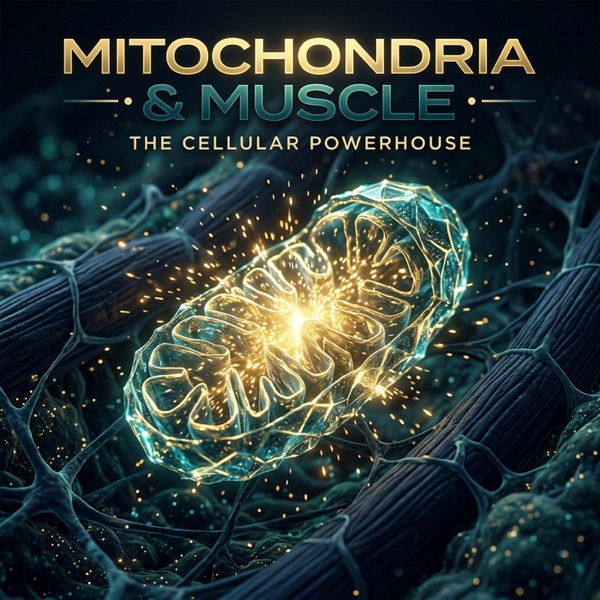
Mitochondria & Muscle
Examining human performance from the organelle level: ATP recycling, PGC-1alpha transcriptional pathways, and cellular respiration.
- Episodes
- 5
- Releases
- Weekly
- Typical length
- 18 min
- On air since
- 2026
- Latest episode
- 2 days ago
Episodes
5 episodes, newest first
-
18 min
Inside the Cooling Fiber: mTORC1, Protein Synthesis, and Cold
Show notes
Inside the Cooling Fiber: mTORC1, Protein Synthesis, and Cold
Welcome to Mitochondria & Muscle. Today the action is microscopic. Mechanical loading changes cellular signals; amino acids reach the fiber; cold water lowers its temperature. We will examine how those events intersect, what muscle biopsies can reveal, and where direct protein-synthesis measurements sharpen the picture.
A hard resistance session leaves muscle with a biological construction order: mechanical loading activates growth signaling, while nutrients, immune cells, and time help turn that signal into new tissue. An ice bath taken immediately afterward may make the athlete feel recovered while cooling the muscle during a period when the very processes needed for adaptation are underway; separating cold exposure from lifting is a prudent strategy, but no study has established a universally safe four-to-six-hour cutoff.
-
17 min
The Rechargeable Phosphate: Inside the Muscle–Mitochondria Circuit
Show notes
The Rechargeable Phosphate: Inside the Muscle–Mitochondria Circuit
Welcome to Mitochondria & Muscle. Phosphocreatine answers an urgent ATP demand, but mitochondria must help refill the reserve. Today we map that cellular circuit, explain why the first seconds of effort matter, and follow the same chemistry into a brain where the clinical answers are less certain.
Creatine does not manufacture energy; it helps cells keep ATP available at the precise moments when demand outruns ATP production, using phosphocreatine as a rapidly rechargeable phosphate reserve. That chemistry is well established in muscle and present in the brain, but the compelling possibility that supplementation protects thinking under sleep loss or low oxygen remains more conditional—and less thoroughly proven—than its effects on high-intensity exercise.
-
18 min
Inside the Leucine Sensor: From Sestrin2 to Strength
Show notes
Inside the Leucine Sensor: From Sestrin2 to Strength
Welcome to Mitochondria & Muscle. Inside a fiber, leucine changes a molecular interaction that helps regulate mTORC1. Outside the fiber, meals and loading determine whether that signal has the materials to matter. Today, we follow both scales without mistaking cellular activation for a clinical outcome.
An older muscle can receive ample food yet mount a smaller protein-synthesis response to a modest meal: the challenge is not simply eating protein, but supplying enough indispensable amino acids while repeatedly giving muscle a reason to use them. Leucine-rich meals and resistance exercise can help overcome this anabolic resistance, but neither a precise leucine number nor a 30-minute post-workout deadline overrides adequate daily intake, training, and the realities of illness and aging.
-
16 min
Inside the Recovery Night: Fluid Transport Is Not Autophagy
Show notes
Inside the Recovery Night: Fluid Transport Is Not Autophagy
Welcome to Mitochondria & Muscle. Two compelling recovery stories are often merged: fluid moving outside brain cells and material recycled within them. Today we separate glymphatic transport from autophagy, trace mTORC1 and AMPK signaling, and ask which measurements can actually demonstrate cellular turnover.
Sleep is not a passive shutdown: its changing electrical, vascular, endocrine, and thermal states coordinate opportunities for brain-solute movement and bodily repair that wakefulness cannot simply replace. The compelling image of a sleeping brain washing itself clean is rooted in important experiments, but its exact contribution to human amyloid and tau clearance—and its relationship to cellular autophagy—remains an active scientific question.
-
18 min
From a Quiet Ride to Mitochondrial Remodeling
Show notes
Why HIIT Is Not Enough: The Case for 180 Minutes of Base Cardio
Welcome to Mitochondria and Muscle. If you only do sprint intervals, you are leaving your greatest longevity adaptations on the table.
Why exercising precisely below lactate threshold (1.5–2.0 mmol/L) stimulates mitochondrial volume, fatty acid oxidation, and metabolic flexibility better than high-intensity intervals.
Fitness lists
More Fitness shows picked out from the charts










More in Fitness
Placed highest on Apple Podcasts' Fitness chart right now