Podcast
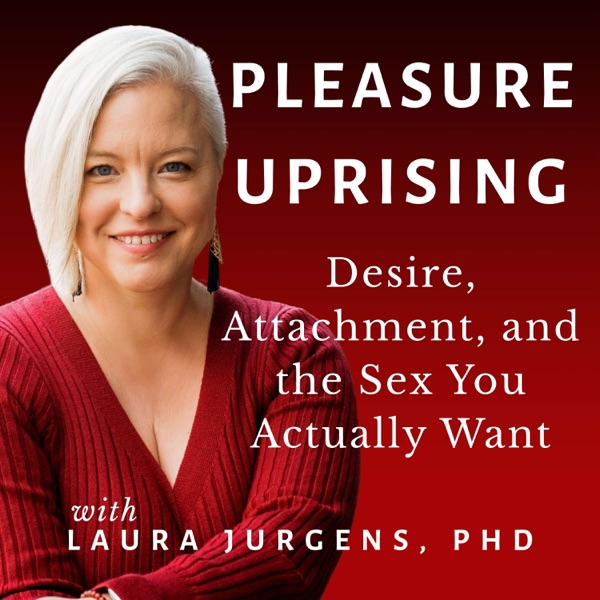
Pleasure Uprising: Desire, Attachment, and the Sex You Actually Want
Formerly The Desire Gap Podcast
Most people who feel disconnected from their desire, their pleasure, or their partners have spent years assuming something is wrong with them. It isn't. The disconnection is real — but it traces back to what most of us were never taught: how to be in our bodies fully, how to connect to each other authentically, how to know and ask for what we need without guilt or shame. Culture shapes that — the broader culture we inherit, and the family we grew up in — and it can be unlearned. Pleasure, secure attachment, and authentic desire are your birthright.
You can learn what you were never taught — and unlearn what got in the way.
Dr. Laura Jurgens is a somatic sex and intimacy specialist, Master Certified Intimacy Coach, American Board of Sexology Certified Sex Educator, and former research professor whose work sits at the intersection of nervous system science, attachment theory, and genuine embodied pleasure. Every episode delivers the somatic, body-based tools that generic relationship advice and most therapists miss entirely — because desire, pleasure, and connection aren't fixed by talking more. They're fixed by giving your body and your nervous system reparative experiences that shift you out of your past.
This show covers: getting out of your head during sex · low libido and what actually helps · somatic and nervous system approaches to intimacy · desire discrepancy and mismatched libido · secure attachment and relationship repair · sexual shame and body disconnection · how to talk about sex without fighting · ADHD and desire · the orgasm gap and why it exists · reclaiming pleasure on your own terms.
Whether you've tried therapy, books, date nights, or just quietly wondering why intimacy feels harder than it should — this show will help you understand why those things don't move the needle — and what does.
New episodes weekly. Start wherever you are.
Free resource: Get Out of Your Head — A Starter Guide to Releasing the Pressure, Shame, and "Shoulds" Around Intimacy at https://laurajurgens.com/guide
Wheel of Erotic Emotions: https;//laurajurgens.com/wheel
For deeper analysis and the research behind desire, arousal, and attachment -- plus a chance to ask me questions, subscribe to my Substack here: https://laurajurgens.substack.com/
- Episodes
- 146
- Releases
- Weekly
- Typical length
- 34 min
- On air since
- 2024
- Latest episode
- 1 day ago
Episodes
146 episodes, newest first
-
1 hr 3 min
When the News Is Full of Sexual Violence: Rage, Loss of Desire, and Men’s Silence
Episode 146
Show notes
A listener wrote in asking how to bring her male partner into her emotional experience of the sexual violence in the news. Especially without having to teach him everything first. I think many of you may have a similar question. So I made you an episode.
When sexual violence dominates the headlines, a lot of us end up either carrying it alone or doing the emotional labor of explaining our own pain to the people closest to us, with sometimes disappointing results. I wanted to offer a real way through that doesn’t ask you to choose between caring for yourself and being heard.
In this episode:
• Why naming your desire to be understood, even before you know how to say what you’re feeling, is itself a gift to your partner
• How to actually identify and name the emotions you’re carrying, rage, exhaustion, grief, fear, so you can ask for what you need
• A script for telling someone how you want to be received before you share something hard, instead of hoping they guess right
• The difference between a good response and a bad one, and what to do when your partner gets defensive
• Why this collective rage and exhaustion erodes desire, and what actually helps you come back into connection
• What men in your life need to hear, and why silence, even well-intentioned silence, doesn’t land the way they think it doesYou don’t have to carry this by yourself, and you don’t have to be anyone’s teacher to be loved well. Let people show up for you.
Topics: sexual violence, rage, loss of desire, sexual trauma, relationship communication, intimacy coach
Resources mentioned:
• My original article: "What We Actually Need From You Right Now" at Pleasure Uprising Substack
• Rage Becomes Her by Soraya Chemaly (book) — Simon & Schuster
• Believed (NPR podcast) — https://www.npr.org/podcasts/510326/believed
• Roll Red Roll (documentary) — PBS POV
• Know My Name by Chanel Miller (book) — Penguin Random House
• Missoula: Rape and the Justice System in a College Town by Jon Krakauer (book) — https://jonkrakauer.com/Get my free guide: Get Out of Your Head: A Starter Guide to Releasing the Pressure, Shame, and "Shoulds" Around Intimacy at https://laurajurgens.com/guide
Follow me on Substack for deeper dives into the research and notes from my practice at https://laurajurgens.substack.com/
The Guide to Finding Your Secret Turn-Ons includes the Wheel of Erotic Emotions: https://laurajurgens.com/wheel
© Laura Jurgens, PhD, Pleasure Uprising. Quote with attribution and a link to the original. No reproduction in full and no use for AI training.
-
21 min
When Nothing Has Worked to Fix Your Sex Life: How to Build Hope Again
Episode 145
Show notes
When nothing has worked to fix your sex life, it’s easy to decide nothing will. You’ve tried a few things, they didn’t help, and so you stop trying. I understand why. But that conclusion is a belief, not a fact, and it’s the belief that keeps people stuck in their relationships and sex lives for years.
I recorded this episode on a walk around my neighborhood, up the steep hill I’d been begrudging and semi-avoiding for months. Somewhere on the climb I realized the hill wasn’t the problem. My negativity bias was. The same is often true of the things you’ve decided can’t change in your relationship.
In this episode:
• Why avoiding a problem that feels hopeless makes it feel even more hopeless, and how that shows up as low energy, numbing, and overworking
• The belief that the past predicts the future, and why you already know it isn’t true
• How I turned the hill I was dreading into my favorite loop, and what that reminded me about negativity bias
• Why hope isn’t something that falls from the sky and hits you in the head like an acorn, and the simple writing practice I use to build it
• What teaching kids and adults to swim showed me about believing change is possible
• Why every hard change I’ve made, from quitting smoking and drinking to earning a PhD and building a business, started with hope before I was ready to invest the time, effort, or money to actually do itHope is the part you build for free. And it has to come first.
Topics: feeling stuck in relationship, improving your sex life, negativity bias, avoidance, building hope, making change
Get my free guide: Get Out of Your Head: A Starter Guide to Releasing the Pressure, Shame, and "Shoulds" Around Intimacy at https://laurajurgens.com/guide
Follow me on Substack for deeper dives into the research and notes from my practice at https://laurajurgens.substack.com/
The Guide to Finding Your Secret Turn-Ons includes the Wheel of Erotic Emotions: https://laurajurgens.com/wheel
© Laura Jurgens, PhD, Pleasure Uprising. Quote with attribution and a link to the original. No reproduction in full and no use for AI training.
-
32 min
Autism and Sex: Nothing About You Is a Problem
Episode 144
Show notes
This episode is about autism and sex, autism and intimacy, and the myths that keep autistic people from seeing what they bring to relationships. It's the first in a series on autism and relationships.
A pattern I see in my work with autistic clients and their partners is that they come to me sure that the autism is the problem. It's usually not. There are usually just some specific needs to be addressed and some specific strengths to capitalize on. Plus, most autistic people I work with benefit from even stronger doses of what neurotypical people benefit from: clear communication, practice, and a plan.
In this episode:
• Why "aromantic," "asexual," "no empathy" and "not interested in partnership" don't describe autistic people as a group at all
• The double empathy problem: autistic and non-autistic people misread each other in both directions, and only one side gets called deficient
• Why asexuality, demisexuality, queerness and gender fluidity show up more often in autistic people, and why none of that is a problem to solve
• The autistic strengths that also make great lovers
• Sensory needs in sex (lighting, sound, smell, texture, pressure, pacing) and how to negotiate them like any other preference
• Why needing sensory downtime is not rejecting your partner
• What my client actually needed: not better "reading," but explicit questions, practice, and a planNothing about being autistic is a problem for relationships and intimacy. You have specific needs, like everyone else, and what's unique about you is likely what makes you a fantastic partner.
Topics: autism and sex, autism and intimacy, neurodivergent relationships, double empathy problem, sensory needs, consent
Get my free guide: Get Out of Your Head: A Starter Guide to Releasing the Pressure, Shame, and "Shoulds" Around Intimacy at https://laurajurgens.com/guide
Follow me on Substack for deeper dives into the research and notes from my practice at https://laurajurgens.substack.com/
The Guide to Finding Your Secret Turn-Ons includes the Wheel of Erotic Emotions: https://laurajurgens.com/wheel
© Laura Jurgens, PhD, Pleasure Uprising. Quote with attribution and a link to the original. No reproduction in full and no use for AI training.
-
58 min
Sex After Divorce and Purity Culture: How Amber Let Go of Sexual Shame
Episode 143
Show notes
"I want to create a relationship with my body, my mind, pleasure and intimacy that is rooted in my values & freedom, without guilt or shame. I want to have sex with someone I'm not married to and not feel dirty or immoral the next day."
That's what my client Amber wrote on her intake form in June. She rated herself a 1 out of 10. Ten weeks later, she rated herself a 10. In this episode, Amber and I talk about how she made that giant leap.
This is a conversation about building sexual confidence after divorce and letting go of sexual shame. Amber grew up in purity culture and came to me when she was just starting to date again, worried that her desire was too much and feeling that her job in bed was to make the other person comfortable. She tells you what she practiced to shift into owning her pleasure, receiving pleasure without shame, and letting go enough to get back into her body and enjoy the way it responds instead of judge it. She also talks about learning to accept her own desires and preferences for relationship, rather than worrying about being "too much" or assuming having needs means you have an attachment problem (which is not necessarily true).
In this episode:
• How Amber learned to receive: lying back, being seen in pleasure, and accepting her face, her sounds and her shaking legs instead of being embarrassed by them
• What changed when she said her fantasies out loud to someone who didn't flinch, after years of feeling "insatiable" and dirty for wanting so much
• The anatomy lesson, mirror work and daily breath practice that changed how she feels about her vulva
• Asking for what she wants without apologizing, including an orgasm before penetration
• Why sex stopped hurting once foreplay took as long as her body needed
• How she went from freezing or fawning to saying no out loud, starting with low-stakes role play
• Why wanting more contact from a partner wasn't anxious attachment. It was having needs and not getting them met
• The sentence she prepared for the morning after, so shame didn't get the first word.Amber got here by listening to what her body asked for, one small decision at a time, and practicing until she trusted herself. If you're starting over after divorce, struggling with people-pleasing, feeling like you're "too much," or still hearing the voice of religious shaming in your head, this one is for you.
Topics: sexual confidence, sex after divorce, sexual shame, receiving pleasure, purity culture, boundaries
Get my free guide: Get Out of Your Head: A Starter Guide to Releasing the Pressure, Shame, and "Shoulds" Around Intimacy at https://laurajurgens.com/guide
Follow me on Substack for deeper dives into the research and notes from my practice at https://laurajurgens.substack.com/
The Guide to Finding Your Secret Turn-Ons includes the Wheel of Erotic Emotions: https://laurajurgens.com/wheel
© Laura Jurgens, PhD, Pleasure Uprising. Quote with attribution and a link to the original. No reproduction in full and no use for AI training.
-
44 min
How to Last Longer in Bed: What It Really Takes & What Partners Really Want
Episode 142
Show notes
If you want to last longer in bed, the stopwatch is probably not your biggest problem. Most men who orgasm faster than they want to are carrying performance anxiety, and it shows up as tension in the pelvic floor, tension in the whole body, and a habit of pulling away from the person they're with.
Here's the thing. When researchers asked women whose partners came quickly what distressed them most, the top answer was not how fast it happened. It was his lack of attention and his focus on his own performance. This episode is for men who come faster than they want to, and for the partners who love them.
In this episode:
• Why partners are usually upset about the shame and the withdrawal, not the clock, and what research says about average time to orgasm
• How anxiety, pelvic floor tension, and old masturbation habits train your body to orgasm fast
• A five-minute breath and pelvic floor practice, plus how to slow down and ride the waves in self-pleasure
• What to say to your partner, whether you're the one struggling with PE or the one who's partner is struggling
• How to take the pressure off tonight, before any practice has time to work
• Where cock rings, positions, and medication fit, and when to see a doctorLasting longer is worth working on. But staying present and engaged with your partner, whether you've orgasmed or not, is what your partner will remember, and that part you can start right now.
Topics: how to last longer in bed, lasting longer, performance anxiety men, premature ejaculation, early ejaculation, pelvic floor exercises for men
Get my free guide: Get Out of Your Head: A Starter Guide to Releasing the Pressure, Shame, and "Shoulds" Around Intimacy at https://laurajurgens.com/guide
Follow me on Substack for deeper dives into the research and notes from my practice at https://laurajurgens.substack.com/
The Guide to Finding Your Secret Turn-Ons includes the Wheel of Erotic Emotions: https://laurajurgens.com/wheel
© Laura Jurgens, PhD, Pleasure Uprising. Quote with attribution and a link to the original. No reproduction in full and no use for AI training.
-
38 min
How to Initiate Sex With a Responsive Desire Partner
Episode 141
Show notes
If you ask your partner "do you want to have sex?" and they say no almost every time, the problem might not be desire. Seriously.
It's the question. Responsive desire doesn't show up to that question. It shows up in response to something tangible happening that enables desire. So if nothing has happened yet, there's nothing there to say yes to. That's not rejection. That's an honest answer to a question that can't be answered yet.
Responsive desire is also the most common form of desire in long-term relationships, and in most adults over 40, regardless of gender, in my practical experience. Almost nobody depicts it that way, so a lot of people think something's wrong with them for having it.
Today I'm going to help you understand responsive desire and how to navigate it, including how to make more effective invitations.
In this episode:
• What responsive desire actually is, and why it works like breadcrumbs rather than a switch
• Why asking for sex point blank almost always gets a no from a responsive desire person, and why that's not the problem it looks like
• Why no has to be genuinely safe before yes becomes possible, and why nobody is ever entitled to their partner's body
• What to actually ask for instead of asking for sex, and how to build a "menu" of what generally feels good
• The exact conversation to have before you're in bed, not during
• How to avoid the pitfall of turning a good night into next time's obligation
• Why this matters even more if you're neurodivergent, and what pathological demand avoidance (PDA) has to do with itIf you give yourself real time and space, with no predetermined destination, desire tends to show up. You just can't demand it in advance.
Topics: responsive desire, initiating sex, sexual rejection, desire discrepancy, consent, neurodivergence and intimacy
Links to other episodes mentioned:
Saying No Vs. Rejection: https://laurajurgens.com/138-sexual-rejection-vs-saying-no/
Get my free guide: Get Out of Your Head: A Starter Guide to Releasing the Pressure, Shame, and "Shoulds" Around Intimacy at https://laurajurgens.com/guide
Follow me on Substack for deeper dives into the research and notes from my practice at https://laurajurgens.substack.com/
The Guide to Finding Your Secret Turn-Ons includes the Wheel of Erotic Emotions: https://laurajurgens.com/wheel
© Laura Jurgens, PhD, Pleasure Uprising. Quote with attribution and a link to the original. No reproduction in full and no use for AI training.
-
32 min
Your Superpowers: Building Sexual Confidence From What You Already Do Well
Episode 140
Show notes
You know what you struggle with in bed, and you're probably pretty hard on yourself about it. But if I ask what you're good at, do you go blank? Focusing on our deficits is just what brains do, but it costs us more than we think.
You're not broken, and you are not starting from zero.
I spend a lot of time on this show talking about what gets in the way. Shame, performance, the stories you absorbed about your body. That work matters. But there's a flip side that gets overlooked: you almost certainly have sensual and sexual strengths right now that you have never once given yourself credit for. The things that come easily to us just feel like the water we swim in, so we assume everyone has them and we don't count them as anything.
And that costs you, because when all you can see is the gap between where you are and where you want to be, you start using that gap as proof you'll never get there.
In this episode:
• Why fixating on what's missing quietly undermines your ability to get there
• The tale of two Lauras: the softball season I quit before it ended, and the Olympic weightlifting I'm still doing and loving
• How measuring backwards from where you started keeps motivation alive
• Sixteen categories of sensual and sexual superpowers, from knowing your erogenous zones to flirting, receiving, consent, imagination, and taking your time
• Why nobody has all of them, and why you don't have to work on everything
• An exercise to find your own, and what to do once you have the listGetting out of performance isn't only about putting down the act. It's also about finding out what's underneath it and owning that. You can't stop performing if you don't believe you have anything real to offer without the performance. You do.
Topics: sexual confidence, sexual self-esteem, body confidence, embodiment, pleasure, sexual shame
Get my free guide: Get Out of Your Head: A Starter Guide to Releasing the Pressure, Shame, and "Shoulds" Around Intimacy at https://laurajurgens.com/guide
Follow me on Substack for deeper dives into the research and notes from my practice at https://laurajurgens.substack.com/
The Guide to Finding Your Secret Turn-Ons includes the Wheel of Erotic Emotions: https://laurajurgens.com/wheel
© Laura Jurgens, PhD, Pleasure Uprising. Quote with attribution and a link to the original. No reproduction in full and no use for AI training.
-
33 min
The Worth Wound: Why You're Attracted to People Who Don't Want You
Episode 139
Show notes
I used to break up with the good ones. The kind, available, clearly-into-me ones. Not because I got bored. Because it made my skin crawl. I knew it was bad for me, but I didn't fully understand why I felt that way until I learned to feel worthy, twenty years later.
This is the final episode in my series on attachment wounds and how they shape desire and relationship dynamics. Today's is the worth wound: the belief that love has to be earned. We talk about how this impacts relationships and, among other things, turns intimacy into performance instead of presence.
In this episode:
• Where the worth wound gets built in childhood, even in loving families, and why high-achieving or scarcity-driven households produce it so reliably
• How it shows up differently in the body: sexual numbness or pain in people with vulvas, erectile difficulty or hypersexuality in people with penises, both tied to performance anxiety
• Why being fully wanted by someone who's clearly into you can feel like an ick instead of a relief, and what that reaction is actually protecting you from
• The two erotic pathways this wound creates, why playing with them can be healing if you know how to ask a partner for the right stuff, and how to tell which one your fantasies are running
• How this wound plays out in long-term relationships: testing partners, over-functioning, and the black hole dynamic where nothing your partner offers ever feels like enough
• The two-part practice for healing it: soothing the inner child parts that hold the not-enoughness, then practicing being instead of doing
• The sentence most worth-wound carrying people crave from themselves and their loved onesYou are not required to perform your way into being loved. That was never the deal, even when it felt like it was. You get to just be wanted.
Topics: feeling unworthy, attachment wounds, dissociating during sex, feeling numb during sex, performance anxiety men, people pleasing
Get my free guide: Get Out of Your Head: A Starter Guide to Releasing the Pressure, Shame, and "Shoulds" Around Intimacy at https://laurajurgens.com/guide
Follow me on Substack for deeper dives into the research and notes from my practice at https://laurajurgens.substack.com/
The Guide to Finding Your Secret Turn-Ons includes the Wheel of Erotic Emotions: https://laurajurgens.com/wheel
© Laura Jurgens, PhD, Pleasure Uprising. Quote with attribution and a link to the original. No reproduction in full and no use for AI training.
-
44 min
How to Say No to Sex Without Rejecting Your Partner
Episode 138
Show notes
She wanted more sex with her husband. She flirted. She invited him to bed. She was not subtle. And he had an entire set of moves for avoiding it. Staying up working late. Taking a very long shower and hoping she'd be asleep by the time he came to bed. Acting harried, a quick peck, roll over.
He almost never said no out loud. He told me directly that he was avoiding saying it because he didn't want to hurt her feelings. He thought that was the kind version.
It was so much worse than a no would have been. Because what she was receiving, night after night, was not "not tonight." It was "I don't want you."
Here's the punchline, straight out: a no and a rejection are not the same thing. A no is information about this moment. A rejection is the withdrawal of connection. Most of us have collapsed them into one thing, and it's costing us.
In this episode:
• Why a no is just one piece of data about right now, and a rejection is something you do with your body and your attention
• The two reasons people overstate their no: not feeling entitled to say it, and never having seen it done well
• What the nonverbal rejection dance does to a relationship over time, and why invitations eventually stop happening altogether
• A four-step way to say no out loud and stay connected while you do it
• What to do if you're the one receiving it, because this is not a one-person job
• Why the desire for an orgasm and the desire for connection are different wants, and what happens when you conflate them
• Other ways of connecting, and why most of my clients turn out to want to feel wanted more than they want sex at any given moment (regardless of gender)You can say no as often as it's true. A no is a gift of trust. It's the rejection that does the damage, and those are two completely different dances. This episode will show you how to separate them.
Topics: sexual rejection, saying no to sex, desire discrepancy, mismatched libido, responsive desire, feeling rejected by partner
Get my free guide: Get Out of Your Head: A Starter Guide to Releasing the Pressure, Shame, and "Shoulds" Around Intimacy at https://laurajurgens.com/guide
Follow me on Substack for deeper dives into the research and notes from my practice at https://laurajurgens.substack.com/
The Guide to Finding Your Secret Turn-Ons includes the Wheel of Erotic Emotions: https://laurajurgens.com/wheel
© Laura Jurgens, PhD, Pleasure Uprising. Quote with attribution and a link to the original. No reproduction in full and no use for AI training.
-
23 min
The Freedom Wound: Why You Say Yes When You Want to Say No
Episode 137
Show notes
Picture someone who says yes to almost everything. They're helpful, they're loyal, they always show up. And yet there's always some reluctance. A headache. A tiredness. They take forever to get out the door. Underneath all that yes is a wagon load of resentment about being asked in the first place.
This shows up in bed exactly the way it shows up everywhere else. They think they want intimacy. They say they want it, and they probably mean it. But when the moment comes, their body does something else. If you ask what changed, they may genuinely not know.
This is episode four of the specific attachment wounds and erotic emotions series, and it's about what happens when a small child's no was not allowed. Around age two to five, we're supposed to discover that we get to decide things for ourselves, at least sometimes. When that gets squashed, or love is conditional on compliance, life turns into a series of obligations. The autonomy that never got a legitimate outlet goes underground into slowness, procrastination, and quiet resistance.
A lot of people with this wound have to be allowed to say no before they can find a yes. Not as a preference. As a requirement.
In this episode:
• Where the freedom wound comes from, and the two very different directions it goes depending on whether compliance actually earned love
• What it feels like from the inside, including the pride in enduring and the fury about having had to endure
• Why procrastination and slowness are the body's protest response, not a character flaw
• Why welcoming a partner's no is one of the most erotic things you can do, and why it's non-negotiable for this wound
• The paradox of chosen restraint, and why submitting to control you selected can feel like freedom
• Why dragging your partner into anything is the worst available strategy, and what to do instead
• How to start telling the difference between an obligated yes and a real oneThere is nothing wrong with you. This was a wise strategy for a small person who wasn't allowed to have preferences. You're allowed to have them now.
Topics: sex feels like obligation, people pleasing in relationships, resentment in relationships, saying no, attachment wounds
Get my free guide: Get Out of Your Head: A Starter Guide to Releasing the Pressure, Shame, and "Shoulds" Around Intimacy at https://laurajurgens.com/guide
Follow me on Substack for deeper dives into the research and notes from my practice at https://laurajurgens.substack.com/
The Guide to Finding Your Secret Turn-Ons includes the Wheel of Erotic Emotions: https://laurajurgens.com/wheel
© Laura Jurgens, PhD, Pleasure Uprising. Quote with attribution and a link to the original. No reproduction in full and no use for AI training.
-
43 min
Penis Size, Performance Anxiety, and What Women Really Want
Episode 136
Show notes
A man came to me because his marriage was close enough to over that they'd both used the word divorce. Underneath the resentment and the withdrawal and the fights about everything else was this: his erections came and went. Sometimes they softened partway through. Sometimes they didn't show up.
That is normal. It happens to men at every age. But he was so ashamed of it that he avoided sex with his wife for ten years. She had guessed, and she had told him more than once that it did not matter to her. He did not believe her.
We solved it in about four sessions. None of the actual problems were about his penis. They were about the shame, the silence, the misdirected anger, and the avoidance.
This is the third episode in my body shame series, and it's the one for people with penises. I'm giving you the real numbers on size, hardness, and duration, because they are nothing like what porn taught you. Then I'm going through each specific worry with a fix that gets you both more pleasure and less anxiety.
In this episode:
• Where penis shame comes from, and what porn does to your subconscious when you don't get better information
• The actual average erect length, from clinician-measured data on over 55,000 men, plus what's normal variation (hint: 3" is as normal as 7")
• Why 85% of women are satisfied with their partner's size while only 55% of men are satisfied with their own, and what to do about size, regardless of yours
• The single change that solves lasting-longer anxiety better than any technique, and why stopping sex when you orgasm is the real problem
• Why 75 to 80% of women don't orgasm from penetration alone, and what that means for where your anxiety is aimed
• How performance anxiety physically restricts blood flow, and why you cannot will an erection into existence by worrying at it
• Specific fixes for size concerns, a genuinely small penis, erections that fluctuate, delayed ejaculation, aging, and lower desire
• What women consistently report actually caring aboutYour penis was never the problem. Don't spend any more years of your life creating unnecessary misery because of shame about it.
Topics: erectile dysfunction anxiety, penis size, delayed ejaculation, premature ejaculation, how to last longer, what women want in bed
Get my free guide: Get Out of Your Head: A Starter Guide to Releasing the Pressure, Shame, and "Shoulds" Around Intimacy at https://laurajurgens.com/guide
Follow me on Substack for deeper dives into the research and notes from my practice at https://laurajurgens.substack.com/
The Guide to Finding Your Secret Turn-Ons includes the Wheel of Erotic Emotions: https://laurajurgens.com/wheel
© Laura Jurgens, PhD, Pleasure Uprising. Quote with attribution and a link to the original. No reproduction in full and no use for AI training.
-
29 min
The Trust Wound: Why Being Vulnerable Feels So Dangerous
Episode 135
Show notes
I used to chase accomplishment hard, and I dismissed soft skills and people skills entirely — mostly because I had no idea how to do them. I'd put on this dissociated charm self when I met new people, which wasn't connection at all. It was a disarming move. If I could charm you first, you couldn't get to me. Underneath all of it was a deep fear of being publicly rejected.
A close colleague of mine has the same wound and it looked nothing like that from the outside. Hers came out as passive aggression, eye rolls, indirect judgment, the quiet withdrawal of approval. Underneath: a deep fear of humiliation. Two different flavors of the same armor, both doing the same job of not letting anyone get close enough to make us feel small.
This is episode three of the attachment wounds and erotic emotions series, and it's about the trust wound — what happens when your openness got used against you, and you concluded you'd never be in that position again.
The paradox at the center of it: the erotic emotion people with this wound most often crave is the exact thing they've spent their lives defending against.
In this episode:
• Where the trust wound comes from, and why humiliation specifically drives manipulation as a coping response
• The two developmental paths, depending on how old you were when it happened
• What it feels like from the inside, including the constant low-level tracking of who has power in a room
• Why the powerful poles — revered, dominant, worshiped, unattainable — show up as the obvious turn-ons, and what's often underneath them
• How this shows up in relationships: guilt tripping, triangulation, passive aggression, and pseudo-connection
• Why the vulnerability play that can heal this needs serious aftercare, and what happens if you get dropped
• What actually changed for both me and my colleague, including what she discovered was a real turn-onVulnerability is not the thing that makes you vulnerable. Look around at how many people are working to avoid it. It isn't making them any safer. It's just keeping them from being known.
Topics: fear of humiliation, why is it so hard to be vulnerable, passive aggressive relationship, invulverable
Get my free guide: Get Out of Your Head: A Starter Guide to Releasing the Pressure, Shame, and "Shoulds" Around Intimacy at https://laurajurgens.com/guide
Follow me on Substack for deeper dives into the research and notes from my practice at https://laurajurgens.substack.com/
The Guide to Finding Your Secret Turn-Ons includes the Wheel of Erotic Emotions: https://laurajurgens.com/wheel
© Laura Jurgens, PhD, Pleasure Uprising. Quote with attribution and a link to the original. No reproduction in full and no use for AI training.
-
32 min
Is My Vagina Normal? Undoing Vulva and Labia Shame
Episode 134
Show notes
Around 40, I realized I felt disgust about my own genitals. I'd been carrying middle school bullies' words about female bodies in my head for more than thirty years without ever once questioning them, and it wasn't until I started trying to reclaim my own sexuality that it smacked me in the face. It's very hard to feel pleasure in a part of your body you feel bad about.
If any of that lands, you are in extremely good company, and I want you to know it is not personal, not yours alone, and not permanent.
This episode covers where female genital shame comes from, why it's more layered than penis shame, and the exact four-step process I used to repair my own relationship with my vulva. Plus the myths worth dismantling on the way: that vulvas are dirty, that porn vulvas resemble real ones, and that "vagina" is the right word for the parts that actually give you pleasure.
A scope note: this episode addresses cis women's experience specifically. Trans people with vulvas face distinct and important challenges with genital shame that deserve dedicated coverage, and I'm working with a trans colleague on a collaborative episode on that.
In this episode:
• Where vulva shame comes from, and the strange contradiction at the center of it — women are the only sex with an organ that exists purely for our own pleasure
• Why middle school is so often where genital shame gets installed, and what's actually going on for the boys doing the installing
• The dirty myth, and why calling a vulva dirty makes about as much sense as calling a flower dirty
• Why porn vulvas aren't real-world vulvas, and how to normalize the actual range
• Vulva versus vagina, why the distinction matters for your pleasure, and how to pick language that works for you
• My four-step repair process: acknowledging the harm, normalizing through exposure, mirror work, and a daily gratitude practice
• The eviction exercise — identifying whose voice is actually in your head, and taking away their voteThere is no downside to loving your genitals. None. And on the other side of that shame is considerably more pleasure than you currently have access to.
Topics: vulva shame, genital shame, body shame, labia, women's pleasure
Resource Links: https://www.labialibrary.org.au/labia_gallery/
https://www.all-vulvas-are-beautiful.com/
https://www.thevulvagallery.comGet my free guide: Get Out of Your Head: A Starter Guide to Releasing the Pressure, Shame, and "Shoulds" Around Intimacy at https://laurajurgens.com/guide
Follow me on Substack for deeper dives into the research and notes from my practice at https://laurajurgens.substack.com/
The Guide to Finding Your Secret Turn-Ons includes the Wheel of Erotic Emotions: https://laurajurgens.com/wheel
© Laura Jurgens, PhD, Pleasure Uprising. Quote with attribution and a link to the original. No reproduction in full and no use for AI training.
-
37 min
The Dependency Wound: When Care Was Never Something You Could Count On
Episode 133
Show notes
One partner wants sex constantly and can't understand why they're being refused. The other has quietly stopped wanting it at all and feels like they're constantly being pestered. Most people assume these two have opposite problems. Often times, they don't. They have the same challenge underneath, but they are coping in different ways.
We're going beyond the standard "anxious or avoidant" here. Most of us learned early on whether care was something we could count on, and when the answer was unreliable, we did what smart, adaptive human children do: we picked a coping strategy and got very good at it. There are two main choices children make — pursue harder, or stop needing.
Those two roads lead to very different adults, very different ways of existing in relationships, and very specific erotic desires. This episode will help you understand the challenges, drawbacks, opportunities, and desires that come from each path, and how to work with those to have better connections, easier relationships, and a more satisfying sex life.
This is episode three of the attachment wounds and erotic emotions series, and the second one on specific wounds.
In this episode:
• Where the dependency wound comes from, including causes that have nothing to do with bad parenting and everything to do with circumstances that made consistent attunement hard
• The two survival strategies it creates, and what each one actually feels like from the inside
• Why the under-dependent's deepest erotic craving is often identical to the over-dependent's, just buried under years of pretending it isn't there
• How both patterns land on a partner, in and out of bed
• Why over-dependents and under-dependents are drawn to each other, and why that match can go sideways fast
• What movement actually looks like for each, including the single most important thing an under-dependent can do before they quietly shut someone out for goodYour needs are real. Both sides of this wound are just different ways of coping with the same early experience, and you can learn to count on care being there.
Topics: anxious avoidant attachment, my partner never wants sex, sex feels like obligation, mismatched libido couples, desire discrepancy
Get my free guide: Get Out of Your Head: A Starter Guide to Releasing the Pressure, Shame, and "Shoulds" Around Intimacy at https://laurajurgens.com/guide
Follow me on Substack for deeper dives into the research and notes from my practice at https://laurajurgens.substack.com/
The Guide to Finding Your Secret Turn-Ons includes the Wheel of Erotic Emotions: https://laurajurgens.com/wheel
© Laura Jurgens, PhD, Pleasure Uprising. Quote with attribution and a link to the original. No reproduction in full and no use for AI training.
-
33 min
Body Shame and Your Sex Life: It's Not Your Fault, and Only You Can Fix It
Episode 132
Show notes
Body shame is pervasive, especially for women but increasingly for everyone, and it gets in the way of much more than how we feel in a swimsuit. It gets in the way of presence, pleasure, and our capacity for real connection. This is the first episode in a series I'm doing on body shame. If you've ever been so in your head about how you look that you couldn't stay present with a partner, or with yourself, this one is for you.
I walk through where body shame actually comes from (spoiler: it's not truth, or you, that's the problem), the business model built on manufactured insecurity, the medical misinformation and racial history behind our cultural obsession with weight, and why shaming yourself has never once helped anyone change. I also share the exact steps I used to move from shame to neutral to genuinely loving my body.
In this episode:
• Why body shame kills presence, pleasure, and desire, and why underconfidence itself isn't sexy
• Where body shame really comes from: family, culture, diet culture, and a patriarchy that built this by design, not by accident
• The advertising strategy behind manufactured insecurity, including research on exactly when women feel worst about themselves
• Debunking the medical myths: why BMI was never built to measure individual health, and why weight stigma itself, not weight, is the real risk factor
• The racial history behind fat phobia and Eurocentric beauty standards, and how that bias still shows up in medicine today
• Why shaming yourself has never once helped you change, and what your inner rebel is actually trying to tell you
• My own story of hiding my arms for years, and finally wearing tank tops without a second thought
• "Point positive," the whitewater kayaking principle I now use to retrain my brain out of shame spirals
• The exact steps for shifting from shame to neutral to genuinely believing you're lovable and attractive exactly as you areTopics: body image and sex, overthinking sex, get out of your head in bed, fatphobia, health at every size, mindset work for body image
Resources mentioned: Health at Every Size: The Surprising Truth About Your Weight, by Lindo Bacon, PhD https://lindobacon.com/health-at-every-size-book/
Get my free guide: Get Out of Your Head: A Starter Guide to Releasing the Pressure, Shame, and "Shoulds" Around Intimacy at https://laurajurgens.com/guide
Follow me on Substack for deeper dives into the research and notes from my practice at https://laurajurgens.substack.com/
The Guide to Finding Your Secret Turn-Ons includes the Wheel of Erotic Emotions: https://laurajurgens.com/wheel
© Laura Jurgens, PhD, Pleasure Uprising. Quote with attribution and a link to the original. No reproduction in full and no use for AI training.
-
19 min
The Safety Wound: When Your Body Was Never Home
Episode 131
Show notes
Part 2 of the Attachment Wounds & Erotic Emotions Series
Maybe you have a tendency to intellectualize or spiritualize your experience, but not always fully feel it. Or maybe you can only really arrive in your body when something intense is happening. This episode is about how that happens, how it shapes your erotic needs and the way you show up in intimacy, and what to do about it, if you choose.
The safety wound is the earliest developmental wound we're covering in this series. It shows up in desires, in relationship, and in sex, plus in every day life where people with this wound have a tendency to dissociate. This episode is Part 2 in the Attachment Wounds and Erotic Emotions series — if you haven't listened to Episode 130 yet, start there first.
What Is the Safety Wound? Origins and Early Development
The safety wound forms in the very first stage of life — from the womb through infancy, before language, and before verbal memory as we know it. The unmet need is fundamental: a sense that the world is safe to exist in, and that the body is a safe place to be.
The causes can include traumatic birth, early separation from a birth mother through adoption or loss, time in a NICU, parental anxiety or depression, domestic chaos, overwhelming or unpredictable environments, or generational trauma. Often nothing was done consciously or intentionally. The body simply learned, very early, that being present was dangerous — and dissociation became the primary survival strategy. This is just a coping style, and it carries some challenges that can be worked with.
In this episode:
• What the safety wound is, where it comes from, and why it forms so early — before language, before memory
• Why dissociation here is a brilliant survival adaptation, not a pathology — and how I recognized it in my own experience
• How this wound is named across Hakomi, NARM, and the Somatica Institute® framework — and why the older Freudian label is worth leaving behind
• What the safety wound feels like from the inside: the floating quality, the empathy overload, the pull toward intellectualizing and spiritual bypassing — and the deep current of pain, fear, or rage that often lives underneath
• How the safety wound shapes erotic desire through two pathways: resolution (craving calm, merged, held, contained, seen) and repetition with agency (craving intensity, edge, risk, primal)
• Why craving dangerous or intense experiences in a chosen context makes complete sense for this wound — and why felt safety is still the prerequisite, even for the edgy stuff
• What the safety wound looks like in relationships: the connection that arrives and quietly disappears, and what partners tend to experience in bed
• What healing looks like for this wound — embodiment first — and why somatic work is more relevant here than therapy or spirituality aloneCompanion resource for this series: The Wheel of Erotic Emotions → laurajurgens.com/wheel
Get my free guide: Get Out of Your Head: A Starter Guide to Releasing the Pressure, Shame, and "Shoulds" Around Intimacy at https://laurajurgens.com/guide
Follow me on Substack for deeper dives into the research and notes from my practice at https://laurajurgens.substack.com/
The Guide to Finding Your Secret Turn-Ons includes the Wheel of Erotic Emotions: https://laurajurgens.com/wheel
© Laura Jurgens, PhD, Pleasure Uprising. Quote with attribution and a link to the original. No reproduction in full and no use for AI training.
-
39 min
Beyond Anxious and Avoidant: Here's What's Actually Driving Your Desires
Episode 130
Show notes
That thing that turns you on but you've never quite been able to explain? Or the relationship dynamic you keep recreating? Those aren't random. And they aren't fully explained by your attachment style.
This is the introduction episode for a series on attachment wounds and erotic desires. Before we get into the specific wound patterns, I'm laying the foundation — what attachment styles actually are, where they fall short, and how to understand attachment patterns beyond the standard (avoidant, anxious, disorganized or secure) boxes. We'll talk about how our childhood experiences and specific attachment wounds tend to lead to specific turn-ons. Plus, why that's good news and will help you de-shame your desires.
In this episode:
• Why attachment styles are learned habits, not personality traits or life sentences
• How your attachment response shifts depending on who you're with, how they communicate, and the specific felt safety of that relationship
• Why the anxious/avoidant label doesn't capture the full picture — and what the deeper wounds underneath those patterns actually are
• A preview of the five developmental wounds this series explores: safety, dependency, trust, autonomy, and worth
• The core skills that underlie secure attachment — and why they're learnable, not fixed traits reserved for people who had easier childhoods
• How early unmet needs shape not just your relational patterns but your specific erotic desires — and why that connection makes complete sense once you see itCompanion resource for this series:
Dr. R. Chris Fraley's attachment quiz at yourpersonality.net/relstructures/ — the most useful tool I've found for understanding your patterns in the context of specific relationships, not just in the abstract
The Wheel of Erotic Emotions — a visual map of common erotic emotions organized by category → laurajurgens.com/wheel
Get my free guide: Get Out of Your Head: A Starter Guide to Releasing the Pressure, Shame, and "Shoulds" Around Intimacy at https://laurajurgens.com/guide
Follow me on Substack for deeper dives into the research and notes from my practice at https://laurajurgens.substack.com/
The Guide to Finding Your Secret Turn-Ons includes the Wheel of Erotic Emotions: https://laurajurgens.com/wheel
© Laura Jurgens, PhD, Pleasure Uprising. Quote with attribution and a link to the original. No reproduction in full and no use for AI training.
-
28 min
What Makes a Great Lover? Research Shows It's These 8 Traits
Episode 129
Show notes
If you're searching for how to be a better lover, chances are you're encountering a lot of opinions that aren't rooted in fact. Most of us absorbed a version of what makes a great lover without ever being taught it — from movies, porn, romance novels, and a culture that never corrects those images with reality. The result is a subconscious checklist that includes perfect technique, the right body, spontaneous chemistry, and orgasms that look like movie scenes. And most of us are quietly measuring ourselves and our partners against it.
Here's what the research actually says: none of that is what separates great lovers from everyone else.
Dr. Peggy Kleinplatz at the University of Ottawa spent years interviewing people having what she calls magnificent sex — the largest in-depth study of its kind — and what they described looks almost nothing like what we've been taught to aspire to. The traits that actually made the difference are learnable. And almost nobody is talking about them.
In this episode:
• The cultural myths most of us are still measuring ourselves against — and why they're not just unhelpful, they're actively in the way
• All eight traits Dr. Kleinplatz found in people having truly magnificent sex, and what each one actually means in practice
• Why the cure for low desire isn't more desire for the sex you're already having — it's more desirable sexThe book referenced in this episode is Magnificent Sex by Peggy Kleinplatz: https://www.routledge.com/Magnificent-Sex-Lessons-from-Extraordinary-Lovers/Kleinplatz-Menard/p/book/9780367181376
Topics: what makes a great lover, magnificent sex research, low desire, low libido, somatic sex coach, intimacy coach, feminist sex coach, embodiment, erotic intimacy, sexual communication, be a better lover
Get my free guide: Get Out of Your Head: A Starter Guide to Releasing the Pressure, Shame, and "Shoulds" Around Intimacy at https://laurajurgens.com/guide
Follow me on Substack for deeper dives into the research and notes from my practice at https://laurajurgens.substack.com/
The Guide to Finding Your Secret Turn-Ons includes the Wheel of Erotic Emotions: https://laurajurgens.com/wheel
© Laura Jurgens, PhD, Pleasure Uprising. Quote with attribution and a link to the original. No reproduction in full and no use for AI training.
-
34 min
When Parenting Your Partner is Killing Your Desire
Episode 128
Show notes
You love your partner. You're pretty sure you're still attracted to them. So why does your body say no — and why does it feel so connected to the fact that you've reminded them three times this week to do one thing?
It is connected. The slow creep of feeling like your partner's parent is one of the most consistent desire-killers I see in my practice. In this episode I'm breaking down the three forms it takes, where each one comes from, and what actually moves the needle — whether you're the one carrying the household or the one wondering why your partner never wants sex anymore.
In this episode:
• The three patterns I see most: chore-based parenting, "good-boy syndrome," and anxiety-based reassurance-seeking — and how to recognize which one you're in
• Why your nervous system cannot be in caretaking mode and erotic mode at the same time, and why wanting to want your partner isn't enough to override that
• The flip side: why the person in the "child role" often has high desire and gets stuck in a loop they can't see from the inside
• Where this comes from — work-life balance issues, patriarchy and male learned helplessness on one end; the developmental roots of not being able to self-soothe on the other
• Why the frustrated-complaints approach keeps not working — and what I've seen actually work instead
• What moving out of this dynamic looks like, depending on which side of it you're onTopics: parenting your partner, desire killer, low libido, not attracted to partner, emotional labor, mental load, resentment and desire, nervous system and sex drive, somatic intimacy coach, intimacy coach, relationship coach, male learned helplessness, self-soothing, attachment anxiety
Get my free guide: Get Out of Your Head: A Starter Guide to Releasing the Pressure, Shame, and "Shoulds" Around Intimacy at https://laurajurgens.com/guide
Follow me on Substack for deeper dives into the research and notes from my practice at https://laurajurgens.substack.com/
The Guide to Finding Your Secret Turn-Ons includes the Wheel of Erotic Emotions: https://laurajurgens.com/wheel
© Laura Jurgens, PhD, Pleasure Uprising. Quote with attribution and a link to the original. No reproduction in full and no use for AI training.
-
38 min
Even Light Power Play Needs a Negotiation (Here's How to Make It Sexy)
Episode 127
Show notes
Most people who are experimenting with power play and BDSM aren't doing anything extreme. They're just two people who trust each other, trying to "spice it up." But skipping the negotiation conversation because it feels like it has to be a mood killer is a rookie move that can lead to real problems.
I'm not talking bruises here, I'm talking about emotional distance, shut down, and loss of libido.
This episode is built around a real couple — smart, communicative, good at relationships — who did years of power play without ever having a proper negotiation conversation, because they both assumed that trusting each other was enough. It wasn't. The fallout was a sexless relationship, nervous system shutdown, and a lot of hurt that took real work to untangle.
I want to help you avoid that entirely.
Whether you're using restraints, doing impact, or just soft-topping: the negotiation is the first scene. Done right, it's not a clipboard and a liability waiver — it's where the anticipation starts, where you find out what your partner actually wants, where you start co-creating something that's going to be really, really good. This episode is about how to do that.
In this episode:
• Why smart, aware people keep skipping BDSM negotiation — and what it actually costs them
• What subspace is, why your prefrontal cortex goes offline in it, and why that means the bottom has to be an architect of the negotiation, not a passenger
• The real difference between topping/bottoming and dom/sub dynamics (and why accidentally agreeing to the wrong one causes relationship problems)
• How to make the negotiation desire-forward, not just limit-focused — starting with how you want to feel, who you want to be, and what energy from a partner opens you up
• Why aftercare isn't an afterthought, and how to talk about it before you play
• Where to find real community and credible resources if you want to go deeperWhether you're kink-curious or have been playing for years, this one's worth your time.
Resources mentioned:
Yes, No, Maybe Lists from various sources (pick your favorite):
Babeland: https://www.babeland.com/babe-blog/how-tos/yes-no-maybe/
Bex Caputo: https://www.bextalkssex.com/yes-no-maybe/
Sunny Megatron: https://sunnymegatron.com/consent-sexual-boundaries-yesnomaybe/Get my free guide: Get Out of Your Head: A Starter Guide to Releasing the Pressure, Shame, and "Shoulds" Around Intimacy at https://laurajurgens.com/guide
Follow me on Substack for deeper dives into the research and notes from my practice at https://laurajurgens.substack.com/
The Guide to Finding Your Secret Turn-Ons includes the Wheel of Erotic Emotions: https://laurajurgens.com/wheel
© Laura Jurgens, PhD, Pleasure Uprising. Quote with attribution and a link to the original. No reproduction in full and no use for AI training.
Mental Health lists
More Mental Health shows picked out from the charts










More in Mental Health
Placed highest on Apple Podcasts' Mental Health chart right now