Podcast
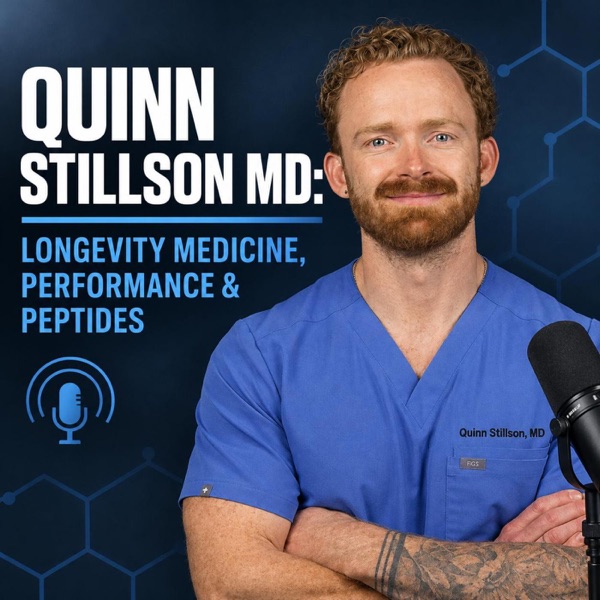
Quinn Stillson MD: Longevity Medicine, Performance & Peptides
Quinn Stillson, MD, is a physician and strength coach. Each episode takes one question and works through the research: Does BPC-157 actually help injuries heal? How much muscle do GH peptides build, and do you keep it? Is retatrutide the right GLP-1 for you? Which supplements are worth taking, and which aren’t?
You’ll get the mechanisms, the human data, the risks and an honest read on how strong the evidence is, including when the answer is “we don’t know yet.”
Topics include peptides (BPC-157, TB-500, GHK-Cu, MOTS-c, Semax and more), GLP-1s like semaglutide, tirzepatide and retatrutide, testosterone, supplements, longevity testing and training for healthspan.
Episodes are the audio versions of videos from the Quinn Stillson MD YouTube channel. When an episode refers to charts or study graphics, you’ll find them in the video.
Free peptide guide and newsletter: quinnstillsonmd.com
This podcast is for educational purposes only and is not medical advice. Talk with your physician before starting, stopping or changing any medication, peptide or supplement. Some compounds discussed are not FDA-approved.
- On air since
- 2025
- Episodes
- 13
- Releases · typical length
- Monthly · 46 min
- Latest episode
- 1 month ago
Episodes
13 episodes, newest first
-
46 min
Full Body MRI: Who Should (& Should Not) Get One
Show notes
Should you get a full body MRI? Most people decide based on cost. That's the wrong question. Even with unlimited money, for the average person the scan sends roughly 10 people down a path of potential harm for every 1 it potentially helps. But there is a specific group of people where it's worth it, and this video shows you how to find out if you're one of them.
In this video, Dr. Quinn Stillson (MD, A4M board-certified in longevity medicine) walks through the actual evidence on whole body MRI screening, the kind sold direct-to-consumer by Prenuvo, Ezra (now Function Health) and others: what a standard scan can and can't see, how likely it is to find something that matters for YOU, the real numbers on incidental findings, biopsies and overdiagnosis, and a step-by-step framework for deciding. No sales pitch, no "it's a scam." Just the data, finding by finding.
The result: a three-tier system for who should get one, who shouldn't, and how to do it right if you do.
In this video, you'll learn:
Why a full body MRI is NOT the same as an MRI of every body part (and what that costs you in detail)
The cancers it actually sees well vs. the ones it's nearly blind to (colon, breast, lung, prostate)
Which sequences a scan needs (T1, T2, STIR, DWI, Dixon) and the tell for a scan that's skipping them
The add-ons: brain MRA, FLAIR, volumetrics, cardiac strain, body composition. Which are worth it
The real cancer detection rate (1.57%) and how your genes, family history and medical history change it
The non-cancer findings that can change what you do: fatty liver, AAA, spine fractures, pancreatic cysts, brain aneurysms, meningiomas
Tracking data (brain volume, muscle quality, organ volumes): what the scan adds over DEXA and bloodwork
Why ~30% of people get an indeterminate finding and only 2-4% have something serious
The hidden costs: anxiety, extra imaging, radiation, biopsies, surgery for benign findings
Overdiagnosis: why 42-58% of screen-detected kidney cancers were never going to hurt anyone
The decision framework: elevated AND spread-out risk, the tracking gate, age, and anxiety
The three tiers (and the "do not get one" list)
How to do it right: the 3 questions to ask the provider, ONCO-RADS, and planning repeat scansBest for:
– Anyone considering a Prenuvo, Ezra or other direct-to-consumer full body MRI
– People with a family history or genetic risk trying to figure out if the scan actually helps them
– Longevity enthusiasts who want the tracking data and need to know if it's worth it
– Anyone who already got one and is staring at an "indeterminate finding"
– Clinicians who want the numbers, not the marketingTimestamps
00:00 Should You Get a Full Body MRI? Why This Is Not a Cost Question
01:51 Full Body vs Dedicated MRI - Why It Sees Less
03:54 Cancers It Detects & Misses
05:38 Other Findings It Detects & Misses (Aneurysms, Cysts, Fractures, Etc)
07:10 Not All Scans Are Equal: Sequences & Skimping
09:11 Add-Ons - Body Comp, Brain MRA & Volumetrics, Heart Strain, Organ Aging
11:12 Cancer Detection Rate in YOU & Why It's Individualized
12:50 Genes, Family History, & Medical History: What Raises YOUR Odds
15:42 Fatty Liver, AAA & Spine Fractures
18:19 Pancreatic Cysts, Heart Strain & Brain Aneurysms
21:30 Tracking: Muscle Quality, Brain Volume, & Organ Aging
23:28 Risk #1 - The 30% Problem (Indeterminate Findings)
24:54 Anxiety, Extra Imaging, Biopsies & Surgery
28:31 Overdiagnosis - Was the Cancer ACTUALLY Going to Hurt You?
31:26 Should YOU Get One? The 2 Conditions (Elevated AND Spread Out Risks)
35:05 Tracking Data: Worth It?
36:34 Age & Anxiety: The Final 2 Decision Makers
38:02 The 3 Tiers of Use Cases (& Who Should NOT Get One)
40:30 Do It Right, Steps 1-3 - What to Ask, Which Add-Ons, & Results Plan
42:45 Do It Right, Steps 4-5 - Screenings & Repeat ScansGet the FREE Full Body MRI Decision Guide (every risk factor, every number, and the walkthrough from this video): https://www.quinnstillsonmd.com/home#mri-guide
Subscribe for weekly videos on peptides, longevity & performance!
Medical Disclaimer
This video is for educational purposes only and does not constitute medical advice. Imaging and screening decisions should be made with a qualified healthcare provider who knows your personal and family history. Nothing here is a recommendation for or against any specific scan, provider, or treatment.#FullBodyMRI #WholeBodyMRI #MRIScreening #Longevity #CancerScreening #PreventiveMedicine #Biohacking
-
1 hr 18 min
I Ranked Every Way to Build Muscle & Lose Fat - Most Aren't Worth It.
Show notes
Most people building muscle and losing fat are optimizing the wrong variable. The single fastest studied way to gain muscle adds 13 lbs of lean mass in 10 weeks — but effectiveness alone tells you nothing about whether something is worth doing. The interventions with the biggest body composition effects are very often the worst things you can do for your long-term health.
In this video, Dr. Quinn Stillson (MD + strength coach) ranks EVERY body recomposition intervention on three axes: how much muscle and fat it actually moves in kilograms, what it costs you on the longevity axis, and how much human evidence actually exists. Everything gets plotted on one graph — from creatine to trenbolone — so you can see the trade-off for yourself instead of being told what to think.
The result: five free, unglamorous interventions get you 80–90% of the best body composition you can reach without paying for it somewhere else. Everything else is competing for what's left.
In this video, you'll learn:
Why testosterone is the perfect case study for how dose and duration drive BOTH efficacy and longevity harm
Tier 1: the exact resistance training volume, cardio prescription, step count, deficit size, protein target, and sleep parameters — with the kg effect size for each
How much muscle and fat you can actually gain and lose naturally (the FFMI ceiling)
Why GLP-1s are Tier 1b and not Tier 1 — and what most people get wrong about muscle loss on them
Comprehensive lab optimization: the full panel and what fixing your deficiencies is actually worth
Creatine's real effect size — and why it nearly matches TRT at 1% of the cost
GH peptides: the honest efficacy number, who's a candidate, and why the gains are rented, not owned
Myostatin/activin inhibitors (bimagrumab) — the best recomp data in existence, and why you can't get it
MOTS-c, 5-Amino-1MQ, SLU-PP-332 — what the animal data shows and why it likely won't transfer
Anabolic steroids: what they actually give you, what the cardiovascular data really says, and how much you keep after stopping
Supraphysiologic GH: 27 RCTs, increased lean mass, zero strength improvement
SARMs, insulin, clenbuterol, and DNP — ranked honestly, not dismissed
Why HMB, collagen, omega-3, citrulline, and EAAs didn't make any tierBest for:
– Anyone who wants to build muscle and lose fat without trading away healthspan
– People currently using or considering peptides, TRT, or anabolic steroids
– Lifters who've plateaued and are deciding what to add next
– Clinicians and biohackers who want effect sizes and evidence grades, not opinions
– Anyone tired of being sold supplements that do nothingTimestamps
00:00 Efficacy, Longevity, & Strength of Evidence - The Ranking Axes
01:59 Testosterone (Men & Women) - Doses for Efficacy + Longevity
07:41 Importance of Tier 1 & How We’re Ranking the Interventions
09:18 Optimizing Resistance Training for Muscle Growth
12:24 Optimizing Aerobic Training for Body Recomp
16:41 Tracking NEAT (Non-Exercise Activity Thermogenesis)
18:22 Calorie Deficit - How Large Should Your Deficit Be?
20:09 Protein - Daily Amount & Timing
22:45 Sleep Optimization for Body Recomp - Duration, Timing, Alcohol
26:14 How Much Muscle Can You Actually Gain Naturally with Tier 1?
28:29 How to Track Body Composition at Home
30:16 GLP-1s - Why They’re NOT Tier 1
35:00 Cagrilintide & Amylin Agonists - Add-Ons to GLP-1s?
36:24 Myostatin/Activin Inhibitors (Bimagrumab) - The Future of Body Recomp?
38:12 Tier 2 - Lab Optimization (+ Starting Lab Panel for Body Recomp)
42:56 Creatine - Why It’s Still UNDERrated
45:27 Tier 3 - GH Peptides - ACTUAL Effect Size (Overrated?)
51:33 Tier 4 - MOTS-c - Do You Need it to Optimize GLP-1 Use?
54:24 5-Amino-1MQ & SLU-PP-332 - Worth The Cost?
56:59 Tier 5 - Anabolic-Androgenic Steroid Use (Long-Term)
01:01:21 Short-Term Anabolic Use - Lower Risk?
01:05:08 Efficacy of Short-Term Anabolic Use - Do Gains Last After Stopping?
01:09:34 Growth Hormone (Supraphysiologic) & GH vs GH Peptides
01:13:17 SARMs, Insulin, Clenbuterol, & DNP
01:15:40 Why Most Interventions Aren’t Worth ItGet the free peptide guide at my website: quinnstillsonmd.com
Purchase the Hume Body Pod below (FSA/HSA eligible) — up to 50% off!
Code: QUINN
https://humehealth.com//discount/QUINN?redirect=/pages/hume-body-pod&utm_source=youtube&utm_medium=influencer&utm_campaign=QUINNSubscribe for weekly videos on peptides, longevity & performance!
Medical Disclaimer
This video is for educational purposes only and does not constitute medical advice. Several compounds discussed are not FDA-approved and are available for research purposes only. Long-term safety and efficacy in humans have not been established for many of the interventions covered. Always consult a qualified healthcare provider before starting any medication, peptide, or supplement.#BodyRecomposition #BuildMuscle #FatLoss #Longevity #Peptides #TRT #Creatine #GLP1
-
1 hr 15 min
Do Peptides Cause Cancer? BPC-157, TB-500, CJC-1295 & More
Show notes
"Do peptides cause cancer?" is one of the most common questions about BPC-157, TB-500, and the GH peptides—and it's also the most misunderstood. You're normally given one of two answers: yes, be terrified, or no, don't worry about it. Neither is right, because this was never a yes-or-no question. Cancer doesn't work that way—and once you understand how it actually does work, the question reshapes into something far more useful for deciding how to use these compounds.
In this video, Dr. Quinn Stillson (MD + strength coach) breaks down the complete framework: the three stages of cancer development, exactly which peptides act at each stage and how, actual estimated risk numbers for every peptide on the list, and what you should do differently because of it. Every peptide is placed against real-world comparators—obesity, alcohol, sedentary time, acromegaly, EPO, and organ transplant immunosuppression—so you know what "increased cancer risk" actually means in practice.
In this video, you'll learn:
What it actually means for something to "cause" cancer—initiation, promotion, and progression
Why ~60% of men over 79 already have prostate cancer—and why that isn't as scary as it sounds
Why no peptide can INITIATE cancer (and the one contaminant that can)
Which peptides may actually LOWER your cancer risk (GLP-1s, Thymosin Alpha-1, MOTS-c, Epitalon, GHK-Cu)
Melanotan I vs II: the human data, the case reports, and the UV confounder nobody mentions
GH peptides: why the feedback system matters, and why IGF-1 LR3 and PEG-MGF are different
Follistatin's two-faced relationship with cancer—promoter or suppressor?
BPC-157: does it promote angiogenesis or just modulate it? Evaluating the anti-tumor claim
TB-4/TB-500: the most concerning peptide on the list, and exactly why
Arsenic in research-use-only vials—the Belgian study that found 10x the injectable limit
Why "if peptides caused cancer, wouldn't we know by now?" is wrong—the Xeljanz lesson
Estimated risk ranges for EVERY peptide, compared to obesity, alcohol, and smoking
The four things that actually reduce your risk: screening, sourcing, dosing, and cyclingBest for:
– Anyone using BPC-157, TB-500, CJC-1295, Ipamorelin, IGF-1 LR3, or Melanotan
– People who've heard peptides cause cancer and want the actual evidence
– Anyone with a personal or family history of cancer considering peptides
– Biohackers and clinicians who want mechanisms and numbers, not fear or dismissal
– Anyone deciding whether the risk-benefit of a specific peptide is worth itTimestamps
00:00 Do Peptides Cause Cancer? Why You Need a New Framework
01:40 What "Causing" Cancer ACTUALLY Means (The 3 Stages)
03:22 Stage 1 - Initiation & DNA Damage
04:48 Can Peptides Damage Your DNA and INITIATE a Cancer?
06:09 Stage 2 - Promotion (And Why You Probably Already Have Cancer Cells)
10:17 Stage 3 - Progression & The Angiogenic Switch
13:37 Can Peptides PROGRESS a Cancer?
15:18 Peptides That May LOWER Cancer Risk (GLP-1's, TA1, & More)
20:18 The Data Problem With Every Peptide (& Why They're All Different)
21:32 Melanotan I & II
28:59 GH Peptides (CJC-1295, Tesamorelin, Sermorelin, Ipamorelin)
32:39 IGF-1 LR3 & PEG-MGF
34:37 Follistatin
37:38 BPC-157
41:22 TB-4 & TB-500
46:01 Arsenic & Other Contaminants in the Vial
48:20 If Peptides Caused Cancer, Wouldn't We Know By Now?
52:11 Everyday Cancer Risks for Comparison
55:38 Estimated Risk - GH Peptides, IGF-1 LR3, & PEG-MGF
58:38 Estimated Risk - Follistatin & Melanotan I & II
01:01:14 Estimated Risk - BPC-157
01:04:53 Estimated Risk - TB-4 & TB-500
01:07:18 What To Do With This Information - Risk-Benefit Analysis
01:10:33 How To Lower Your Cancer Risk From PeptidesGet the free peptide guide at my website: quinnstillsonmd.com
Subscribe for weekly videos on peptides, longevity & performance!
Medical Disclaimer
This video is for educational purposes only and does not constitute medical advice. Most peptides discussed are not FDA-approved and are available for research purposes only. Long-term safety and cancer risk in humans have not been established—all risk estimates in this video are informed approximations based on mechanisms and comparator data, not direct human evidence. Always consult a qualified healthcare provider before starting any peptide or medical therapy.#Peptides #BPC157 #TB500 #CancerRisk #CJC1295 #Melanotan #Longevity
-
51 min
Semax: Everything You Need to Know - Benefits, Risks & Who Should Use It
Show notes
Semax is often marketed as a powerful nootropic peptide that can improve focus, memory, and cognition but the actual evidence tells a more nuanced story. While Semax has shown promising effects in specific situations, particularly during periods of cognitive stress, fatigue, and neurological recovery, there is far less evidence that healthy, well-rested individuals will experience the same benefits.
In this video, Dr. Quinn Stillson (MD + strength coach) breaks down the complete evidence behind Semax from its development and use as a prescription drug in Russia to its mechanisms, potential cognitive benefits, neurological applications, and possible risks. Most importantly, we walk through a risk-benefit framework to help you understand who may actually benefit from Semax and who probably shouldn't use it.
An important note up front: while Semax has more human research than many experimental peptides, much of the available clinical evidence comes from smaller Russian studies that lack the rigorous randomized, double-blind, multicenter trials typically required for drug approval in the US or EU. I'll flag these limitations throughout so you can understand exactly how strong the evidence is for each potential use case.
In this video, you'll learn:
The history of Semax and it's development and current clinical use in Russia
The level of evidence for Semax compared to the level of evidence generally required for US/EU drug approval
How Semax was created from an ACTH fragment—and why the PGP sequence matters
How Semax may influence BDNF, serotonin, dopamine signaling, and cholinergic neurons
Why its cognitive benefits may be strongest during periods of stress, fatigue, and high cognitive demand
What the human evidence actually shows for focus, attention, and memory
Why Semax has been studied for stroke recovery and neurological protection
The potential evidence for ADHD, mood, eye conditions, and neurodegenerative disease
The biggest potential risks—including anxiety, hypervigilance, seizure concerns, and unknown long-term effects
Who may have the strongest risk-benefit case for considering Semax—and who should avoid itBest for:
– Anyone researching Semax for focus, memory, or cognitive performance
– Biohackers and performance-focused individuals considering nootropic peptides
– People interested in peptides for neurological recovery and neuroprotection
– Clinicians and evidence-minded viewers who want the research behind the claims
– Anyone trying to understand whether Semax's potential benefits actually outweigh its risksTimestamps
00:00 Does Semax Actually Improve Cognition?
01:07 History of Semax Use In Russia & Its Strength of Evidence
04:09 Semax Structure, Development, & the Power of Its ACTH Origins
09:03 How Semax Works on Cognition – BDNF, Serotonin, Dopamine
13:02 Human Evidence for Cognitive Enhancement
17:09 Why Semax May Work Better Under Stress
20:40 Semax for Mood & Chronic Stress
21:35 Stroke Recovery & Neuroprotection
25:52 Preventing Cognitive Decline & Alzheimer's Dementia
28:52 Semax for Eye & Optic Nerve Conditions
30:08 Semax for ADHD & Attention Disorders
32:44 Other Potential Uses of Semax (Inflammation, Nerves, Gut)
35:26 Semax Causing Anxiety?
37:27 Risks of Increased BDNF (Seizures, Maladaptive Rewiring, & Chronic Pain)
39:43 Risks of Serotonin and Dopamine Upregulation
40:56 Other Risks of Semax (Malignancy, Drug Interactions, & More)
43:40 Who Should Avoid Semax?
45:16 Who Might Actually Benefit From Semax?
49:15 When Semax Probably Isn't Worth the RiskGet the free peptide guide at my website: quinnstillsonmd.com
Watch the Semax Series
Part 2 coming soon: administration methods, dosing, timing, frequency, and cycle length.Subscribe for weekly videos on peptides, longevity & performance!
Medical Disclaimer
This video is for educational purposes only and does not constitute medical advice. Semax is not FDA-approved in the United States, and long-term safety and efficacy have not been fully established. Always consult a qualified healthcare provider before starting any peptide, supplement, or medical therapy.#Semax #SemaxPeptide #Peptides #Nootropics #CognitiveEnhancement #BrainHealth #Neuroprotection #Longevity
-
1 hr 15 min
Retatrutide Masterclass: How To Use It Optimally (Dose, Frequency, Diet, Exercise, & Supplements)
Show notes
Retatrutide is the most powerful weight loss peptide ever studied—but the drug is only half the equation. HOW you use it determines whether you walk away lean, strong, and metabolically healthier, or whether you lose muscle, watch your skin and hair suffer, tank your energy, and STILL leave fat loss on the table. The same appetite suppression that makes Retatrutide so effective is exactly what gets people into trouble when they lose weight too fast.
In this video, Dr. Quinn Stillson (MD + strength coach) breaks down the complete practical framework for using Retatrutide optimally—the monitoring, training, diet, supplementation, and the full dosing, frequency, timing, and cycling strategy. Every recommendation is built from the clinical evidence and tied back to the single most important variable: finding YOUR optimal rate of weight loss.
This is Part 2—the "how to" guide. If you haven't decided whether Retatrutide is right for you yet, watch Part 1 first.
In this video, you'll learn:
Why your speed of weight loss is the master variable—and how it drives muscle, bone, skin, hair, and metabolic outcomes
The complete lab panel to run on Reta, how often, and how to interpret it
Vitals monitoring: resting heart rate, HRV, and blood pressure—and when they signal it's time to stop
How much lean mass loss is too much (and why "lean mass" isn't what you think)
The optimal exercise routine: resistance training specifics + fasted zone 2 cardio logic
Tier 1–3 diet framework: calorie deficit, protein targets, hydration, timing, and quality
How to avoid GI side effects (nausea, constipation, and the nausea spiral)
The top supplements on Reta—plus collagen, calcium, and EAAs
Why oral/sublingual Reta is a scam and it must be subq
The four dosing principles and your best STARTING dose for YOUR situation
Dose escalation: how and when to move up (and why the standard max dose is too high)
Should you split your dose across the week? What the data actually shows
Best time of day to inject—optimizing for tolerability over efficacy
How long to stay on, whether to cycle, weaning, and switching to other GLP-1sBest for:
– Anyone currently on or starting Retatrutide who wants to use it optimally
– People worried about losing muscle, hair, or skin quality on a GLP-1
– Lifters and athletes wanting to protect lean mass during weight loss
– Biohackers and clinicians wanting an evidence-based protocol, not a one-size-fits-all cycle
– Anyone who watched Part 1 and is ready for the practical guideTimestamps
00:00 Why Using Retatrutide Incorrectly is Ineffective and Dangerous
01:50 Optimal Rate of Weight Loss - The Dangers of Losing Weight Too Fast
06:55 Lab Monitoring - Lab Panel, Frequency, and How to Interpret
12:59 Vitals Monitoring - Heart Rate, HRV, Blood Pressure
15:32 Body Composition Monitoring - How Much Lean Mass Loss is Too Much?
23:25 Optimal Exercise Routine - Specifics for Strength Training and Cardio on Reta
28:30 Diet - Best Calorie Deficit, Amount of Protein, and Water
34:20 Diet - Protein Timing + Quality & Carbs with Reta
39:24 How to Avoid Side Effects (Nausea, Constipation, etc)
41:07 Best Supplements on Reta - Top 5 + Collagen, Calcium, EAA’s
46:12 Form of Administration - Can You Take Retatrutide Orally?
46:58 Dosing Principles - Variable Responses and Balancing Efficacy, Cost, & Side Effects
48:38 Best Starting Dose Depending on YOUR Situation
53:31 Dose Escalation - How and When to Increase Your Dose
59:38 Max Dose for Retatrutide - Why the Standard Max Dose is Too High
01:00:57 Optimal Frequency - Should You Split Up Your Reta Dose Throughout the Week?
01:05:24 Best Time of Day to Inject Reta - Optimizing for Side Effects and Efficacy
01:07:19 How Long to Stay on Reta - Should You Cycle? When to Switch to Other GLP-1s?Get the free peptide guide at my website: quinnstillsonmd.com
Purchase the Hume Body Pod below (FSA/HSA eligible) — up to 50% off!
Code: QUINN
https://humehealth.com//discount/QUINN?redirect=/pages/hume-body-pod&utm_source=youtube&utm_medium=influencer&utm_campaign=QUINNWatch Part 1 First
Is Retatrutide ACTUALLY Right for YOU? → https://youtu.be/n-XZulcXpZsSubscribe for weekly videos on peptides, longevity & performance!
Medical Disclaimer
This video is for educational purposes only and does not constitute medical advice. Retatrutide is not FDA-approved and is currently available for research purposes only. Long-term safety and efficacy in humans have not been established. Always consult a qualified healthcare provider before starting any peptide or medical therapy.#Retatrutide #GLP1 #Peptides #WeightLoss #Tirzepatide #Semaglutide #Longevity
Fitness lists
More Fitness shows picked out from the charts