Podcast
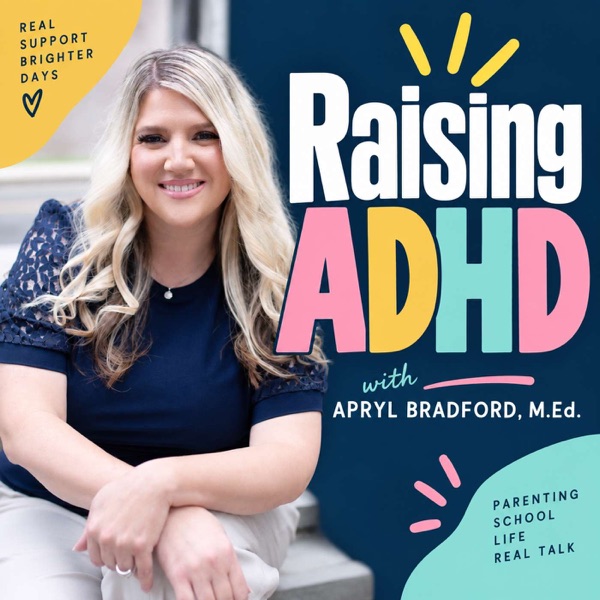
Raising ADHD: Real Talk For Parents & Educators
Raising a child with ADHD can feel overwhelming—meltdowns, school struggles, medication decisions, and the constant fear you’re doing it wrong. Raising ADHD is the podcast for parents and teachers who want clarity, strategies, and real-life support.
Hosted by Apryl Bradford, M.Ed. (former teacher and ADHD mom) and Dr. Brian Bradford, D.O. (Child & Adolescent Psychiatrist), this show cuts through the myths and misinformation about Attention-Deficit/Hyperactivity Disorder. Together, Apryl and Dr. Bradford bring both lived experience and clinical expertise to help you:
• Understand what ADHD really is (and isn’t)
• Navigate school challenges and partner with teachers
• Make sense of medication options without the jargon
• Support your child’s strengths while tackling everyday struggles
• Feel less alone and more empowered on this journey
Each week, you’ll hear practical tips, the latest insights from the field, and conversations that validate what you’re living through. Whether you’re dealing with emotional outbursts, executive function challenges, or the stigma that still surrounds ADHD, you’ll find real talk and real help here.
If you’ve ever asked yourself, “Am I doing this right?”—this podcast is your answer.
Disclaimer: This podcast is for educational and informational purposes only. It is not medical or psychiatric advice and should not replace professional consultation with a qualified healthcare provider. Always seek the advice of your physician or other licensed professional with any questions you may have regarding your child’s health or behavior.
- Parenting chart
- #147
- Episodes
- 51
- Releases
- Weekly
- Typical length
- 30 min
- On air since
- 2025
- Latest episode
- 1 day ago
Episodes
51 episodes, newest first
-
26 min
Why Reward Charts Don’t Work for ADHD Kids (and the 3 Fixes That Make Them Work)
Episode 50
Show notes
ADHD reward charts fail for three fixable reasons: the reward’s too far away, the goal’s too big, or you’re rewarding a skill you never taught. How to make charts actually work.
You made the chart. The adorable one off Etsy. Your kid picked the prize and was all in Monday and Tuesday. By Wednesday they couldn’t care less and you’re refereeing meltdowns over unearned stars. The chart ends up in the trash. Here’s the thing: reward charts really do work for ADHD kids. We’re just using them wrong.
Reward charts are one of the most proven tools in evidence-based ADHD behavior support, so if yours keeps failing, the chart isn’t the problem, the way it’s being used is. In this episode I break down the three biggest mistakes parents make with ADHD reward charts and discipline charts, and the fix for each. Mistake one, the reward is too far away for a brain wired for immediate feedback (that’s delay discounting). Mistake two, the goal is too big, so we reward “get ready for school” when that’s really a dozen executive function skills stacked together. And mistake three, the one I see constantly, we reward a behavior we never actually taught. I bring in my old classroom model, I do, we do, you do, and show how my Points to Progress method reinforces small steps instead of demanding perfection. We’re not rewarding perfection. We’re reinforcing progress.
What you’ll learn
• Why a reward chart is a tool inside a system, not a strategy that fixes behavior on its own.
• Mistake one: why Friday is forever to an ADHD brain, how delay discounting kills motivation, and why immediate points win.
• How to build in daily spend-and-save so the reward is never too far off.
• Mistake two: why “get ready for school” is a dozen skills, not one, and how shaping breaks it down.
• Why a bar set too high turns a reward chart into one more reminder of what your child can’t do.
• Mistake three: rewarding a skill you never taught, and the I do, we do, you do model that fixes it.
• The Points to Progress method: reinforcing the baby steps toward independence instead of demanding the finished behavior.
• How to write goals that hold up in a court of law, like “get dressed with one reminder,” so the rules never shift.
• Building a no-cost reward store your child actually wants, and why earned points are never taken back.
• What to do when your child doesn’t earn their points, and how to read a run of missed points as information.Timestamps
00:00 When reward charts fall apart
03:21 Mistake one: the reward is too far away
08:45 Mistake two: the goal is too big
11:24 Mistake three: rewarding a skill you never taught
17:44 Make points valuable with a reward store
20:15 What to do when points aren’t earned
22:14 Your quick-win baby-step plan
24:05 Recap: reinforce progress, not perfectionRead the full transcript
One thing to do next
Before you redesign the chart, find out which executive function skills your child is strong in and which need support, so you know what to actually reward. Take the free Executive Function Check-In at raisingadhd.org/quiz.
Coming up next week
Dr. Bradford joins me to talk about how to talk to your kids about their behavior. Hit follow so it lands the moment it drops.
Resources and related episodes
Free Executive Function Check-In quiz: raisingadhd.org/quiz
Ep35: Why Consequences Don’t Work for ADHD Kids, And What to Do Instead
Ep33: ADHD Executive Function in Real Life, Why Checklists Fail and the Scaffolding System That Actually Works
Ep22: ADHD Morning Routine Chaos, How to Find Your Battle Zone and Fix It
Find me on Instagram: @raisingadhd_orgHosts
I’m Apryl Bradford, a former classroom teacher with a master’s in education and mom raising a child with ADHD. I host the Raising ADHD podcast.
-
30 min
Why Your ADHD Child Won’t Listen: The Brain Science Nobody Explains
Episode 49
Show notes
Why won’t your ADHD child listen? It’s not defiance. The brain science behind listening, plus the hear-focus-understand-remember-do framework and how to help.
You’ve said it three times. “Go get your pajamas on.” Nothing. You say it a fourth time, louder, and now you’re the one who yelled and they’re asking why you always yell. Before you decide your child is ignoring you on purpose, let’s look at what’s actually happening in their brain.
One of the most asked questions in ADHD parenting is why won’t my child listen. In this episode I go past the usual executive function answer and into the research, two studies on how the ADHD brain processes sound and spoken instructions. You’ll learn why your child can physically hear you and still not follow through, why they can repeat an instruction back word for word and still not do it, and why they often don’t ask for help because they don’t realize they didn’t understand. Then I give you a simple framework, hear, focus, understand, remember, do, so you can find the exact spot where listening breaks down and match the support to it instead of just repeating yourself louder.
What you’ll learn
• Why “why won’t my child listen” is the wrong question, and the one to ask instead.
• What the research shows about how the ADHD brain directs attention toward important sounds, and why your voice can get lost in the noise until you yell.
• Why ADHD is less about being distracted by everything and more about difficulty locking onto the sound that matters.
• The difference between understanding the basic facts and deeper comprehension, and why “go clean your room” asks for more than your child may realize.
• Why your child often can’t recognize when they haven’t understood an instruction, so they don’t ask for clarification.
• The working memory gap: why they can repeat your instructions back perfectly and still come downstairs having done only one of the four things.
• The hear, focus, understand, remember, do framework for finding where listening actually breaks down.
• How to match the support to the breakdown: getting attention first, making instructions specific, shortening steps, or helping them start.
• The foundational four for almost any ADHD struggle: pause, get curious, support the skill, connect and repair.Timestamps
00:00 The real question behind “why won’t my kid listen”
01:00 What the research says beyond executive function
02:26 Study one: how the ADHD brain handles auditory attention
06:23 What that looks like at your kitchen counter
09:25 Study two: listening comprehension and working memory
20:20 The framework: hear, focus, understand, remember, do
25:20 Matching the support to the breakdown
28:05 The foundational four and your next stepRead the full transcript
One thing to do next
Pick the one battle you’re sick of having, mornings, homework, screens, or bedtime, and let me walk you through where your child is actually getting stuck. The ADHD Reset is a seven-day program you can do in under ten minutes a day. Get it at raisingadhd.org/reset.
Resources and related episodes
The ADHD Reset, a 7-day program for the one battle you’re sick of having: raisingadhd.org/reset
Ep27: Executive Function Skills and ADHD, Why Your Child Can’t “Just Do It”
Impulsive Behavior in ADHD, Why Your Child Has No Pause Button and How to Build One
Ep19: Stop Sitting in Mom Guilt, How to Repair With Your ADHD Child After You Lose It
Find me on Instagram: @raisingadhd_orgHosts
I’m Apryl Bradford, a former classroom teacher with a master’s in education and mom raising a child with ADHD, alongside my husband Dr. Brian Bradford, a child and adolescent psychiatrist.
-
29 min
ADHD Discipline: Stop Punishing the Same Behavior Over and Over
Episode 48
Show notes
Consequences don’t work for your ADHD child because they’re not instructions. Why bigger punishments backfire, and the hold-teach-reinforce shift that builds real skills.
___________________________________________________________________
Hit their brother, lose the iPad. Miss the homework, lose the screen. The consequence doesn’t land, so next time you make it bigger, then bigger again. If you keep escalating and keep having the same fight, the problem isn’t the size of the consequence.
Description
This is the companion to last week’s “you’ve tried everything” episode, so start there if you missed it. Today I dig into why consequences keep failing for ADHD kids. We’ve blurred consequences and punishment, and we’ve started believing that if the punishment is upsetting enough, our child will choose better next time. The trouble is a consequence can tell a child something matters, but it can’t hand them a skill they don’t have yet or can’t reach in the moment. Using a gym analogy we all recognize, I unpack why knowing what to do and doing it consistently are two different things, then give you the shift that actually works: hold the limit, teach the replacement, and reinforce the progress, not the perfection. I also walk through my five-level skills ladder, the exact approach I used to turn our morning routine around.
Inside this episode
• The difference between a consequence and a punishment, and why that distinction changes everything.
• Why escalating punishments backfire, and what a consequence actually can and cannot do.
• The gym analogy: why you hit snooze even knowing exercise is good for you, and what that reveals about your child.
• The perfection trap, and why we expect kids to go from struggling to flawless overnight.
• The three-part shift: hold the limit, teach the replacement, reinforce the progress.
• How to teach a replacement skill through calm, playful role-play before the next blowup.
• The five-level skills ladder, from “I remember for them” to true independence.
• Why the environment, not your reminders, should do more of the work as your child climbs the ladder.
• Why progress isn’t a straight line, and why a skill used Tuesday may still need reminders Wednesday.
• The bigger goal: raising capable kids who understand how their brain works, with their self-esteem intact.Timestamps
00:00 When consequences stop working
01:36 Consequences versus punishment
04:26 The gym analogy and the perfection trap
09:45 Hold the limit, teach the replacement
16:28 The five-level skills ladder
24:30 Raising capable kids with self-esteem
27:34 Pick one battle and resetRead the full transcript
One thing to do next
Pick the one battle you’re sick of having, mornings, homework, screens, bedtime, and let me walk you through it. The ADHD Reset is a seven-day program where you pick one battle, figure out where your child is actually getting stuck, and learn what to try next, in less than ten minutes a day. Get it at https://raisingadhd.org/reset.
Resources and related episodes
• The ADHD Reset, a 7-day program for the one battle you’re sick of having: https://raisingadhd.org/reset
• Last week’s episode: You’ve Tried Everything With Your ADHD Child and Nothing Works, Here’s Why
• Ep22: ADHD Morning Routine Chaos, How to Find Your Battle Zone and Fix It
• Find me on Instagram: @raisingadhd_orgHosts
I’m Apryl Bradford, a former classroom teacher with a master’s in education and mom raising a child with ADHD, alongside my husband Dr. Brian Bradford, a child and adolescent psychiatrist.
-
26 min
You've Tried Everything With Your ADHD Child and Nothing Works. Here's Why
Episode 47
Show notes
Tried every ADHD strategy and nothing seems to work? ADHD behavior problems often continue because we’re solving the wrong problem. Learn how executive function challenges can drive behavior and how to find the real breakdown underneath it instead of stacking more strategies.
_______________________________________________________________________
Checklists, reward charts, timers, visuals, consequences, laying it all out the night before. You've saved 47 Instagram posts telling you 47 different things to do, and you're still standing by the door at 7:42 asking where the shoes are. What if the problem isn't that you haven't tried enough?
If you've tried everything and nothing sticks, this episode challenges the whole approach. The issue usually isn't that you haven't tried enough strategies. It's that you tried too many, too fast, without figuring out what's actually breaking down. I break down the strategy loop that keeps parents stuck, why "can't get out the door" is an outcome and not a problem, and the difference between a child who's unwilling and a child who's struggling. Then I share the shift that changed how I handle the battles in my own house: stop being the firefighter and start being the detective. Your child's hardest moments aren't just something to make disappear. They're information. Pick one battle, watch it for a few days before you try to fix it, and let it tell you what's really going on.
Inside this episode
• Why we're drowning in ADHD strategies, and why more advice isn't the answer.
• The strategy loop: how one problem turns into 14 failed fixes.
• Why "can't get out the door" is an outcome, not a problem, and the ten different breakdowns that could be underneath it.
• Why the same checklist helps one child and does nothing for another.
• Knowing is not doing: why your child can know exactly what to do and still not do it in the moment.
• A real missing-assignment story, and how many hidden steps sit underneath "just turn in your homework."
• Why consequences are not instructions, and what a consequence actually can and cannot do.
• The one question to start asking: is my child unwilling to do this, or struggling to do it?
• How to think like a detective instead of a firefighter, and the questions that turn a battle into information.
• The one-battle experiment: pick your hardest battle zone and just watch it for a few days before fixing anything.Timestamps
00:00 When nothing works anymore
00:55 The promise of quick fixes
03:15 Getting stuck in the strategy loop
04:55 Find the breakdown underneath
08:40 Knowing is not doing
09:55 The missing assignment problem
13:40 Consequences are not instructions
16:20 Unwilling or struggling?
17:45 Think like a detective, not a firefighter
20:10 Pick one battle and watch
21:45 A look at what's coming nextRead the full transcript
One thing to do next
Pick your one battle zone this week, mornings, homework, screens, or bedtime, and just watch it for a few days before you try to fix it. Notice when it starts, what happens right before, and where your child gets stuck. That information is the whole point.
Coming up next week
If consequences worked, you wouldn't still be having the same battle. Next week we dig into why consequences keep failing for ADHD kids and what to reach for instead.
Resources and related episodes
• Free Executive Function Check-In quiz: raisingadhd.org/quiz
• Ep35: Why Consequences Don't Work for ADHD Kids, And What to Do Instead
• Ep27: Executive Function Skills and ADHD, Why Your Child Can't "Just Do It"
• Ep22: ADHD Morning Routine Chaos, How to Find Your Battle Zone and Fix It
• Find me on Instagram: @raisingadhd_orgHosts
I'm Apryl Bradford, a former classroom teacher with a master's in education and mom raising a child with ADHD, alongside my husband Dr. Brian Bradford, a child and adolescent psychiatrist.
-
32 min
ADHD and School: How to Get a 504 or IEP (Even When the School Keeps Stalling)
Episode 46
Show notes
504 vs IEP for ADHD, explained by a former teacher. What each plan is, who qualifies, how to request an evaluation in writing, and what to do when the school stalls.
____________________________________________________
A mom messaged me this week. Her medicated third grader was on the honor roll last year. This year he's dropped to a 68 in his favorite subject, coming home drained, and the school's answer to three years of asking for help is still "let's try this first." If that's you, this one's for you.
If you've ever felt confused about the difference between a 504 and an IEP, or gotten the runaround when you asked for help, this episode breaks it all down. As a former teacher and a mom, I walk through what a 504 plan actually is, what an IEP adds on top of it, and who qualifies for each, straight from federal law and the U.S. Department of Education's own guidance. I bust the two myths that trip parents up most, that a medicated child or a child with passing grades can't qualify, and I give you the exact five-step process for requesting an evaluation in writing, including what to do when the school refuses or hides behind RTI. The throughline: you can be calm and persistent at the same time, and that combination is far more powerful than anger.
Inside this episode
• What a 504 plan is: a civil rights protection that changes the environment around your child, with real ADHD accommodation examples.
• Why an ADHD diagnosis is generally presumed to substantially limit major life activities, so you don't have to prove your child is "disabled enough."
• The medication myth: why a school legally must evaluate your child as if the medication were removed.
• The grades myth: why a child earning A's can still qualify, because the standard is substantial limitation, not failure.
• What an IEP is and how it goes further: specialized instruction, related services, measurable goals, and stronger legal protections.
• Who qualifies for an IEP under the "other health impairment" category, and why the discrepancy model does not apply to ADHD.
• The clean way to tell them apart: a 504 changes the environment, an IEP changes the education itself.
• The five-step process to request an evaluation, starting with the single most important move: put it in writing.
• Why looping in the district's 504 coordinator changes the room, and how to find that person.
• What to do when the school refuses: prior written notice, procedural safeguards, and the one sentence that restarts the process.
• Why RTI cannot be used to delay or deny an evaluation, with the exact Department of Education guidance to cite.Timestamps
00:00 A mom hits the wall at school
02:08 Teachers aren't the enemy, and a quick disclaimer
03:40 504 plans explained, with ADHD examples
08:08 Eligibility myths about medication and grades
10:51 IEPs explained and what they add
13:51 Who qualifies for an IEP
16:10 How to request an evaluation
18:14 Handling a refusal with prior written notice
20:23 Why RTI can't delay an evaluation
24:18 Be calm, persistent, and prepared
27:56 The free download and final encouragementRead the full transcript
One thing to do next
Grab the free download: a list of ADHD-specific 504 accommodations plus the five questions to ask before your next 504 meeting, including the exact language to use when the school pushes back and where each one is grounded in federal law. Get it at raisingadhd.org/504.
Resources and related episodes
• Free 504 accommodations list and meeting questions: raisingadhd.org/504
• Part 3 of the back-to-school series: How to Talk to Your Child's Teacher About ADHD (Start the Year as a Team)
• Ep24: ADHD School Behavior Problems, Why Nothing's Changing and the Framework That Will
• Find me on Instagram: @raisingadhd_orgHosts
I'm Apryl Bradford, a former classroom teacher with a master's in education and mom raising a child with ADHD, alongside my husband Dr. Brian Bradford, a child and adolescent psychiatrist.
-
42 min
The ADHD Middle School Transition: How to Help Your ADHD Child Survive (and Actually Grow in) Middle School
Episode 45
Show notes
The ADHD middle school transition is a real risk point. Why symptoms spike, why medication isn't enough, and how to build the executive function bridge your child needs.
__________________________________________________________
One or two teachers becomes six or seven. One classroom becomes a locker, a schedule, and a pile of deadlines. Somewhere along the way we started calling this "be more independent," walked our kids to the edge of a cliff, and hoped they'd grow wings on the way down. Let's build the bridge instead.
Middle school is not elementary school with bigger kids. It's a major jump in executive function demands, and the research calls it a genuine risk point for kids with ADHD. In this episode I put on my former junior-high-teacher hat and walk through why symptoms can actually spike at this transition, why medication doesn't teach planner skills, and why parent involvement matters just as much now as it did in elementary school even though this is exactly when everyone tells you to back off. Then I reframe middle school as a practice window, the years before grades count, and give you a simple plan: pick one invisible skill, make it visible, practice it in a calm moment, and scaffold it for the first month. The core message: middle school success can't rest on reminders and hope. It rests on explicitly teaching the skills middle school suddenly demands.
Inside this episode
• Why the move to middle school is a research-backed risk point, and why inattention, hyperactivity, and impulsivity can bump up right at this change.
• Why medication creates access to skills but does not teach a child to use a planner, manage a binder, or track six teachers' assignments.
• What scaffolding actually looked like in elementary school, and why all of that invisible support disappears overnight.
• Why writing the assignment in the planner is only the first link in a long chain of skills, and how every link can break.
• Why parent support tends to drop right when the research says it should stay steady, and how your role shifts from supervising to skill coaching.
• The three coaching questions that build time management and planning: what do you have, when will you do it, and how long will it take.
• A simple after-school rhythm: short rest, quick planner check while the day is fresh, then decompress or start.
• How to build a color-coded organization system without buying out the Amazon school aisle.
• How to find and fix the one link in the chain that keeps breaking, from lost homework to blank planners.
• Teaching time by measuring it, breaking big projects into visible next steps, and giving your child scripts for asking for help.Timestamps
00:00 Why middle school feels like a cliff
04:25 Why this transition is a risk point for ADHD kids
08:16 What elementary scaffolding really looks like
12:07 The planner is a chain of skills, not one skill
14:43 Why parent support drops right when it shouldn't
18:54 Independence is the goal, not the starting point
22:17 A simple after-school rhythm
28:01 Build a color-coded system
31:43 Fix the one link that keeps breaking
33:47 Teach time by measuring it
35:50 Scripts for asking for help
37:51 Your one-skill experiment for this weekRead the full transcript
One thing to do next
Take the free Executive Function Check-In to see which of the eleven skills your child is strong in and which need support, so you know exactly which one to scaffold first. Get it at https://raisingadhd.org/quiz.
Resources and related episodes
• Free Executive Function Check-In quiz: https://raisingadhd.org/quiz
• Ep27: Executive Function Skills and ADHD, Why Your Child Can't "Just Do It"
• Ep33: ADHD Executive Function in Real Life, Why Checklists Fail and the Scaffolding System That Actually Works
• Ep8: How to Help Your ADHD Child Actually Get Their Homework Done Without the Nightly Battles
• Impulsive Behavior in ADHD, Why Your Child Has No Pause Button and How to Build One
• Find me on Instagram: @raisingadhd_orgHosts
I'm Apryl Bradford, a former classroom teacher with a master's in education and mom raising a child with ADHD, alongside my husband Dr. Brian Bradford, a child and adolescent psychiatrist.
-
39 min
How to Talk to Your Child's Teacher About ADHD: Start the Year as a Team, Not the Punishment Department
Episode 44
Show notes
How to talk to your child's teacher about ADHD and start the year as a team. A former teacher's plan for one clear goal, positive feedback, and no double punishment.
_________________________________________________________________
You're already bracing for it: the email, the phone call, the note in the folder. You can't sit beside your child all day, so the school tells you what went wrong and leaves you wondering what you're supposed to do with it once they walk in the door. Here's how to close that gap.
This is Part 3 of the back-to-school series, and it's the one I can speak to from both sides, as a former teacher and as a mom. Today is about the teacher relationship: how to start the year as a team instead of waiting for the first hard email, and how to do it without becoming the person expected to punish your child all over again at home. I walk through giving your child a fresh start with a new teacher, explaining ADHD simply, handing over a strength map, letting the first few weeks give you data, and building a small school-to-home plan that actually gets used. The line to hold onto: home is not the second punishment location for school behavior. The principle underneath the whole series stays the same, support what your child's brain needs and let go of what it doesn't.
Inside this episode
• Why a new teacher deserves a fresh start, and why you don't hand over last year's list of everything that went wrong.
• What ADHD support actually requires from a classroom, and what's realistic to ask of a stressed teacher.
• How to make teamwork explicit from day one, before anything has gone wrong.
• How to explain ADHD to a teacher in a few plain sentences that give behavior context without excusing it.
• How to give the teacher a strength map so they see your whole child, not just the hard parts.
• Why you let the first couple of weeks provide data instead of solving every possible problem before the first bell.
• The case against double punishing, and what to do at home instead of a second consequence.
• The simple school-to-home plan: one specific target behavior, quick tracking, a fast reward, and a short review at home.
• How to set healthy communication boundaries so the daily report doesn't become an emotional dump.
• A ready-to-use email script for open house or that first message to the teacher.Timestamps
00:00 Dreading the first message from school
02:40 A fresh start with a new teacher
06:41 What ADHD support really needs
09:35 Make teamwork explicit from day one
13:42 Explain ADHD simply and clearly
15:42 Share strengths and name skills
21:00 Let the first weeks provide data
24:26 Stop double punishing after school
27:16 Build a simple school-to-home plan
33:43 Set healthy communication boundaries
35:20 The email script and final encouragementRead the full transcript
One thing to do next
Grab the free teacher-letter prompt. Plug it into your favorite AI tool, add a few details about your child, and it writes the letter to your child's teacher for you. Get it at raisingadhd.org/letter.
Resources and related episodes
Free teacher-letter prompt: raisingadhd.org/letter
Free Executive Function Check-In quiz: raisingadhd.org/quiz
Part 1 of the series: ADHD Back-to-School Burnout, How to Take the Weight Off Before the School Year Starts
Part 2 of the series: Getting Your ADHD Child Ready for School Without Crushing Who They Are
Ep1: The Truth About ADHD, Why the Name Gets It Wrong and What You Need to Know
Ep24: ADHD School Behavior Problems, Why Nothing's Changing and the Framework That Will
Find me on Instagram: @raisingadhd_orgHosts
I'm Apryl Bradford, a former classroom teacher with a master's in education and mom raising a child with ADHD, alongside my husband Dr. Brian Bradford, a child and adolescent psychiatrist.
-
26 min
Dreading the Teacher's First Report? How to Get Your ADHD Child Ready for School
Episode 43
Show notes
Getting your ADHD child ready for school isn't about fixing their behavior. How to protect their self-esteem, set a boundary on teacher feedback, and plant one small support.
________________________________________________________________
A mom posted in an ADHD parenting group: "Anyone else so nervous for the first weeks of school? I'm not excited to hear about how challenging my kid is being." The comments blew up. If you've ever felt your stomach drop watching a teacher walk toward you with that look, this one is for you.
This is Part 2 of the back-to-school series, and it's not the "fix your kid's behavior" episode the world expects. Getting your ADHD child ready for school is really about protecting their self-esteem and protecting your relationship with them in a season when it feels like everyone is pointing out what's wrong. I share a hard, personal story about my own son's kindergarten year, then walk you through a simple four-part approach: build an identity counter-story so a behavior report never becomes your child's identity, decide ahead of time what teacher feedback is allowed to mean, teach one small skill through playful role-play, and choose a single regulation anchor for the first few weeks. We are not installing a 27-step behavior system. We're planting a couple of small supports that can grow.
Inside this episode
• The reframe for the whole season: the goal isn't perfect behavior, it's protecting your child's self-esteem, your connection, and one or two supports for school.
• How to name your child's true identity out loud so it becomes a counter-story to whatever email or report comes home.
• How to decide in advance what a teacher's feedback means, so other people's judgments don't become your child's identity at home.
• Teaching one skill with role-play, and why practicing both the wanted and unwanted behavior works.
• Choosing one regulation anchor: an after-school decompression window or a 30-second morning connection ritual.
• How to handle your own embarrassment and burnout, and how to repair with your child after you snap.
• The simple four-step plan you can start this week in two to three calm, playful minutes a day.Timestamps
00:00 The Facebook post every ADHD parent recognizes
02:30 A kindergarten story and the mom guilt that stuck
05:20 Reframing readiness beyond compliance
07:44 Build an identity counter-story
13:08 Teach one skill with role-play
18:31 Choose one regulation anchor
20:22 Handling your own embarrassment and repair
21:54 The simple four-step planRead the full transcript
https://www.buzzsprout.com/2531405/19609702-back-to-school-without-shame/transcript
One thing to do next
Take the free Executive Function Check-In to see where your child is strong and where they need support before the year starts. Get it at https://raisingadhd.org/quiz.
Coming up next week
Part 3 of the back-to-school series: preparing the teacher. How to communicate about your child's ADHD up front, so you start the year on the right foot instead of waiting for the first hard email.
Resources and related episodes
Free Executive Function Check-In quiz: https://raisingadhd.org/quiz
Part 1 of the series: ADHD Back-to-School Burnout, How to Take the Weight Off Before the School Year Starts
Impulsive Behavior in ADHD, Why Your Child Has No Pause Button and How to Build One
Ep5: After-School Meltdowns and ADHD, A 3-Step Plan Parents Can Start Tonight
Ep20: Why Your ADHD Child Thinks "I'm the Problem" and How Repair Changes Their Identity
Find me on Instagram: @raisingadhd_orgHosts
I'm Apryl Bradford, a former classroom teacher with a master's in education and mom raising a child with ADHD, alongside my husband Dr. Brian Bradford, a child and adolescent psychiatrist.
-
35 min
Beat Back-to-School Burnout: The ADHD Mom's Prep Plan for a Calmer School Year
Episode 42
Show notes
Back-to-school prep for ADHD families starts with you. Simple decisions to make now, from meals to meds to bedtime, so you start the year less loaded and more regulated.
______________________________________________
It's late July. The kids are still in swimsuits, but the back-to-school bins are already at Walmart, and the school emails are landing. You know it in your bones: if you're stressed, everyone's stressed. So before we prep the kids or the teachers, this first episode is about you.
This kicks off a three-part back-to-school series, and Part 1 is all about taking weight off your shoulders before the year starts. I walk through the two battle zones where school stress hits hardest (mornings and evenings), then give you the small, decide-it-once moves that quietly lighten the load: setting your school breakfasts and lunches on rotation, the launch pad and weekly clothes systems, outsourcing groceries and repeat purchases, handling the med check and school form now instead of on day one, and easing bedtime back in 10-minute shifts instead of one brutal Sunday night. The principle underneath all of it: support what your child's brain and your brain need, and let go of what neither one does. Pick one or two of the heaviest rocks and move them now.
Inside this episode
• The Raising ADHD™ principle for back-to-school: support what your brain and your child's brain need, and let go of the rest.
• How to find your worst battle zone, mornings or evenings, so you focus your energy in one place.
• Decide breakfast once: build a short rotation that cuts decision load and makes grocery shopping easier.
• The launch pad method and the weekly clothes organizer, plus why doing it at night beats doing it in the morning.
• How to end the daily lunch negotiation by deciding home-lunch and school-lunch days ahead of time.
• Outsourcing that protects your nervous system: grocery delivery and subscriptions for the repeat items you always run out of.
• The two ADHD-specific tasks to knock out this week: the medication check and the school medication form.
• How to reset bedtime without a fight by shifting 10 to 15 minutes a night, dimming lights, and easing screens and reading back in.
• The one rule to close: pick one or two changes that take the biggest load off you, and let the rest go.Timestamps
00:00 Late July, the in-between, and why this episode is about you
02:56 The one principle: support what the brain needs, drop the rest
05:09 Making mornings easier before school starts
14:00 Ending the daily lunch negotiation
18:39 Outsourcing groceries and repeat purchases
24:24 Med checks and school forms to handle now
26:48 Resetting bedtime without a fight
31:27 Pick one change and share itRead the full transcript
One thing to do next
Grab the free Morning Toolkit, the decide-it-once system for calmer school mornings, at raisingadhd.org/morning.
Coming up next week
Part 2 of the back-to-school series: getting your ADHD kid ready. We'll dig into the routines, regulation, and expectations that help them start the year steady, without you turning into a drill sergeant.
Resources and related episodes
Free Morning Toolkit: https://raisingadhd.org/morning
Free Executive Function Check-In quiz: https://raisingadhd.org/quiz
Ep38: ADHD Summer Survival, 5 Small Things Saving My Life Right Now
Ep34: The Best Daily Routine for a Child With ADHD (Summer Edition)
Ep9: The ADHD Bedtime Battle, Why Your Child Won't Sleep and How to Finally Fix It
Find me on Instagram: @raisingadhd_orgHosts
I'm Apryl Bradford, a former classroom teacher with a master's in education and mom raising a child with ADHD, alongside my husband Dr. Brian Bradford, a child and adolescent psychiatrist.
-
27 min
Are Weekends Making Your ADHD Child's Behavior Worse? Why Monday Mornings Are So Hard
Episode 41
Show notes
Is a packed weekend making ADHD behavior worse? Why kids start Saturday in regulation debt, and a simple weekend check-in for calmer Monday mornings.
____________________________________________
Soccer at nine, birthday party at two, block party after that. By Sunday night everyone's fried, and Monday morning feels like pushing a wet noodle out the door. You thought doing more would help. Here's the uncomfortable question I'm asking with zero judgment.
Your child doesn't start the weekend fresh. After five days of holding it together at school, they start it in regulation debt, and a calendar packed with fun can feel like more of the same. In this episode I break down why ADHD kids hit Saturday already depleted, how both over-scheduling and under-scheduling backfire depending on your child's actual recharge style, and why hyperactivity gets misread as extroversion so often. Then I walk you through a three-step framework for designing a weekend around your child's nervous system instead of everyone else's expectations, plus the Friday night check-in that takes about two minutes. The reframe: plan your weekends around the nervous system, not around fear, guilt, or what every other family is doing.
Inside this episode
• Why your child starts the weekend in regulation debt, and why after-school restraint collapse doesn't reset by Saturday morning.
• The good-intentions trap: structure, enrichment, and screen-avoidance all pushing you toward a fuller calendar.
• Why hyperactivity is a neurological symptom and not a personality type, and how that leads us to misread what our kids actually need.
• Why the bouncing-off-the-walls kid may be the one who needs low-stim time, and the quiet, spacey kid may be the true extrovert.
• Step one: observe one weekend on purpose and collect data on their recharge style, not your shoulds.
• Step two: name your child's recharge profile. Chiller or adventurer, with no moral ranking either way.
• Step three: do one thing less or one thing more. Start small instead of overhauling the calendar.
• Why your own recharge profile matters just as much, and what to do when yours and your child's don't match.
• The Raising ADHD™ Weekend Check-In you can run in two minutes on a Friday night.Timestamps
00:00 The packed weekend and the Monday morning that follows
02:03 The uncomfortable question, asked with zero judgment
02:28 What's actually happening by Friday
03:49 Restraint collapse and starting the weekend in regulation debt
05:13 The good-intentions trap
06:16 The light bulb moment that started this episode
13:16 The reframe: plan around the nervous system, not fear
13:49 The soccer guilt and the "good parent" trap
16:01 What does your brain need this weekend?
17:14 Two kids, two completely different recharge styles
17:39 Why hyperactive doesn't mean extroverted
20:23 Step one: observe one weekend on purpose
21:39 Step two: name your child's recharge profile
23:43 Step three: do one thing less or one thing more
26:27 You are the other half of their nervous system
27:47 The Raising ADHD™ Weekend Check-In
29:08 No guilt, just curiosity and dataRead the full transcript
One thing to do next
Take the free Executive Function Check-In to see where your child is strong and where they need support. It takes about five minutes and gives you a personalized snapshot. Get it at raisingadhd.org/quiz.
Resources and related episodes
Free Executive Function Check-In quiz: https://raisingadhd.org/quiz
Ep39: ADHD Parenting Burnout, The 3 Stages, the Signs, and What Actually Helps
Ep5: After-School Meltdowns and ADHD, A 3-Step Plan Parents Can Start Tonight
Ep34: The Best Daily Routine for a Child With ADHD (Summer Edition)
Ep22: ADHD Morning Routine Chaos, How to Find Your Battle Zone and Fix It
Find me on Instagram: @raisingadhd_orgHosts
I'm Apryl Bradford, a former classroom teacher with a master's in education and mom raising a child with ADHD, alongside my husband Dr. Brian Bradford, a child and adolescent psychiatrist.
-
32 min
Impulsive Behavior in ADHD: Why Your Child Has No Pause Button and How to Build One
Episode 40
Show notes
Impulsive behavior in ADHD kids isn't defiance, it's a delayed pause button. What's happening in the brain, the three types of impulsivity, and an 8-step way to help.
____________________________________________________
Your child does something so far past logic that you're left staring at the mess asking "why would you do that?" Here's the hard truth: they don't know either. Their brain generated "go" before it could generate "stop."
I open with a powdered-sugar snowstorm in my kitchen, because impulsive behavior in ADHD kids is one of the most maddening things to parent. In this episode I break down what impulse control actually is (response inhibition), why the ADHD brain's pause button is delayed and underpowered, and the three types of impulsivity you're seeing at home and school. Then I walk you through an 8-step stop-and-think system you can teach in calm moments and prompt in hot ones, plus the environment tweaks that cut impulsive behavior fastest while the skill is still building. The reframe: a child who cannot pause cannot use the skills they already have.
Inside this episode
• What impulse control really is, and why Peg Dawson and Dr. Russell Barkley call it the foundation the other executive function skills depend on.
• What's happening in the ADHD brain: the weaker, later stop signal and the role dopamine plays.
• The three types of impulsivity: verbal, motor/behavioral, and emotional, and how they show up at different times of day.
• The core reframe: your child isn't the kid who never thinks, they're the kid whose brain needs help building a pause.
• Why you teach the pause in calm moments and prompt it in hot ones, never mid-meltdown.
• The 8-step stop-and-think system, from picking one behavior to praising the pause instead of perfection.
• Why pairing the pause with a physical body cue helps the brain insert the delay.
• The environment changes that reduce impulsive behavior fastest while the skill develops.
• Your one-week plan: one behavior, one pause script, three calm practice reps.Timestamps
00:00 Why impulse control feels impossible
02:07 The powdered sugar morning story
03:55 What impulse control really means
08:10 The ADHD brain and the weak stop signal
12:21 The three types of impulsivity
14:55 The reframe: skills need a pause
16:29 Teach a pause script in calm moments
19:50 The 8-step stop-and-think system
27:33 Reduce risk by changing the environment
29:01 Your weekly plan and closing encouragementRead the full transcript
Resources mentioned
Free Executive Function Check-In quiz, to see where your child is strong and weak: http://raisingadhd.org/quiz
One thing to do next
Take the free Executive Function Check-In to find out whether impulse control is one of your child's weaker skills, and see how your profile compares to theirs. Get it at raisingadhd.org/quiz.
Resources and related episodes
Ep27: Executive Function Skills and ADHD, Why Your Child Can't "Just Do It"
Ep31: ADHD Meltdowns vs Tantrums
Ep36: Your ADHD Child Isn't Trying to Drive You Crazy
Find me on Instagram: @raisingadhd_orgHosts
I'm Apryl Bradford, a former classroom teacher with a master's in education and mom raising a child with ADHD, alongside my husband Dr. Brian Bradford, a child and adolescent psychiatrist.
-
43 min
ADHD Parenting Burnout: The 3 Stages, the Signs, and What Actually Helps
Episode 39
Show notes
ADHD parenting burnout is real, and it's not the same as being tired. The three stages, why parents of ADHD kids burn out faster, and five research-backed ways to recover.
__________________________________________________
You keep saying you're just tired. A good night's sleep should fix it, but it doesn't, and the moment your kid walks in the door your tank hits empty. That's not tired. That might be burnout, and there's a real difference.
If you've felt stressed, checked out, or burned out from parenting, this one's for you. I break down what ADHD parenting burnout actually is (and what it isn't), the three research-backed stages, and why parents of kids with ADHD are over four times more likely to experience it. Then I walk through the emotional, physical, and behavioral warning signs, and five research-backed ways to start recovering in the life you actually have. The big reframe: your well-being isn't separate from your child's outcomes. It's part of the treatment plan.
Inside this episode
• The real difference between stress and burnout, and the simple test that tells them apart.
• The three stages of parental burnout: physical and emotional exhaustion, emotional distancing, and loss of fulfillment.
• Why burnout is distinct from depression, and why that distinction changes what helps.
• Why ADHD families burn out faster: the hidden regulation load, the invisible mental load, social isolation, and the disproportionate weight mothers carry.
• What burnout looks like emotionally, physically, and behaviorally, including the snap-and-guilt loop.
• Five research-backed ways to recover: behavioral strategies, self-compassion, the right community, nervous system regulation, and micro recovery over macro recovery.
• Dr. Kristin Neff's three-line self-compassion practice you can do in the moment.
• The sticky-note brain dump that clears mental load when everything feels urgent.
• Why naming burnout is itself the first action step that lowers stress for your whole family.Timestamps
00:00 What you'll gain from this episode
01:45 Stress vs burnout, and why they're not the same
04:04 The three stages of parental burnout
08:47 Why ADHD families are uniquely vulnerable
17:52 The emotional, physical, and behavioral warning signs
20:44 Five research-backed ways to recover
34:05 Reducing your load with tools and respite
36:34 The reframe, a listener shout-out, and next stepsRead the full transcript
Resources mentioned
ARCH National Respite Network, to find and fund temporary relief care by state: archrespite.org
One thing to do next
Get short, practical Raising ADHD™ reframes in your inbox each week, the kind you can read in under five minutes and use the same day. Join my email list at raisingadhd.org.
Resources and related episodes
Ep19: Stop Sitting in Mom Guilt, How to Repair With Your ADHD Child After You Lose It
Ep23: ADHD Without Medication, What Actually Works
Ep28: How to Discipline Kids With ADHD, What the Research Says Actually Works
Find me on Instagram: @raisingadhd_orgHosts
I'm Apryl Bradford, a former classroom teacher with a master's in education and mom raising a child with ADHD, alongside my husband Dr. Brian Bradford, a child and adolescent psychiatrist.
-
20 min
ADHD Summer Survival: 5 Things Saving My Life Right Now
Episode 38
Show notes
Surviving summer with an ADHD kid? Here are five small, real-life things saving my sanity right now, plus a pep talk for when nothing feels like it's helping.
________________________________________________________________
It's week five of summer and you're holding on for dear life. Same. Here are the small, ordinary things keeping me afloat this ADHD summer, and why noticing what's working can shift a hard season.
This one's a little different. Instead of a behavior or a strategy, I'm sharing the five things quietly saving my life this summer: independent outdoor play, my beloved air fryer, a hands-on project that gets me out of the house, nighttime reading, and a grab-and-go protein breakfast. Some are big, some are tiny, all of them are real. Underneath the list is a practice I want you to steal for any hard season with an ADHD kid: pausing long enough to notice what's actually holding you up, not just what's going wrong. I close with a pep talk for the parent who feels like nothing is saving their life right now.
Inside this episode
• The practice of asking "what's saving my life right now," and why we rarely stop to notice what's working.
• Why independent outdoor play is a win for your kid's confidence and your own mental break.
• The air fryer (and paper plates) that make fast, low-cleanup summer meals possible when you work from home.
• Why a hands-on project of my own in a different space gives me a reset without needing a full day off.
• Reading at night as a no-guilt escape, no deep literary credit required.
• The grab-and-go high-protein breakfast that takes the morning off my plate.
• A mini pep talk and the one-small-thing practice for when it feels like nothing is helping.Timestamps
00:00 Week five of summer and holding on for dear life
01:02 Why noticing what works matters, and the practice behind this episode
02:51 Independent outdoor play
07:10 Fast, low-cleanup meals with the air fryer
09:59 A hands-on project of your own for a reset
12:20 Reading as a nightly escape
13:59 A high-protein breakfast shortcut
15:59 A pep talk for when nothing feels like it's saving your life
18:26 The one small thing to notice todayRead the full transcript
Mentioned in this episode
The Lazy Genius Podcast with Kendra Adachi, the inspiration for this format
One thing to do next
Get short, practical Raising ADHD™ reframes in your inbox each week, the kind you can read in under five minutes and use the same day. Join my email list at raisingadhd.org.
Resources and related episodes
Ep10: ADHD and Friendships, Why Your Child Struggles to Fit In
Ep34: The Best Daily Routine for a Child With ADHD (Summer Edition)
Ep9: The ADHD Bedtime Battle
Find me on Instagram: @raisingadhd_orgHosts
I'm Apryl Bradford, a former classroom teacher with a master's in education and mom raising a child with ADHD, alongside my husband Dr. Brian Bradford, a child and adolescent psychiatrist.
-
49 min
Traveling With ADHD Kids: How to Plan a Vacation That Doesn't End in Meltdowns with Mary Katherine Brooks
Episode 37
Show notes
Traveling with an ADHD child without the meltdowns is possible. A travel expert shares how to plan Disney, cruises, and trips that actually feel like a vacation.
______________________________________________________________
The thought of planning a vacation with your ADHD kid makes your stomach clench, so you either skip it or push through and come home needing a vacation from your vacation. There's a third option.
In today's episode, I'm sitting down with travel expert Mary Katherine Brooks (MK) of MK's Magical Adventures, who designs vacations for families with ADHD, autism, and other complex needs. We cover why the "one perfect trip" pressure backfires, how to build margin into a Disney day so nobody melts down, why cruises and all-inclusives fit neurodivergent families so well, the truth about Disney's DAS pass, and a simple reset for when a day goes sideways. If you've looked at the logistics of traveling with an ADHD child and decided it wasn't worth it, this conversation is the reframe that makes vacation feel possible again.
What you'll learn
• Why planning a trip with an ADHD child feels paralyzing, and the mindset shift that makes it doable.
• Why a rough trip is a data point for next time, not a reason to give up on travel for good.
• How to build margin into every day, and a full margin day into the week, so the trip actually feels restful.
• Why Disney deluxe resorts double as a safety feature for kids who bolt, plus how early entry and extended evening hours help ADHD families.
• Why cruises and all-inclusives work so well for neurodivergent kids: built-in structure paired with real voice and choice.
• The reality of Disney's DAS pass (Disability Access Service) and why you can't build a whole trip around it.
• A simple in-the-moment reset plan for when a vacation day starts going off the rails.
• Why a human travel advisor beats AI for planning, since AI is often years behind in the travel space.Timestamps
00:00 The vacation that leaves you needing a vacation from your vacation
02:27 Apryl's travel story: 40 states, a Greece flight, and the summer trip that never happened
04:16 Meet MK and the families she designs trips for
06:30 For the parent who's already given up on travel
06:43 The Christmas analogy: a bad trip is a data point, not a verdict
10:09 MK's planning process, from first call to hour-by-hour itinerary
13:21 Why "hit the ground running to get your money's worth" backfires
18:03 What your kid actually remembers, and it isn't the rides you skipped
20:49 What a well-paced ADHD-friendly week looks like, and why margin matters
26:09 Why cruises and all-inclusives fit neurodivergent families
28:08 The best destinations and trip formats, and why they work
29:30 A real ADHD itinerary: early entry, deluxe resorts, and VIP tours
35:17 Accommodations to ask for, and the truth about the DAS pass
40:00 A simple reset when a vacation day goes off the rails
44:13 MK's one big takeaway for tired parents
45:54 How to connect with MK
One thing to do next
Grab MK's best travel tips in one free, easy download so you don't have to hold it all in your head. Get it at raisingadhd.org/37.
Read the full transcript
About our guest
Mary Catherine Brooks (MK) owns MK's Magical Adventures, a travel agency she founded in 2022 that plans vacations for families with ADHD, autism, food allergies, and other complex needs. She grew up with ADHD herself and builds trips around how your family's brains and bodies actually work.
Instagram: @mks_magical_adventures
Website: mksmagicaladventures.com (book a consultation call directly from the site)
Coming up next week
What's saving my life right now. An honest roundup of the tools, tricks, and small finds making life with an ADHD kiddo easier this season. Hit follow so it lands the moment it drops.
Resources and related episodes
Free travel tips download: raisingadhd.org/37
Last week's episode on dopamine-seeking and sensory-seeking behavior
Ep34: The Best Daily Routine for a Child With ADHD (Summer Edition)
Find Apryl on Instagram: @raisingadhd_org
Hosts
Apryl Bradford, former classroom teacher with a master's in education and mom raising a child with ADHD, alongside Dr. Brian Bradford, child and adolescent psychiatrist.
-
31 min
Your ADHD Child Isn't Trying to Drive You Crazy: Here's What's Really Going On
Episode 36
Show notes
Why your ADHD child kicks, hums, and can't sit still, and what to do instead of yelling. A simple reframe for sensory and dopamine-seeking behavior.
_________________________________________________________
You're three minutes into the drive home, and your kiddo is already kicking the back of your seat, humming the same three notes on a loop, and poking their sibling until everyone's yelling. You're white-knuckling the wheel, wondering if they're doing it on purpose. They're not.
In this episode, we're breaking down the ADHD behaviors that drive parents up the wall: kicking the car seat, rocking in the chair, fidgeting, tapping, stimming, and playing the same song on repeat. She explains why a child with ADHD often can't sit still, what the dopamine reward system and the sensory system are actually chasing in those moments, and why "just stop it" rarely works. You'll learn the difference between dopamine-seeking and sensory-seeking behavior, three quick questions to tell them apart, and a simple weekly experiment that channels the need instead of fighting it. Same kid, same energy, a lot less yelling.
What you'll learn
• Why kicking, rocking, humming, and poking are usually a regulation attempt, not defiance or misbehavior.
• How the ADHD brain's understimulation drives both dopamine-seeking (chasing interest) and sensory-seeking (chasing movement, pressure, and sound), and why the two usually show up together.
• Three quick questions to tell whether a behavior is dopamine-driven, sensory-driven, or both.
• Why the goal is never zero movement, and how to protect people and property while giving the need a better job to do.
• Real swaps that work: a resistance band on the car seat, a wobble cushion, a car stimulation kit, and "yes here, no there" boundaries.
• Three decisions you make once and reuse forever: your non-negotiables, your family's okay stims, and a go-to script for high-stress moments.
• The one-week experiment: one situation, one behavior, one outlet, one sentence.Timestamps
00:00 The after-school car ride every ADHD parent knows
02:55 The anchor reframe: regulation attempt, not moral failure
04:42 A no-degree-required look at the two systems driving the behavior
07:54 Three behaviors we're putting under the lens
10:04 Behavior 1: kicking the car seat
15:28 Behavior 2: rocking and kicking at the table
18:21 Behavior 3: the song on repeat and the sibling poking
21:06 Three quick questions to tell dopamine from sensory
22:24 Three decisions you make once and reuse forever
26:30 Your one-week experiment: one situation, one behavior, one outlet, one sentence
29:10 The reframe to carry into your week
Read the full transcript
https://www.buzzsprout.com/2531405/19316217-adhd-regulation-in-the-real-world/transcript
One thing to do next
Get a short Raising ADHD™ reframe in your inbox each week, one you can read in under two minutes and use the same day. Join the email list at raisingadhd.org.
Coming up next week
Mary Katherine from MK's Magical Adventures is joining me to tackle traveling with ADHD kiddos: how to survive flights, road trips, and routine-wrecking vacations without the meltdowns. Hit follow so it lands the moment it drops.
Resources and related episodes
Free Executive Function Check-In quiz: raisingadhd.org/quiz
Ep29: How to Manage ADHD Hyperactivity Without Fighting It
Ep31: ADHD Meltdowns vs Tantrums
Find Apryl on Instagram: @raisingadhd_org
Hosts
Apryl Bradford, former classroom teacher with a master's in education and mom to a child with ADHD, alongside Dr. Brian Bradford, child and adolescent psychiatrist.
-
45 min
Why Consequences Don't Work for ADHD Kids (And What to Do Instead)
Episode 35
Show notes
Traditional discipline doesn't work for ADHD kids—here's the brain science why, plus 6 research-backed strategies that do.
________________________________________________________________
Raise your hand if you've ever been told, "You just need to discipline your child more."
Or maybe you've thought it yourself: Why won't they just try harder? This isn't that hard.
Here's what no one told you: traditional discipline techniques—consequences, punishments, taking things away—don't work for ADHD kids. And it's not because you're doing it wrong. It's because the ADHD brain is wired differently, and the strategies we were all taught assume a brain that doesn't exist in your child.
In this episode, Apryl breaks down the actual neuroscience (from Johns Hopkins, Harvard, NIH, and the largest ADHD treatment trial ever conducted) to show you exactly what's happening in your child's brain—and why punishment often makes ADHD symptoms worse, not better.
Then she walks you through six discipline strategies that are backed by decades of research and tested in her own ADHD home.
You'll learn:
• Why your child's prefrontal cortex is running up to 3 years behind (and what that means for expectations)
• The dopamine problem: why consequences don't "register" the same way
• Time blindness explained—and why "wait until your father gets home" was never going to work
• The 6 discipline strategies that actually work for ADHD brains
• Why the most-tested ADHD intervention has a 92% success rate (and how to use it at home)
• The one mindset shift that changes everything: from enforcer to executive function coachIf you've tried everything and nothing sticks, this episode will finally explain why—and give you a new playbook.
RESOURCES MENTIONED
• Behavior Breakthrough Week: https://raisingadhd.org/breakthrough – Kickoff June 7th
-
28 min
The Best Daily Routine for a Child with ADHD (Summer Edition)
Episode 34
Show notes
What's the best daily routine for a child with ADHD? Not a rigid schedule, but a flexible anchor system. Get the research-backed summer framework that actually works.
___________________________________________________
School ends, and within 48 hours, your ADHD kid is dysregulated, bored, melting down, and you're wondering how you'll survive until August.
Here's why: the school day has been doing invisible work for your child's brain all year. It offloads sequencing, time management, transitions, and task-switching. When summer hits, your child loses both the internal capacity AND the external support at the same time.
But the fix isn't a color-coded hourly schedule you'll abandon by day three. It's building flexible anchors your child's brain can latch onto—without making you the full-time cruise director.
In this episode, Apryl breaks down the Summer Anchor Framework and the three research-backed non-negotiables that protect your child's brain (and your sanity) all summer long.
You'll learn:
• Why ADHD symptoms spike in summer—and what the research says about preventing it
• The Summer Anchor Framework: structure without rigidity
• The 3 non-negotiables every ADHD summer routine needs (backed by Harvard research)
• How to prevent the "summer slide" that consumes your child's entire fall semester
• Practical ideas for the daily learning block that don't feel like school
• What Apryl's own summer schedule looks like (real-life, not Pinterest-perfect)If you've been dreading summer or white-knuckling your way through it, this episode gives you a framework you can actually stick with.
RESOURCES MENTIONED
• Free resource: Behavior Breakthrough Week waitlist – https://raisingadhd.org/breakthrough
• Previous episode: Managing ADHD Without Medication
• Summer Bridge Workbooks
• Read-alouds: The Lemonade War by Jacqueline Davies, Mr. Lemoncello's Library by Chris GrabensteinPractical ideas for the learning block:
• Math games
• Summer Bridge workbooks
• Reading (or captions-on movie watching)
• Sidewalk chalk math/shapes
• Read-alouds with chapter books -
23 min
ADHD Executive Function in Real Life: Why Checklists Fail and the Scaffolding System That Actually Works
Episode 33
Show notes
ADHD executive function is why your checklist isn't working. Learn how to become your child's GPS and scaffold the skills that actually get things done at home.
________________________________________________________________________
You made the checklist. You laminated it. You hung it on the fridge. Your child used it for two days. Now you're frustrated because they won't even look at it, and you're wondering if anything will ever work.
Here's the problem: the checklist was never the issue. Your child's ADHD executive function was. And nobody taught you how to scaffold a tool into a skill.
ADHD executive function is the brain's GPS. It's what gets your child from "time to get ready" to actually being ready. Your child has the car, the engine, and the ability to drive. What's missing is the navigation. And handing someone a map when their GPS is broken doesn't fix anything. It just gives them one more thing to forget.
In this episode, Apryl shows you exactly what ADHD executive function looks like in real life (including a hilarious melatonin-and-ant-trap story), walks through her actual morning routine step by step, and teaches you the scaffolding system that builds your child's internal GPS over time.
You'll learn:
• What ADHD executive function actually is and why it's the real reason things aren't getting done
• The GPS analogy: Why your child knows WHERE they want to go but can't navigate HOW
• Why checklists add one more task to a brain already struggling with working memory
• How to become your child's GPS until their ADHD executive function catches up
• A real-life ADHD morning routine from start to finish (including the 40-minute breakfast that actually helps)
• The 3 layers of scaffolding: From full support to independence
• How to scaffold a checklist IF you want to use one (so it actually works)
• Why consistency builds ADHD executive function faster than any tool
• What to do when ADHD executive function skills slip backAfter this episode, you'll stop blaming the checklist and start building the scaffolding that makes ADHD executive function actually grow.
RESOURCES MENTIONED
• Behavior Breakthrough Workshop Week – https://raisingadhd.org/breakthrough
• Blog post: How to Create a Morning Routine That Works for Your ADHD Child - https://raisingadhd.org/morning-routine
• Free ADHD Executive Function Quiz – https://raisingadhd.org/quiz -
42 min
How to Talk to Kids About Having ADHD: A Mom's Guide to Making It Normal
Episode 32
Show notes
Not sure how to talk to your child about ADHD? Get age-specific scripts, do's and don'ts, and the mom perspective on making the conversation feel natural, not heavy.
_____________________________________________________________Have you been putting off the ADHD conversation with your child? Maybe you're not sure what to say. Maybe you're afraid you'll say the wrong thing. Maybe you're worried it'll feel too heavy or make them feel like something is wrong with them.
This episode is going to take that weight off your shoulders.
Apryl shares her real-life mom perspective on how she talks to her daughter about ADHD, from tiny everyday car conversations to the bigger moments. She breaks it down by age group with actual scripts you can use, and shares the do's and don'ts that keep the conversation empowering instead of intimidating.
You'll learn:
• How to use everyday moments to talk about ADHD naturally (not as a sit-down "talk")
• The race car brain and Model T brakes analogy that kids actually understand
• Age-specific scripts for preschool/early elementary (4-8), tweens (9-12), and teens (13+)
• How to frame ADHD as different, not broken
• Why books like My Brain is a Race Car and ADHD Rapped Up are so helpful
• How to build self-advocacy so your child can communicate what they need
• The do's and don'ts of language and tone (what to say and what to never say)
• How talking openly about ADHD reduced meltdowns in Apryl's home
• Why your teen should be in the driver's seat of their own treatment planAfter this episode, you'll stop dreading the conversation and start having it. And your child will be better for it.
KEY TAKEAWAYS
The core philosophy: Be open. Make it normal. Use everyday moments. The more you talk about ADHD, the more regular it becomes. And the more your child understands their brain, the more they can advocate for themselves.
Age-by-age approach:
Ages 4-8 (Preschool/Early Elementary): Keep it simple. Use the race car brain with Model T brakes analogy. Normalize "crashes." Frame differences as just different, not bad. Introduce the idea of tools that help the brain (glasses analogy). Use books. Reassure them it's not their fault, they're not alone, and you love them no matter what.
Ages 9-12 (Tweens): Add brain science (prefrontal cortex, executive function as the air traffic control system). Talk about strengths: creativity, hyperfocus, humor, risk-taking. Introduce self-advocacy. Let them have a voice in treatment decisions. Use books like ADHD Rapped Up by Mr. G. Pull up YouTube videos of the brain. Show them successful people with ADHD.
Ages 13+ (Teens): Full transparency. Use the term "executive function skills" because it carries into adulthood. Discuss co-occurring issues (anxiety, depression). Put them in the driver's seat of their treatment plan. Co-create strategies together. Address stigma directly. Show them how successful adults manage ADHD.
Do's and Don'ts:
Do: Start early. Pick a calm moment. Keep it positive and realistic. Use their own language. Revisit often in small, casual ways.
Don't: Say "you ARE ADHD" (say "you HAVE ADHD"). Make it shameful or secret. Focus only on deficits. Use ADHD as a blanket excuse for everything. Present it as a life sentence.
Phrases to keep handy: "Your brain works differently, and different isn't bad. It just means we need different tools." / "ADHD explains why some things are hard. It doesn't define you." / "Lots of kids and adults have ADHD. You're not alone." / "Our job as your parents is to help you figure out how your brain works best."
Ready to Build a Calmer Home? Start Here:
🧩 Take the Free Executive Function Quiz — Compare your skills with your child's and find out where the gaps are
-
42 min
ADHD Meltdowns vs Tantrums: Why They Happen and a 5-Step System to Reduce Them
Episode 31
Show notes
ADHD meltdowns aren't tantrums. Learn why they happen, the ABCs of behavior tracking, and a 5-step system to reduce meltdowns by building invisible skills.
_________________________________________________________
You say "turn off the iPad" and your child loses it. Total, utter meltdown. Or you're at the store, you say no, and everything explodes. Or plans change on vacation and suddenly you're in the middle of a public scene that makes you want to disappear.
If this sounds like your life, take a deep breath. Because these meltdowns aren't random. They're not your child being spoiled. And they're not a reflection of your parenting. They're a nervous system that has hit absolute capacity. And once you understand the pattern, you can actually do something about it.
In this episode, Apryl breaks down the brain science behind ADHD meltdowns, teaches you the ABCs of behavior tracking, and gives you a 5-step system to become the detective who solves the case instead of the fireman constantly putting out fires.
You'll learn:
• The critical difference between a meltdown and a tantrum (and why it matters)
• The volcano analogy: what's really building under the surface before the eruption
• The ABCs of behavior: Antecedent, Behavior, Consequence, and how to track them
• The 4 most common meltdown triggers for ADHD kids
• Which executive function skills are behind screen time, homework, and transition meltdowns
• A 5-step detective system to identify patterns, build skills, and reduce meltdowns over time
• Why punishment stops behavior in the moment but never fixes it long term
• How to create a plan WITH your child when everyone is calmWalk away from this episode knowing that meltdowns aren't mysterious. They have patterns, triggers, and missing skills.
Ready to Build a Calmer Home? Start Here:
🧰 Grab the Free Meltdown Toolkit — This printable toolkit has everything you need to start tracking and reducing your child's meltdowns. Inside you'll get ABC behavior tracking sheets, a trigger pattern tracker (time of day, transition type, demand level, sensory environment), a meltdown-to-skill matching chart that shows you which executive function skills are behind each type of meltdown, and space to build your child's personalized plan. Grab it free at https://raisingadhd.org/meltdown
🧩 Take the Free Executive Function Quiz — Compare your skills with your child's and find out where the gaps are creating friction in your home. 👉 https://raisingadhd.org/quiz
📲 Come Say Hi on Instagram — Real talk, ADHD strategies, and the stuff nobody else is saying out loud. 💛 @raisingadhd_org
SUBSCRIBE & REVIEW If this episode helped you see your child differently, we'd love it if you'd subscribe and leave a review on Apple Podcasts. Every review helps another overwhelmed parent find the support they've been searching for. 💛
Mental Health lists
More Mental Health shows picked out from the charts












More in Mental Health
Placed highest on Apple Podcasts' Mental Health chart right now