Podcast
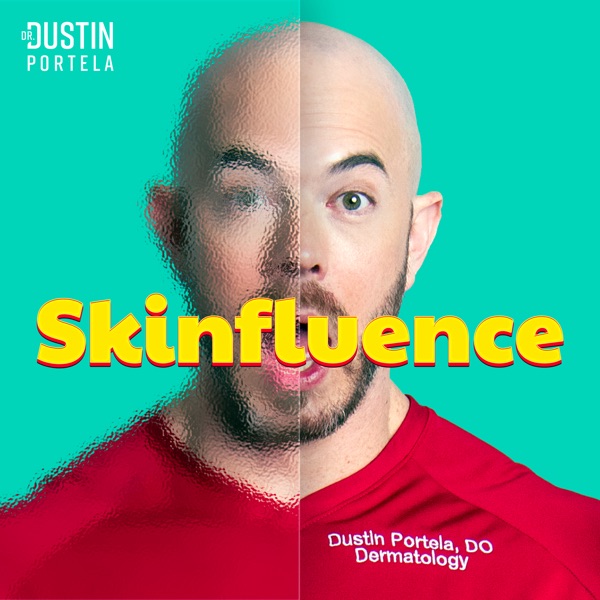
Skinfluence with Dr. Dustin Portela
Skinfluence is a podcast dedicated to helping you understand and take control of your skin health. Hosted by board-certified dermatologist Dr. Dustin Portela and Physician Assistant Austin Lee, each episode blends expert insights with practical advice to guide you through the world of skincare. From treating common concerns like acne and eczema to exploring the latest innovations in cosmetic dermatology, Skinfluence offers trustworthy information you can use—whether you're a skincare beginner or looking to take your routine to the next level. Tune in weekly for science-backed tips, patient stories, and honest conversations about what really works.
Tag: 868329
- On air since
- 2025
- Episodes
- 88
- Releases · typical length
- Weekly · 33 min
- Latest episode
- 5 days ago
Chart history since Oct 26
| Now | Chart | Peak | Since Oct 26 |
|---|---|---|---|
| Off | Medicine Last on it Nov 14 at #195 | #173 |
Episodes
88 episodes, newest first
-
33 min
EP 61: Are Peptide Injections Safe? A Dermatologist on BPC-157 and Copper Peptides
Show notes
The peptide market has a bodega problem. When a reporter walked into a New York City convenience store, bought whatever peptides were on the shelf, and sent them to a lab, most samples didn't contain the molecule advertised. Some had wildly off concentrations. One had thirteen different bacterial colonies. The people buying these products, often reconstituting them from online protocols and injecting them at home, don't know any of this.
Dr. Dustin Portela and Austin Lee spend this episode sorting through one of the most crowded and confusing corners of the wellness world. They start with the basics, what a peptide actually is, why insulin was the first and GLP-1s are the most recent proof that peptide medicine works, and what it means that Eli Lilly is trying to have retatrutide classified as a biologic drug rather than a peptide, an effort largely designed to prevent compounding pharmacies from copying it.
Then they get into the gray market, where things get harder to defend. BPC-157, the injury recovery peptide being called the Wolverine stack when combined with TB-500, has no controlled human trial data behind it. The same is true for most growth hormone secretagogues circulating online. The hosts have both seen teenagers come in having already purchased these compounds, one buying gray market Accutane to treat acne caused by peptides meant to stimulate growth hormone. The anecdotes aren't hypothetical.
The practical guidance here is worth writing down. Topical peptides, GHK-Cu copper peptides, Matrixyl, argireline, carry modest evidence and minimal risk. Injectable peptides from gray market websites labeled "for research purposes only" are another matter entirely, and the idea of injecting anything directly into a joint at home is treated, plainly, as a serious danger. If you're working with a clinic that's also selling you the peptide, that financial entanglement deserves scrutiny.
The episode closes on a point neither host seems to enjoy making: peptides are not a substitute for sleep, real food, and exercise, and the people most drawn to them are often the ones most willing to skip those steps first.
Product of the Week Aqua Drops, available at shop.drdustinportela.com. A hyaluronic acid serum with copper peptides, one of the top sellers in Dr. Portela's office and a practical starting point for anyone curious about topical peptides.
Follow Us Instagram: @skininfluencepod | @drdustinportela | @austinleepac YouTube: Skinfluence Podcast TikTok: @skinfluencepod
-
22 min
EP 60: Hot Takes: Unpopular Dermatology Opinions We Actually Stand Behind
Show notes
There's a version of medical authority that hedges everything, qualifies every claim, and refuses to commit. This isn't that episode. Dr. Dustin Portela and Austin Lee came into the studio ready to say out loud the things they've been thinking quietly, and the result is one of the more honest conversations they've had on the show.
The takes fly fast. Most skincare routines are too long and do more harm than good. The skin supplement industry is built almost entirely on lab data that has never been tested in a human body. The price difference between drugstore and luxury skincare is mostly marketing, the same psychological trick as expensive wine. Celebrity skincare lines have hit saturation and the world doesn't need any more of them. Beef tallow is, as Portela puts it, right-wing coconut oil.
Not every take lands as controversy. Both hosts agree quickly that Accutane is underused, that dermatologists have been fighting skincare misinformation on social media for years, and that sunscreen alone, started early enough, may be the only anti-aging product most people ever need. The agreement itself turns out to be its own kind of hot take in a media environment that profits from confusion.
The episode's most thought-provoking moment comes from a hot take Portela borrowed from a colleague: Medicare funds dermatology residency slots, which means taxpayer money is going toward training cosmetic procedures. Should it be? Portela's counterargument, that ceding the cosmetic space to non-physician practitioners is a worse outcome, leads somewhere interesting: cosmetic companies should fund that portion of training themselves, since they're the ones who benefit when residency graduates go into private practice buying their products.
Austin also weighs in on dermoscopy, the handheld tool he wasn't trained on and now considers essential for catching early melanomas, and there's a brief but pointed take on why pore tightening, as most products promise it, is not actually possible.
Product of the Week Two anti-aging staples from shop.drdustinportela.com: the 5X Retinol and the Rapid Reveal Exfoliation Pads. Use them on alternating nights for a simple skin-cycling routine, and pair with the Ace Hydration Cream or Triple Lipid Cream for best results.
Follow Us Instagram: @skininfluencepod | @drdustinportela | @austinleepac YouTube: Skinfluence Podcast TikTok: @skinfluencepod
-
40 min
Guest Episode: Ink and Skin — What a Dermatologist and a Tattoo Entrepreneur Want You to Know
Show notes
Zach Peterson has built a clothing brand, a gym, and an indoor golf lounge. He also happens to be heavily tattooed and deeply embedded in the tattoo industry. When Dr. Dustin Portela invited him into the studio for a conversation about tattoos from both sides of the needle, the result was something you don't often get: the perspective of someone who lives in that world sitting across from a physician who treats what happens when things go wrong.
The conversation starts where every tattoo should: before you ever book an appointment. Peterson makes the case for visiting a shop in person, watching an artist work, and understanding what you're actually signing up for in terms of time, money, and pain tolerance. His advice on communication, planning, and not getting cheap tattoos tracks almost exactly with what a dermatologist would say about not Groupon-ing your cosmetic procedures.
From there, Portela layers in the medical science most tattoo clients never hear. Why red ink carries the highest risk of allergic reactions, and why that reaction might not show up for months. How the body's macrophages respond to foreign ink from day one, what that means for how tattoos age, and why fine line work that looks stunning at first is especially vulnerable to fading. The conversation on laser tattoo removal gets surprisingly technical, covering why black ink and colored ink require completely different laser wavelengths and why that $200,000 machine decision matters for what your removal options actually are.
There's also an unexpected thread running through the episode: the lack of regulation in the tattoo industry. In Idaho, there is none. That vacuum shapes everything from how artists train to how they approach aftercare, and it's part of why the advice you get from one artist might be the opposite of what another swears by.
The episode wraps with a genuinely fascinating development neither host saw coming: athletes getting general anesthesia so three artists can work their entire back in a single session, and tattoo shops in some states now offering local anesthesia as a standard add-on. The tattoo industry and the cosmetics industry are quietly converging, and this episode is where dermatology meets that intersection.
Follow Us Instagram: @skininfluencepod | @drdustinportela | @austinleepa YouTube: Skinfluence Podcast TikTok: @skinfluencepod
Guest Zach Peterson Instagram: @ZachJPete Tattooed & Successful: @tattooedandsuccessfulco | http://tattooedandsuccessful.com/
-
34 min
Featured Episode - Halloween: Vampires, Werewolves, and the Real Skin Conditions Behind the Myths
Show notes
Every Halloween costume has an origin story. Some of the scariest ones, it turns out, came from actual patients.
This special Halloween episode of Skinfluence starts with a dermatology fact that sounds like fiction: the vampire myth may have a legitimate medical explanation. Porphyria cutanea tarda, a disorder of heme production, forces sufferers to avoid all sunlight, causes extreme blistering burns from even brief sun exposure, leads to gum recession that makes teeth appear fang-like, and in some cases produces urine so dark it resembles blood. Dr. Portela and Austin unpack how this condition, along with tuberculosis in the 19th century, may have fueled some of the most enduring horror folklore in American history, including the largely forgotten New England vampire panic of the 1800s.
From there, the episode moves through the dermatology behind Halloween's greatest hits: the genetic condition that causes terminal hair to grow across every inch of the body (the family of acrobatic performers in Mexico who were billed as werewolves was real); the filiform wart that grows finger-like projections on the face and actually turns black as it dies from treatment; tree man syndrome, in which skin cells proliferate so rapidly the hands and feet develop bark-like growths resembling Groot from Guardians of the Galaxy; cutaneous horns with a pre-cancerous base that can grow large enough to curl like a ram's; hematidrosis, the extremely rare and still poorly understood condition in which extreme stress causes blood to seep through the sweat glands; and argyria, or Papa Smurf syndrome, in which prolonged colloidal silver consumption deposits silver into the skin and turns it a striking shade of blue.
Dr. Portela and Austin also dress up for the occasion, weigh in on the great candy corn debate, and share their go-to Halloween candy picks. It is probably the only episode of this podcast where porphyria, Mercy Brown, and Butterfingers all come up in the same conversation.
Follow Us: YouTube: @DrDustinPortela Instagram: @DrDustinPortela TikTok: @DrDustinPortela
-
35 min
Holistic Dermatology: Is There a Better Way to Treat Your Skin? A Triple Board-Certified Dermatologist on Integrative Dermatology
Show notes
Most dermatology appointments follow the same script: diagnose the condition, prescribe the treatment, move on. But for a growing number of patients, that script is not enough. They want to understand why their skin keeps rebelling even when they follow the rules, and whether there is something their doctor has not thought to ask about.
Dr. Mamina Turegano has built her practice around exactly that question. A triple board-certified dermatologist in dermatology, dermatopathology, and internal medicine, she is also a graduate of the Integrative Dermatology Certificate Program and one of the most trusted voices at the intersection of conventional medicine and holistic skin health. She joins Dr. Portela to talk about what integrative dermatology actually is, why it is gaining traction, and how it is changing the way patients and physicians relate to one another.
The conversation covers a lot of ground. What supplements have enough evidence behind them to warrant recommending for psoriasis or hormonal acne? How do you evaluate an alternative therapy when double-blind trials do not exist? And why does Dr. Turegano believe that the doctor-patient relationship improves when a physician is at least willing to engage with the questions patients are actually asking?
She also shares how she went viral in 2020 with a series called "Strange Anti-Aging Tips I Learned From My Japanese Mother," which became an unlikely lens for applying scientific rigor to folk wisdom, and how that content still resonates because it speaks to something most skincare advice ignores: the idea that skin health is not isolated from everything else going on in your life, your diet, your stress history, and even your past.
Dr. Turegano also discusses the Holistic Psoriasis Management and Nutrition Guide, a book she co-authored with three other clinicians that brings together conventional treatments, Mediterranean diet guidance, supplements, and naturopathic approaches in one resource for patients who want the full picture.
For listeners who have ever felt dismissed by a provider when asking about alternatives, or who suspect there is more to their chronic skin condition than what gets addressed in a 15-minute appointment, this one is worth the time.
Follow Dr. Mamina Turegano: Instagram, TikTok, YouTube: @doctor.mamina Website: http://drmamina.com/
Follow Us: YouTube: @DrDustinPortela Instagram: @DrDustinPortela TikTok: @DrDustinPortela
Fitness lists
More Fitness shows picked out from the charts